Entry No. 25 — the Washington, D.C. file — filed under: plantation history
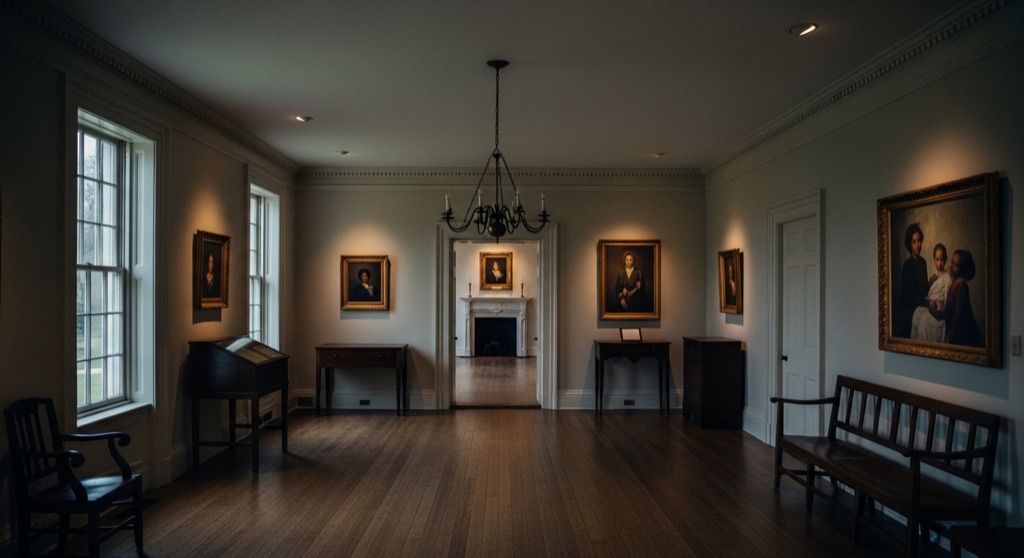
Riversdale House Museum
This Federal mansion was built 1801-1807 as a five-part ensemble for a Belgian merchant's daughter, Rosalie Stier Calvert, on a 739-acre slave plantation - land her son later carved off to found Maryland Agricultural College, now the University of Maryland.
→ Three more unusual museums & collections in Washington, D.C. — never the same twice
The story
If you've ever set foot on the sprawling campus of the University of Maryland, you're standing on what was once a 739-acre slave plantation. Between 1801 and 1807, Belgian merchant Henri Joseph Stier and his daughter Rosalie Stier Calvert erected this five-part Federal mansion to mirror European aristocratic taste. They filled the rooms with imported art while an enslaved workforce cleared the fields, managed the livestock, and kept the household running. Decades later, Rosalie’s son carved off a chunk of that very plantation ground to establish Maryland Agricultural College—the institution that became UMD.
For generations, regional historic home tours glossed over the human cost of the estate, focusing entirely on Federal architecture and Belgian silver. But the reality is that Riversdale's operational footprint extended far beyond decorative brickwork, tying directly into regional Underground Railroad networks and systemic bondage in Prince George's County.
Under modern museum leadership, including director Maya Davis, the site has shifted focus from purely showcasing gilded domesticity to actively tracing the descendants of the enslaved families who built it. You won't just see restored period furniture; you'll learn the names and documented trajectories of the people whose labor subsidized both the Calvert empire and Maryland’s flagship public university.
What it's like
Hop off the MARC train at the Riverdale Park stop and walk a few blocks into a quiet residential neighborhood where the yellow mansion suddenly dominates the streetscape. Plan your visit around the guided house tours—typically running at noon and 2:00 PM—where docents walk you through Rosalie's restored quarters while detailing both elite plantation life and the ongoing efforts to identify enslaved descendants. Afterward, take time to wander the remaining acreage outside. Before you jump on the train, make sure to confirm current operating hours online, as schedule adjustments happen.
The move: Walk the guided noon or 2pm house tour through Rosalie's restored rooms, then stroll the grounds where the plantation's enslaved workforce once lived and labored, a short walk from the Riverdale Park MARC stop.
- 📍 Riverdale Park, MD
- 💸 $$
- ⚡ Up for anything
- 🌗 Indoors
Where: 4811 Riverdale Road, Riverdale Park, MD 20737
Hours: Added 2026-07-19 — confirm current hours before you go.
⚠ Seasonal or scheduled — always check before you go.
Pair it with
- Bladensburg Peace Cross — Drive two miles south to see a surreal 40-foot concrete Latin cross towering over a busy highway traffic median.
- National Bonsai & Penjing Museum — Head under four miles down to the National Arboretum to compare 19th-century land history with miniature trees that have been cultivated since the 1600s.
- Franciscan Monastery of the Holy Land in America — Catacombs — Head three miles southwest into Brookland to swap Federal plantation history for docent-led tours of subterranean replica Roman catacombs.
More weird in Washington, D.C.
Good to know
What is the historical connection between Riversdale and the University of Maryland?
Rosalie Stier Calvert's son, Charles Benedict Calvert, carved off a portion of the family's 739-acre plantation in the 1850s to found the Maryland Agricultural College, which later evolved into UMD.
How do I get to Riversdale House Museum without a car?
The museum sits just a short walk from the Riverdale Park MARC station on the Camden Line, making it accessible directly from Washington Union Station.
When are tours offered?
Guided house tours generally run at 12:00 PM and 2:00 PM, though you should verify current seasonal schedules before heading out.
What new research is the museum doing regarding its history?
The museum actively researches the lives and genealogy of the enslaved people who lived and worked on the plantation, tracing their descendant lines and connecting the site to regional Underground Railroad history.
Plan a visit & invite your people →
Further reading: pgparks.com · Wikipedia · dcist.com · 1856project.umd.edu · Official site
last checked: 2026-07-19