Entry No. 36 — the Washington, D.C. file — filed under: outdoor
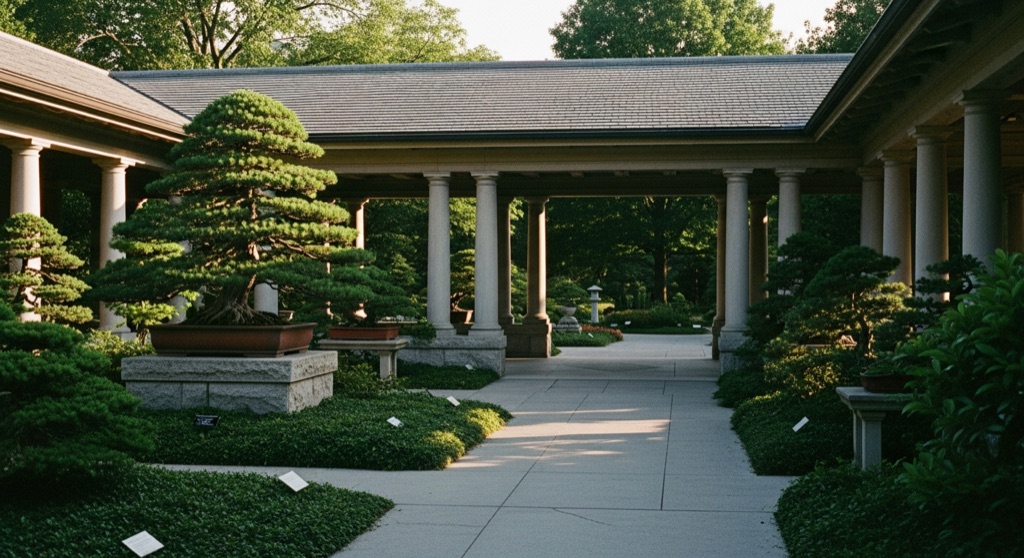
National Bonsai & Penjing Museum
One tree in the Japanese pavilion, a white pine called the Yamaki Pine, has been in continuous bonsai training since 1625 — it was standing about 1.5 miles from ground zero in Hiroshima on August 6, 1945, and its donor family (the Yamakis) didn't reveal that survival story to the U.S. National Arboretum until 2001. It shares the grounds with a Chinese penjing collection and 105 "viewing stones" kept purely for the shapes erosion carved into them.
→ Three more unusual museums & collections in Washington, D.C. — never the same twice
The story
In 1976, Japan gifted 53 bonsai trees to the United States for the Bicentennial. Tucked among them was a Japanese white pine donated by bonsai master Masaru Yamaki. What nobody in Washington realized for a quarter-century—until Yamaki's grandsons visited the arboretum in 2001—was that this tree had been in continuous potting since 1625 and was sitting roughly 1.5 miles from ground zero when the atomic bomb detonated over Hiroshima on August 6, 1945. It survived behind a thick nursery wall that shielded it from the flash and blast wave, leaving it intact while much of the city burned.
Today, the Yamaki Pine resides in the Japanese Pavilion, but the museum grounds span three open-air pavilions—Japanese, Chinese (penjing), and North American—alongside an offbeat collection of 105 "viewing stones" (suiseki and gongshi). These stones are untouched by chisels; collectors preserved them strictly for the miniature mountain ranges, waterfalls, and figures carved into the rock by wind and water erosion over centuries.
The quiet oddity of the place lies in this contrast: living trees sculpted by generations of hands over four hundred years standing next to dead stone sculpted entirely by chance, both curated with the exact same gravity.
What it's like
Located deep inside the U.S. National Arboretum off New York Avenue NE, the museum feels completely detached from the Capitol's marble routine. You wander through open-air wooden courtyards where stunted, centuries-old trees rest on dark pedestals. It is almost always uncrowded outside of peak spring blossom days, giving you room to lean close and trace the gnarled bark. Peak summer brings mid-Atlantic heat into the unconditioned courtyards, so grab water beforehand and duck into the shaded canopy of nearby Fern Valley when you need to cool down.
The move: Walk the Japanese, Chinese, and North American pavilions at your own pace, find the Yamaki Pine's placard and read its full survival story together, then carry it over to a bench in the adjoining Fern Valley for a quiet picnic.
- 📍 Northeast DC — U.S. National Arboretum
- 💸 $
- ⚡ Up for anything
- 🌗 Indoors
Where: 3501 New York Avenue NE, Washington, DC 20002
Hours: Added 2026-07-19 — confirm current hours before you go.
Pair it with
- Franciscan Monastery of the Holy Land in America — Catacombs — Pair a quiet walk among miniature ancient trees with a descent into full-scale subterranean catacomb replicas under two miles away in Brookland.
- Bladensburg Peace Cross — Drive ten minutes east down the highway corridor to contrast meticulous Japanese horticultural art with a towering 40-foot concrete memorial stranded in a traffic island.
- 600 T — Transition from daytime garden courtyards to a dark, unmarked basement cocktail den hidden on a residential corner in nearby Bloomingdale.
More weird in Washington, D.C.
Good to know
How much does it cost to visit?
Admission to both the National Bonsai & Penjing Museum and the surrounding U.S. National Arboretum grounds is completely free.
Where is the Hiroshima survivor tree located?
The Yamaki Pine is displayed in the museum's Japanese Pavilion, marked with an informational plaque recounting its history.
What are the viewing stones?
The collection features 105 natural stones (known as suiseki in Japan and gongshi in China) displayed on tailored wooden bases, kept entirely uncarved to showcase natural erosion patterns.
How do I get there and do I need to check hours?
The venue is inside the National Arboretum at 3501 New York Avenue NE; confirm operating hours before heading out as museum access can differ from general arboretum park hours.
Plan a visit & invite your people →
Further reading: Wikipedia · Official site · Reddit
last checked: 2026-07-19