Entry No. 14 — the Washington, D.C. file — filed under: Civil War
National Museum of Civil War Medicine
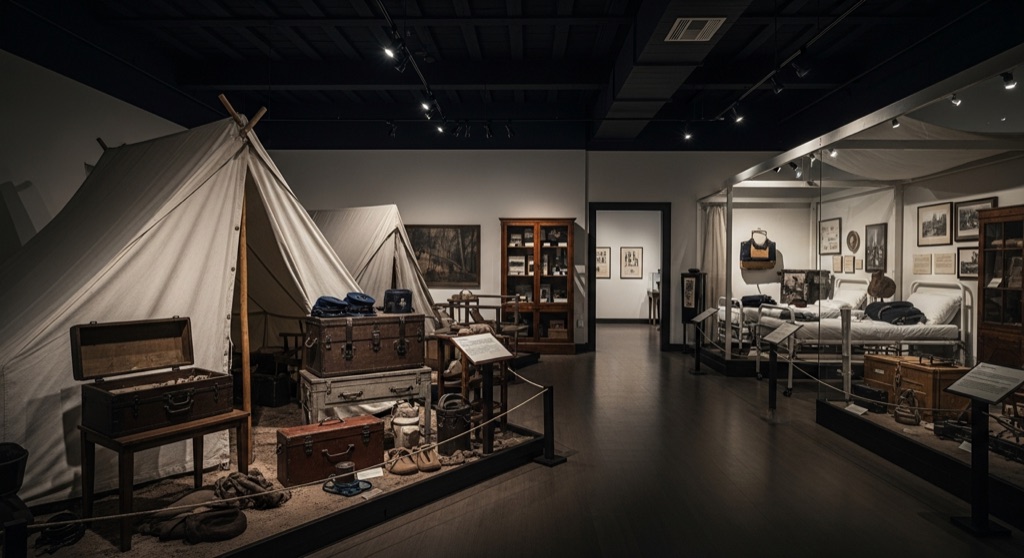
Housed in a 19th-century building that doubled as a furniture maker's shop and undertaker's parlor during the war, the museum displays the only known surviving Civil War surgeon's field tent alongside surgical kits, veterinary-medicine artifacts, and five immersive dioramas walking visitors from army camp through amputation to hospital ward.
→ Three more unusual museums & collections in Washington, D.C. — never the same twice
The story
You are standing inside a building at 48 East Patrick Street that spent the 1860s operating simultaneously as a furniture shop and an undertaker's parlor. The same craftsmen turning cabinet legs were knocking together wooden coffins for dead soldiers down the hall. Today, the space houses a collection devoted to the brutal, rapidly evolving science of keeping men alive when 19th-century lead bullets shattered bone on impact.
Forget the myth that Civil War surgeons were mindless butchers hacking off limbs without anesthesia. The collection walks you through how medical logistics were invented out of sheer necessity—establishing the foundations of the modern ambulance system, battlefield triage, and field hospitals. Among the surgical kits, bone saws, and veterinary tools used on broken army horses, you will find the museum's prize artifact: the only known surviving Civil War surgeon's field tent in existence.
What it's like
You step off the sidewalk into a sequence of five immersive dioramas designed to walk you through the precise pipeline of military casualty care: starting in camp, moving to battlefield evacuation, through the dressing station, into the field hospital, and ending in a long-term hospital ward. The vibe inside is quiet and intensely clinical. Take your time looking closely at the amputation kits—they are clean, precise, and surprisingly methodical. Double-check operating hours before you make the drive, and plan to head down to Frederick's Carroll Creek for air and lunch once you emerge.
The move: Walk the five immersion exhibits in sequence — camp, battlefield evacuation, dressing station, field hospital, hospital ward — then grab lunch along Frederick's Carroll Creek and browse the downtown antique shops before heading back.
- 📍 Frederick, MD
- 💸 $
- ⚡ Up for anything
- 🌗 Indoors
Where: 48 East Patrick Street, Frederick, MD 21701
Hours: Added 2026-07-19 — confirm current hours before you go.
Pair it with
- Ms Caitlin's School of Blacksmithing — Walk two blocks down Patrick Street after examining 19th-century surgical steel to see hot-iron forging inside a downtown storefront.
- W.F. Moran Bladesmith & Artisan Academy — Drive six miles west to Middletown to shift focus from historical scalpels to the forge where modern pattern-welded bladesmithing was revived.
- Ruins of St. John's Episcopal Church — Head west to Harpers Ferry to stand in the stone shell of a church that served as a real field hospital during the war.
More weird in Washington, D.C.

Good to know
What makes the building itself historically relevant?
During the Civil War, the Patrick Street structure functioned as both a cabinetmaking business and an undertaker's parlor, making coffins and preparing bodies directly in downtown Frederick.
What is the rarest artifact on display?
The museum holds the only known surviving Civil War surgeon's field tent, displayed alongside period surgical kits, veterinary artifacts, and medical gear.
How are the exhibits structured?
The main floor uses five sequential immersion dioramas: army camp, battlefield evacuation, dressing station, field hospital, and hospital ward.
Does this organization operate any other historic sites?
Yes, they also manage Clara Barton's Missing Soldiers Office in Washington, D.C., and the Pry House Field Hospital Museum at the Antietam battlefield.
Plan a visit & invite your people →
Further reading: Official site · Wikipedia
last checked: 2026-07-19