Entry No. 29 — the Washington, D.C. file — filed under: blacksmithing
Ms Caitlin's School of Blacksmithing
A one-woman blacksmithing school in a downtown Frederick storefront, run by a smith who is 5'5" and spent four frustrating years training under taller instructors before reverse-engineering a "biomechanical" method of moving steel with body mechanics instead of brute strength — a technique she now claims gets total beginners forging a leaf out of raw steel in a single session.
→ Three more hands-on workshops & classes in Washington, D.C. — never the same twice
The story
Traditional blacksmithing has a built-in biomechanical bias: centuries of heavy anvil work were designed around six-foot-tall men swinging heavy hammers with upper-body torque. When Caitlin Morris spent four years learning the trade from taller instructors, she realized that trying to match their brute-force swings at 5'5" wasn't just exhausting—it was bad physics. Instead of giving up, she systematically dismantled standard hammer technique and re-engineered the trade around body weight, stance, and mechanical advantage.
Operating out of a storefront at 26 West All Saints Street in downtown Frederick, her shop discards the usual iron-pumping bravado of metalworking. Morris focuses on accessible physics: using gravity and leverage so complete beginners—regardless of physical stature or strength—can shape glowing steel without tearing up their joints. By focusing on how human bodies actually move heat and metal, her single-session workshops reliably get first-timers hammering raw steel rods into finished decorative leaves and hooks.
What it's like
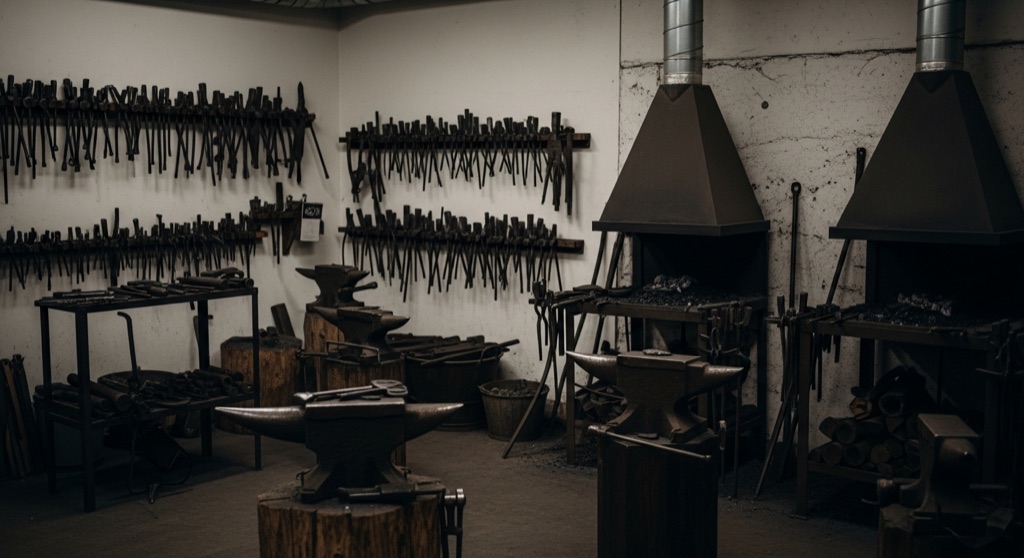
Step off the downtown Frederick sidewalk and you're met with the dull roar of a working forge, radiant ambient heat, and the clear rhythmic ping of steel hitting iron. Classes are hands-on from the moment you step up to the anvil, with Morris walking you through hammer control and posture right beside the hot coals. Leave the synthetic athletic wear at home—sparks will melt polyester onto your skin—and show up in natural cotton or denim with sturdy, closed-toe shoes.
The move: Book a beginner forging session together and take turns at the same anvil hammering a steel rod into a decorative leaf, hook, or other small piece you each get to keep.
- 📍 Downtown Frederick, MD
- 💸 $$
- ⚡ Up for anything
- 🌗 Indoors
Where: 26 West All Saints Street, Frederick, MD 21701
Hours: Added 2026-07-19 — confirm current hours before you go.
Pair it with
- National Museum of Civil War Medicine — Walk two blocks down to inspect the 19th-century surgical tools and field kits crafted in the same era traditional ironwork reached its peak.
- W.F. Moran Bladesmith & Artisan Academy — Drive six miles west to Middletown to contrast Caitlin's modern biomechanical instruction with the historic forge site where Bill Moran revived Damascus bladesmithing.
- Seneca Mill and Quarry Ruins — Head south toward Poolesville to explore the stone quarry ruins that once depended entirely on hand-forged tools and heavy iron machinery.
More weird in Washington, D.C.


Good to know
Do I need upper-body strength or previous shop experience?
No. The entire curriculum is built on body mechanics, leverage, and hammer weight rather than muscle power, specifically tailored so absolute beginners can work iron safely.
What should I wear to a forge class?
Wear natural fibers only—100% cotton jeans, a cotton shirt, and sturdy closed-toe leather boots or shoes. Synthetic materials like nylon or polyester melt near sparks.
Where in Frederick is the school located?
It's located right in Downtown Frederick at 26 West All Saints Street.
Can two people do a session together?
Yes, you can book a session as a pair and take turns working hot steel at the same anvil to forge small keepsakes like decorative leaves or utility hooks.
Plan a visit & invite your people →
Further reading: Official site · downtownfrederick.org · washingtonpost.com
last checked: 2026-07-19