Entry No. 57 — the Seattle file — filed under: roadside-oddity
Ape Cave Lava Tube
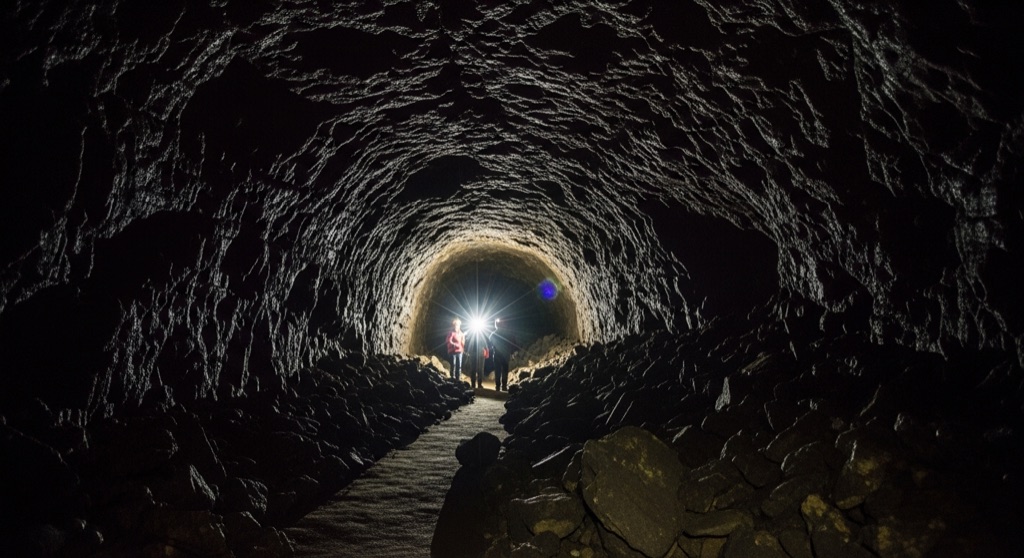
Formed about 2,000 years ago by lava streaming down Mount St. Helens, Ape Cave is the longest continuous lava tube in the continental U.S. at roughly 2.5 miles. There are no lights inside, so you descend the staircases into total darkness with your own headlamp; the easier Lower Cave is a one-hour family route, while the Upper Cave demands rock scrambles and scaling an 8-foot lava wall. It's a genuinely otherworldly, pitch-black underground walk through a volcano's plumbing.
→ Three more weird outdoor & roadside oddities in Seattle — never the same twice
The story
About 2,000 years ago, a vent on the southern flank of Mount St. Helens uncorked a stream of fluid basalt that cooled on the outside while a molten highway kept roaring beneath the crust. When the eruption drained, it left behind a hollow, 2.5-mile stone intestine—the longest continuous lava tube in the continental United States. A logger named Lawrence Johnson stumbled across the sinkhole entrance in 1947, but it was a local youth forestry group called the St. Helens Apes (themselves named after regional Bigfoot stories) who lowered themselves inside with ropes in 1950 to map the darkness.
Unlike limestone caverns carved by dripping water over millions of years, lava tubes are built in a flash of volcanic violence and frozen mid-flow. Inside, you aren't looking at delicate stalactites; you are standing in a raw basalt conduit where the walls still show flow marks, lava drips, and scum lines left behind as the liquid rock receded. Because the overhead rock acts as thermal insulation, the interior sits at a persistent 42°F year-round, entirely blind to summer heat or winter storms above ground.
The cave branches into two very different routes from the main stairwell entrance. Head down-slope into the Lower Cave and you get a relatively gentle, three-quarter-mile walk over sand and rubble that dead-ends near 'The Meatball'—a massive block of cooled lava wedged overhead between the tunnel walls. Turn up-slope into the Upper Cave, however, and the tunnel turns demanding: a 1.5-mile obstacle course over 27 distinct boulder collapses that finishes with an unassisted climb up an eight-foot wall of slick basalt before spitting you out onto a forest surface trail.
What it's like
When you walk down the metal staircase into the sinkhole, the temperature drop hits instantly like stepping into a meat locker. There is zero ambient light once you turn the first corner, meaning if you switch off your headlamp, the darkness is total and absolute. The floor is slick with moisture, dripping ceiling water will hit your neck, and sound deadens against the porous basalt. On peak summer weekends, the Lower Cave gets busy with families clutching dim flashlights, but if you reserve an early morning slot or tackle the Upper Cave scramble, the crowds thin out fast and the subterranean quiet takes over.
The move: Bring headlamps and a thermos, descend into the pitch-dark lava tube, and feel the temperature drop as you explore the Lower Cave together.
📍 Before you go Timed entry reservation (about $2) plus a Northwest Forest Pass required; bring your own light and a warm layer (cave stays ~42F). Seasonal, generally open late spring through fall.
- 📍 Cougar / Mount St. Helens, WA
- 💸 Free
- ⚡ Up for anything
- 🌗 Outdoors
Where: Ape Cave Interpretive Site, Gifford Pinchot National Forest, Cougar, WA
Hours: Added 2026-06-24 — confirm current hours before you go.
⚠ Seasonal or scheduled — always check before you go.
Pair it with
- Recycled Spirits of Iron (Ex Nihilo Sculpture Park) — Combine a dive into Mount St. Helens' volcanic plumbing with a stroll through Dan Klennert's scrap-metal jungle along the scenic approach toward Rainier.
- Mima Mounds Natural Area Preserve — Pair an underground trek through a volcanic tube with an above-ground stroll through hundreds of enigmatic prairie earthworks near Olympia.
- Marsh's Free Museum — Follow up a pitch-black subterranean scramble with a visit to Long Beach's iconic roadside curiosity shrine and its mummified alligator man.
More weird in Seattle
Good to know
Do I need a permit or reservation to enter?
Yes. Between mid-May and late October, the US Forest Service requires a timed-entry reservation ($2 fee per vehicle booked via Recreation.gov) in addition to a standard park pass like the Northwest Forest Pass or a $5 day pass.
How cold and dark is it inside?
It is pitch black and 42°F (5.5°C) constantly. Bring at least two light sources per person (a hands-free headlamp plus a backup flashlight) and dress in fleece or insulated layers with water-resistant outer gear to handle constant ceiling drips.
Can I bring food, pets, or gear inside?
No. Pets, food, trash, and smoking are strictly banned inside the cave to protect delicate bacterial slime on the walls and hibernating bat populations from human contamination and White-Nose Syndrome.
Which section should I explore: Lower or Upper Cave?
The Lower Cave is an easy 1.5-mile round-trip walk on a mostly flat floor that takes about an hour. The Upper Cave is a strenuous 1.5-mile subterranean scramble (plus a 1.3-mile surface trail return) requiring you to scale an 8-foot lava wall and haul yourself over dozens of boulder piles, taking 2.5 to 3 hours.
Plan a visit & invite your people →
Further reading: fs.usda.gov · recreation.gov · wta.org · Atlas Obscura
last checked: 2026-06-24