Entry No. 27 — the Seattle file — filed under: outdoor-weird
Mima Mounds Natural Area Preserve
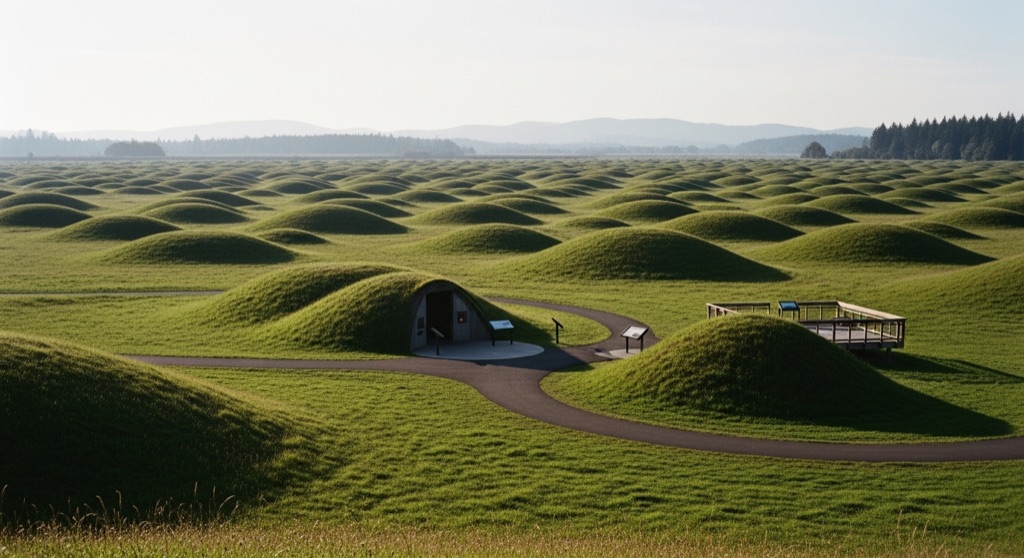
A prairie southwest of Olympia is rippled with hundreds of grass-covered domes a few feet high, stretching across several hundred acres for no reason anyone can fully explain. More than thirty theories exist, from pocket gophers to ancient earthquakes to seismic vibration patterns, and none has been settled. A short paved loop leads to a small interpretive shelter shaped like the mounds and an observation deck where you can survey the strange undulating field.
→ Three more weird outdoor & roadside oddities in Seattle — never the same twice
The story
You pull off Waddell Creek Road into a prairie that looks like a sheet of dirt-colored bubble wrap stretched across hundreds of acres. Hundreds of uniform, grass-covered hummocks—ranging from a few feet to over six feet tall—bump out of the flat Puget prairie ground in every direction. It looks meticulously laid out by human hands or an army of obsessive machinery, but no one actually built them.
Washington State established the site as a Natural Area Preserve in 1976 to protect the landform and rare native prairie grassland, but geologists still haven't settled on how the place came to exist. More than thirty distinct scientific theories line the record. One camp insists prehistoric pocket gophers piled up sediment over thousands of years; another claims seismic vibrations from ancient mega-earthquakes sloshed soil into standing waves; others blame melting glacial ice sheets or wind erosion. Read the trail signs and you'll realize even the experts are essentially guessing.
What makes Mima Mounds genuinely weird isn't just the sheer scale of the bumpy field, but the total lack of consensus. You can stand on a prairie southwest of Olympia, look out at miles of identical dirt pimples, and know that modern geology still doesn't have a definitive answer for what you're staring at.
What it's like
Don't come expecting a rugged backcountry trek—this is a low-stress, eerie walk through a strange landscape. You'll slap a Discover Pass on your dashboard, cross the parking lot, and hit a half-mile paved loop that threads directly through the hummocks. The path leads to an interpretive shelter designed to mimic the shape of a mound, along with an elevated viewing deck that gives you a elevated view across the undulating prairie. Visit in spring if you want native wildflowers popping against the grass mounds, or come on a drizzly weekday if you want to soak in the solitary surrealism. Just keep an eye on the clock, because the main entry gate locks at dusk sharp.
The move: Walk the paved half-mile loop, climb the mound-shaped viewing platform, and argue over whose pet origin theory for the mounds is right.
📍 Before you go Open 7am to dusk daily; gate locks after hours. Requires a Discover Pass ($10/day or $30/year) to park, though there are a few free 15-minute spots. Spring brings prairie wildflowers.
- 📍 near Olympia (Littlerock), WA
- 💸 Free
- ⚡ Up for anything
- 🌗 Outdoors
Where: Waddell Creek Rd SW, Olympia, WA 98512
Hours: Added 2026-06-24 — confirm current hours before you go.
Pair it with
- Odds & Ends - A Curiosity Shop — After trying to solve an unsolved geological mystery in the dirt, drive eleven miles into downtown Olympia to browse taxidermy and oddities.
- Recycled Spirits of Iron (Ex Nihilo Sculpture Park) — Swap unexplained natural dirt hummocks for Dan Klennert's deliberate, junk-metal scrap sculptures hidden in the woods near Rainier.
- Dickman Mill Park — Pair this quiet prairie anomaly with industrial waterfront ruins further north on Commencement Bay.
More weird in Seattle


Good to know
What is the leading theory on how the mounds were made?
There isn't one. Over thirty theories exist, with popular contenders including pocket gopher burrowing habits over millennia, seismic vibration patterns, and glacial ice melting processes.
Do I need a pass to park at Mima Mounds?
Yes, parking requires a Washington State Discover Pass ($10 for a day pass or $30 for an annual pass), though there are a couple of free 15-minute parking spots near the entry.
Is the trail accessible for strollers or wheelchairs?
Yes, there is a paved half-mile loop trail that takes you to the mound-shaped interpretive shelter and viewing platform.
What are the site's operating hours?
The preserve is open daily from 7:00 a.m. until dusk, and the automatic gate locks after hours.
Plan a visit & invite your people →
Further reading: dnr.wa.gov · Wikipedia · wta.org · wa100.dnr.wa.gov · seattlebloggers.com
last checked: 2026-06-24