Entry No. 64 — the Seattle file — filed under: ruins
Dickman Mill Park
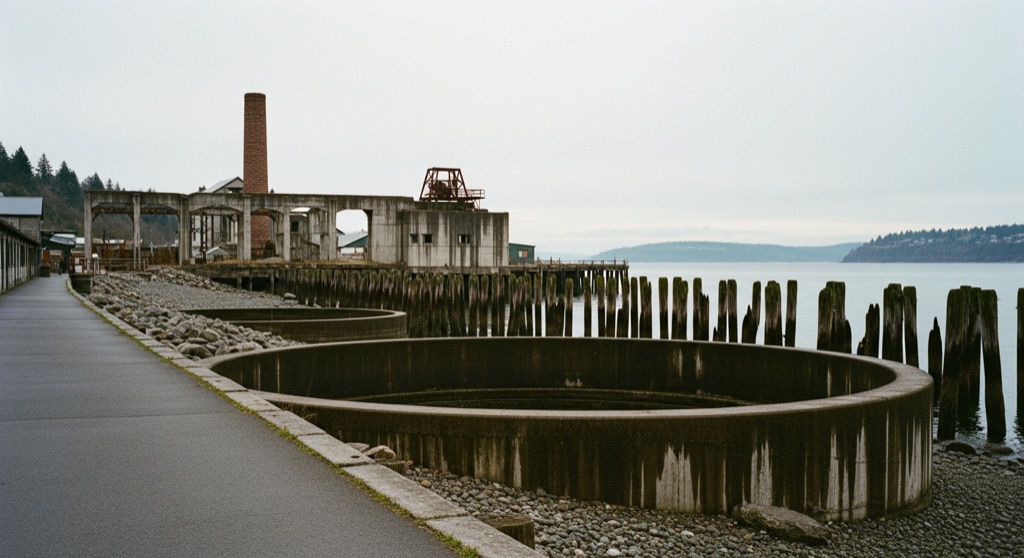
Dickman Mill Park preserves the remains of Tacoma's last operating waterfront sawmill, which was established in 1889 and destroyed by fire in 1979. Today, the public park integrates the mill's concrete foundations, the 60-foot circular foundation of its wigwam burner, and a restored 15-ton historic head saw. Decaying wooden pilings still line the shoreline, offering a stark visual reminder of the city's industrial past.
→ Three more abandoned & forgotten places in Seattle — never the same twice
The story
In 1889, Tacoma’s waterfront was carved up for timber, and the mill that became Dickman Mill went to work on Commencement Bay. For nearly ninety years, it chewed through old-growth timber until a 1979 fire gutted the operation and shuttered the last working sawmill on Tacoma's Old Town waterfront. Rather than scraping the tide flats clean, the city left the bones behind. Today, you walk through an industrial site preserved in place, complete with exposed concrete footings, waterlogged wooden pilings rotting in the saltwater, and the 60-foot circular foundation where the mill's wigwam burner used to incinerate scrap wood.
The centerpiece of the park is the restored 15-ton historic head saw, reinstalled near its original waterfront location to show off the brutal scale of early Northwest logging machinery. To layer on the history, artist Mary Coss added the steel 'Ghost Log' sculpture paired with 'Ghost Timbre'—a digital soundscape that broadcasts historical waterfront audio while you stand at the water's edge. Even the decaying pilings sticking out of the surf have taken on a second life, serving as nesting posts for local purple martin colonies.
What it's like
Expect a wind-whipped waterfront stroll along Ruston Way where heavy iron meets saltwater spray. You can walk the paved trail straight onto the concrete mill foundations and stand inside the circular outline of the old wigwam burner while cargo ships pass across Commencement Bay. The massive 15-ton head saw looms right beside the path without any velvet ropes blocking your view, and interpretive signs explain how the machinery functioned. Go at low tide to get a clearer look at the mossy ruins and the rotting timber pilings sticking out of the mudflats.
The move: Walk along the paved waterfront path to admire the massive restored head saw, photograph the concrete ruins and the circular wigwam burner foundation, and enjoy scenic views of Commencement Bay.
📍 Before you go The site is a fully public, legally accessible municipal park managed by Metro Parks Tacoma, featuring paved walkways and interpretive signs.
- 📍 Tacoma
- 💸 Free
- ⚡ Low-key
- 🌗 Outdoors
Where: 2423 Ruston Way, Tacoma, WA 98402, USA
Hours: Added 2026-07-20 — confirm current access before you go.
Pair it with
- Ford Slope Mine — Pair Tacoma's waterfront saw ruins with Bellevue's overgrown coal mine to trace how heavy industry shaped the Pacific Northwest wilderness.
- Bill Speidel's Underground Tour — Connect Tacoma's 1889 mill history with the buried city streets created after Seattle's own devastating 1889 fire.
- Hat 'n' Boots at Oxbow Park — Trade industrial waterfront concrete ruins for rescued mid-century roadside pop art inside a Georgetown park.
More weird in Seattle


Good to know
Is Dickman Mill Park free to visit?
Yes. It is a public municipal park managed by Metro Parks Tacoma with free access along the paved Ruston Way waterfront path.
What is a wigwam burner?
A wigwam burner was a giant, cone-shaped steel structure used by sawmills to burn scrap wood and sawdust. At Dickman Mill Park, only the 60-foot circular concrete foundation remains.
What is the massive piece of rusty machinery on display?
It is the mill's original 15-ton historic head saw, which was restored and mounted back on the waterfront as part of a park expansion project.
Plan a visit & invite your people →
Further reading: metroparkstacoma.org · theclio.com · nwtrek.org
last checked: 2026-07-20