Entry No. 36 — the San Francisco file — filed under: observatory
Chabot Space & Science Center — Public Telescope Nights
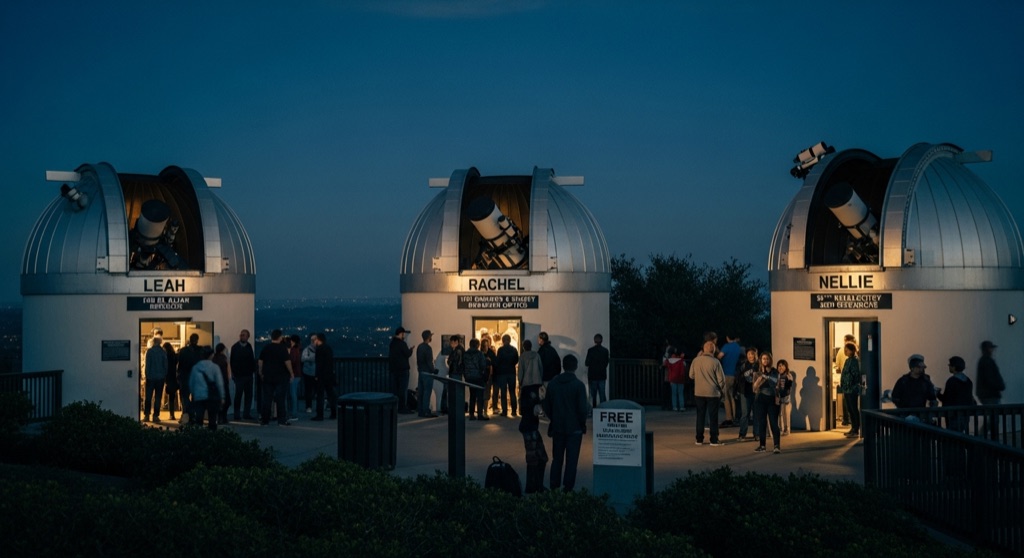
Three named telescopes on a hilltop above Redwood Regional Park, open to the public on weekend nights: Leah, an 1883 Alvan Clark refractor donated by water/hydraulic-mining magnate Anthony Chabot; Rachel, a 1914 Warner & Swasey refractor with Brashear optics, billed as the largest refractor in the western U.S. regularly open to the public; and Nellie, a 36-inch reflector used for research including tracking near-Earth objects.
→ Three at a time, never the same twice — explore weird San Francisco
The story
In 1883, hydraulic mining magnate Anthony Chabot—a man who made his fortune washing down Sierra hillsides with high-pressure water cannons—decided to buy Oakland a piece of the sky. He funded an 8-inch refractor telescope crafted by master optician Alvan Clark and named it Leah. That single brass-bound instrument anchored a public viewing tradition that outlived its benefactor, surviving San Francisco's 1906 earthquake and eventually migrating from downtown Oakland up to the dark ridge above Redwood Regional Park.
By 1914, the observatory added Rachel, a 20-inch Warner & Swasey refractor fitted with optics ground by John Brashear—still the largest refractor instrument in the western United States regularly opened to everyday eyes. Decades later came Nellie, a modern 36-inch reflector scope housed under a steel dome, whose duties include tracking near-Earth asteroids. The result is three generations of glass sitting side by side on a hilltop high above the East Bay fog line.
While daytime visits to the science center require paid museum tickets, the real maneuver happens after dark. On Friday and Saturday nights from 7:30 to 10:30 p.m., the outdoor observatory deck opens up for free. You walk up the concrete ramps past heavy redwoods to stand under three open domes, hopping from 19th-century cast-iron gearing to deep-space research optics in a single evening.
What it's like
Drive up winding Skyline Boulevard until the city grid fades into dark forest. The observation deck gets freezing fast once the sun goes down, so layer up heavy and expect to stand on open concrete in the mountain air. Volunteer astronomers in parkas direct long queues and map constellations overhead with green laser pointers while you wait. The lines move steadily, but the draw is the direct comparison: looking through 140-year-old hand-ground glass at Saturn's rings in one dome, then stepping next door to stare down the steel barrel of a modern 36-inch reflector. If thick ocean fog rolls over the ridge, the metal domes stay clamped shut—check cloud cover before making the drive up.
The move: Show up on a clear Friday or Saturday night, queue at all three domes, and compare views of Saturn's rings through 140-year-old glass versus a modern research scope — then wander the free outdoor viewing deck with the volunteer astronomers.
- 📍 Oakland Hills
- 💸 $
- ⚡ Low-key
- 🌗 Outdoors
Where: 10000 Skyline Blvd, Oakland, CA 94619
Hours: Added 2026-07-20 — confirm current hours before you go.
Pair it with
- Leona Heights Sulfur Mine — After looking at stars funded by hydraulic mining wealth, head down the ridge to inspect the leftover sulfur-yellow industrial footprint of Oakland's abandoned pyrite mine.
- Chapel of the Chimes — Pair historic telescope glass with Julia Morgan's intricate 1928 indoor columbarium maze, illuminated by skylights, fountains, and mosaic tilework.
- California Historical Radio Society / Radio Central Museum — Extend the early 20th-century analog technology theme by visiting rows of vacuum-tube radios and historic wireless transmitters across the estuary in Alameda.
More weird in San Francisco
Good to know
Is attending the weekend telescope nights really free?
Yes. While daytime entrance to the NASA Ames Visitor Center exhibits and planetarium requires ticketed museum admission, access to the Observatory Deck on Friday and Saturday nights (7:30–10:30 p.m.) is free to the public.
Which telescopes do you get to look through?
Weather permitting, volunteers aim all three primary scopes: Leah (the 1883 Alvan Clark refractor), Rachel (the 1914 Warner & Swasey 20-inch refractor), and Nellie (the modern 36-inch reflector).
What happens if it gets foggy or rainy?
Because high humidity and fog damage historic glass optics and sensitive scientific instruments, the domes stay shut during overcast or wet weather. Check fog conditions and Chabot's site before heading up.
Where are the public telescope viewings held?
They take place on the Observatory Deck at 10000 Skyline Blvd, high in the Oakland Hills above Redwood Regional Park.
Plan a visit & invite your people →
Further reading: Wikipedia · Official site
last checked: 2026-07-20