Entry No. 33 — the Salt Lake City file — filed under: oddities
John Hutchings Museum of Natural History
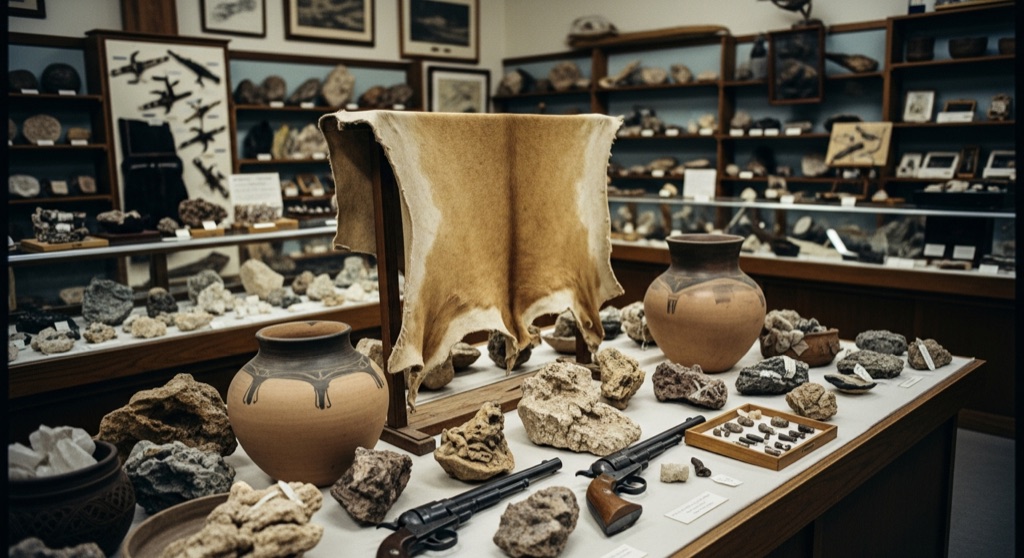
Amid rock and mineral cases, Native American pottery, and a pistol said to have belonged to Butch Cassidy sits one of Utah's strangest relics: a swatch of tanned human skin taken from 18-year-old outlaw Chauncey Millard, who was executed by firing squad in 1869 after selling his own corpse to a doctor for a pound of candy — the doctor later used the skin to wrap surgical instruments.
→ Three at a time, never the same twice — explore weird Salt Lake City
The story
Before it became a civic landmark, this collection was the lifelong personal hoard of John Hutchings and his wife, local amateur naturalists who picked up whatever the Utah soil yielded: mineral specimens, taxidermied birds, pioneer hand tools, and Native American pottery. It retains the dense, unvarnished density of an early 20th-century cabinet of curiosities, packed glass-case by glass-case into downtown Lehi.
Tucked into that sea of geological samples and preserved wildlife sits the museum’s most notorious artifact: a tanned swatch of human skin. It belonged to Chauncey Millard, an 18-year-old outlaw executed by firing squad in 1869. Facing execution, Millard struck a surreal final bargain, selling his own post-mortem corpse to a local doctor for a single pound of candy, which he reportedly ate while awaiting his sentence. After the firing squad did its job, the physician harvested the body, had Millard's skin tanned, and used a portion of it to wrap surgical instruments.
That swatch of outlaw hide sits under glass right alongside a revolver attributed to Butch Cassidy, turning a unassuming small-town heritage hall into one of Utah Valley's most unhinged archives.
What it's like
Expect an earnest, old-school local history setup at 55 N Center Street that feels worlds away from the slick tech-corridor growth taking over Lehi. You will walk past dusty cases of quartz crystals, mounted birds, and pioneer gear before finding the Chauncey Millard display—give yourself time to read the full placard detailing the corpse-for-candy deal. Double-check operating hours before driving out, as schedules for small civic museums like this can shift.
The move: Do the small-town amateur-naturalist circuit — Hutchings couple's donated rocks, birds, and pioneer relics — then track down the Millard case together and read the full placard; it's the kind of story you end up retelling on the drive home.
- 📍 Lehi
- 💸 $$
- ⚡ Up for anything
- 🌗 Indoors
Where: 55 N Center St, Lehi, UT 84043
Hours: Added 2026-07-20 — confirm current hours before you go.
Pair it with
- Holdman Studios — After sifting through tanned human hide and pioneer guns in downtown Lehi, drive three miles over to watch glass artists manipulate molten flame.
- Monte L. Bean Life Science Museum — If you want to continue the oddities-and-taxidermy trail, head south to BYU's campus to visit Shasta, a taxidermied liger.
- Salt Cave & Selenite Crystal Cave at Synchronicities — Balance out the grim true-crime history with a session inside a strip-mall suite lined with 10,000 pounds of pink Himalayan salt.
More weird in Salt Lake City
Good to know
Where is the museum located?
It is located at 55 N Center St in downtown Lehi, Utah.
What is the story behind the human skin display?
It came from Chauncey Millard, an 18-year-old outlaw executed in 1869 who sold his body to a doctor for a pound of candy before his death. The doctor had the skin tanned and used it to wrap surgical tools.
What else is on display at the John Hutchings Museum?
The collection includes rock and mineral specimens, taxidermied birds, Native American pottery, pioneer relics, and a pistol said to have belonged to Butch Cassidy.
Should I call ahead before visiting?
Yes, hours can fluctuate, so it is best to confirm current operating hours before making the trip.
Plan a visit & invite your people →
Further reading: Wikipedia
last checked: 2026-07-20