Entry No. 12 — the Pueblo file — filed under: haunted
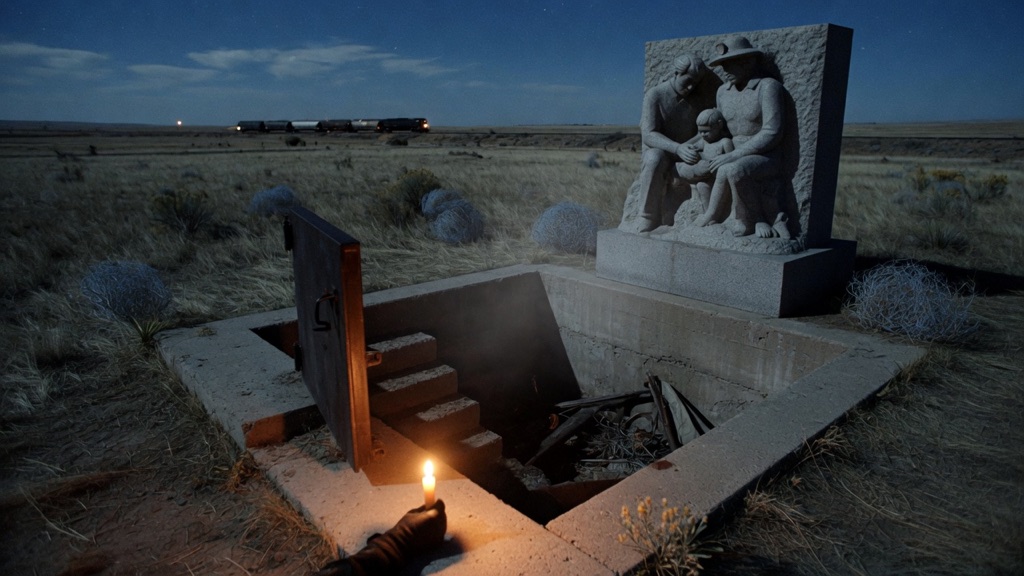
Ludlow Massacre Memorial
“Vandals took the miner's head and the mother's arm; the union recarved them.”
On April 20, 1914, Colorado National Guardsmen and company gunmen machine-gunned and torched a tent colony of striking coal miners. Two women and eleven children suffocated in a dirt cellar under a burning tent. The UMWA bought the field, raised a granite miner and mother in 1918, and encased the death pit in concrete — steel door, steps down, and you can still peer in. Vandals took the miner’s head and the mother’s arm in 2003; the union recarved them. Wind, prairie, passing trains, almost nobody else.
→ Three more abandoned & forgotten places in Pueblo — never the same twice
The story
On April 20, 1914, striking coal miners and their families were living in a tent colony on this scrubby patch of prairie after being evicted from Rockefeller-owned coal camps. That morning, armed company guards and Colorado National Guardsmen opened fire with machine guns and torched the canvasses. Beneath one burning tent, two women and eleven children retreated into a hand-dug dirt cellar beneath the floor to hide from the gunfire. They suffocated in the dark smoke before anyone could reach them.
The United Mine Workers of America bought the charred ground and dedicated a granite monument in 1918—a coal miner, a mother, and a child looking out across the plain. Rather than sealing over the site, the union encased the cellar in concrete, set steps into the earth, and hung a heavy steel door so visitors could step directly down into the space where the families died. In 2003, vandals decapitated the granite miner and severed the mother's arm, but the union tracked down original quarry stone and had the statues recarved by 2005.
What makes Ludlow hit so hard isn't just the history—it's the eerie quiet of the place today. There are no ticket booths, docents, or velvet ropes. You stand on open, wind-blasted prairie alongside active BNSF railway lines, peering into an underground death pit preserved by coal miners to ensure the bloodiest labor conflict in American history stayed visible.
What it's like
You pull off I-25 onto County Road 44 and roll up to a gravel lot that is usually entirely empty. The site is unstaffed and exposed to the weather, with only a covered shelter, a set of interpretive panels, and the granite figures standing over the dirt. Walk directly to the concrete bunker beside the monument: check if the heavy steel door is unlatched. If it's open, you can walk down the concrete stairs into the cramped pit cellar where the victims suffocated; if closed, you can still peer down through the opening. Freight trains rumble past every few hours, the wind rarely stops blowing, and you will almost certainly have the whole grim memory to yourself.
The move: Read the names on the granite aloud to each other, look down into the death pit together, then drive into Trinidad for green chile and let the silence sit.
📍 Before you go Take I-25 Exit 27 (signed for Ludlow) and head west about half a mile on County Road 44; the monument and its gravel lot sit just off the road on open, exposed prairie. The site is free, open daily, and unstaffed — a covered picnic shelter and interpretive panels, but no restrooms or water, so stock up in Trinidad or Walsenburg. The concrete-lined death-pit cellar beside the monument was restored in the early 2020s; check whether the steel door is open before counting on descending the steps. The UMWA holds its annual memorial service here in June — the one weekend the site is not empty.
- 📍 Ludlow (15 mi NW of Trinidad)
- 💸 $$
- ⚡ Up for anything
- 🌗 Indoors
Where: I-25 Exit 27, then ~0.5 mi west on County Road 44, Ludlow, CO 81082
Hours: Added 2026-06-11 — confirm current hours before you go.
Pair it with
- Cokedale Coke Ovens — Drive 12 miles south to walk along 350 abandoned beehive ovens left standing from the same industrial coal system that triggered the Ludlow strike.
- Simpson's Rest — Head into Trinidad to stand atop the rocky bluff where frontier scout George Simpson is buried directly under the city's giant illuminated hillside sign.
- FAROUT Murals of Walsenburg — If you are driving north toward Pueblo, stop 22 miles up I-25 to see large-scale labor and regional murals painted onto Walsenburg's crumbling brick walls.
More weird in Pueblo

Good to know
Is there an entrance fee or staff on site?
No. The memorial is free, open daily, and completely unstaffed. There are no restrooms or water fountains, so buy supplies in Trinidad or Walsenburg before heading out.
Can you actually go inside the subterranean cellar?
Yes, if the door is unlocked. The concrete-lined pit was restored in the early 2020s; when the steel door is unlatched, visitors can step down the stairs into the underground cellar.
When is the site most busy?
The memorial sits silent almost 365 days a year, except during the UMWA's annual memorial service held on a weekend every June.
What happened to the statues in 2003?
Vandals desecrated the granite figures, stealing the miner's head and the mother's arm. The United Mine Workers of America commissioned sculptors to recarve and reinstall the missing limbs and head, completing repairs in 2005.
Plan a visit & invite your people →
Further reading: Wikipedia · visittrinidadcolorado.com · coloradopreservation.org · canyonsandplains.org · cpr.org · Facebook
last checked: 2026-06-11