Entry No. 2 — the Pueblo file — filed under: roadside-oddity
Cokedale Coke Ovens
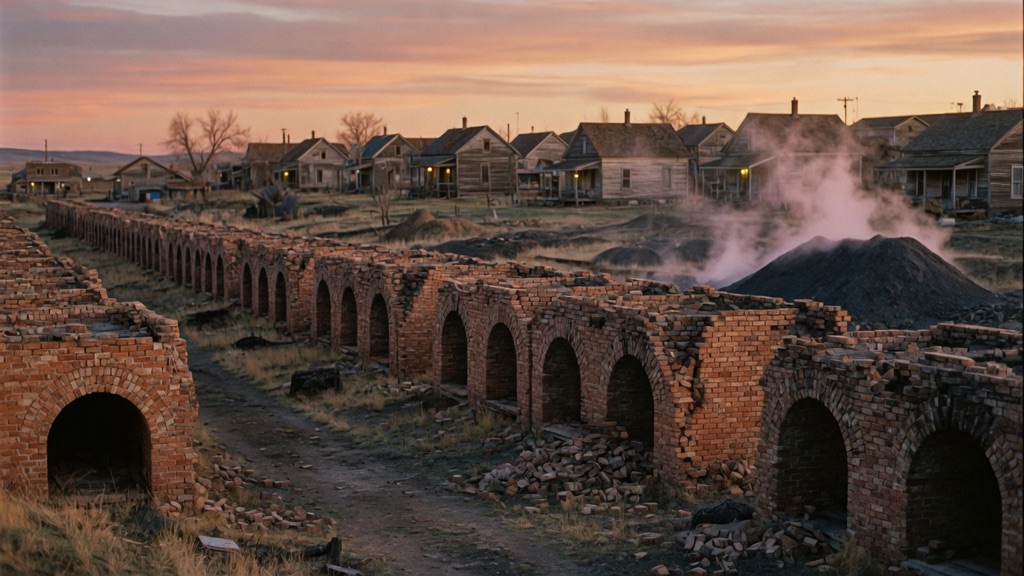
“On cold mornings steam still curls off the slag pile.”
ASARCO built 350 beehive coke ovens here in 1906, and when the mine quit in 1947 nobody bothered to tear them down. So two double-sided rows still run along Highway 12 like a collapsed Roman aqueduct, the largest surviving set in Colorado, once baking 800 tons of coke a day for the smelters. On cold mornings steam still curls off the slag pile. And the company camp behind them never died: about a hundred people still live in Cokedale, the most intact coal town in the state.
→ Three more abandoned & forgotten places in Pueblo — never the same twice
The story
In 1906, the American Smelting and Refining Company (ASARCO) built 350 beehive ovens in a tight valley seven miles west of Trinidad. Their sole purpose was to superheat raw coal, driving off volatile gases to produce 800 tons of high-purity industrial coke a day for smelters and Pueblo's massive steel mills. The fires burned around the clock until 1947, when the mine finally tapped out. Standard industrial practice dictated tearing everything down, but nobody bothered to pay for demolition. They just locked up and walked away.
What remains along Highway 12 looks less like American industrial scrap and more like a ruined Roman aqueduct rotting in the sagebrush. Two long, double-sided rows of brick arches stretch out in parallel, forming the largest surviving cluster of coke ovens in Colorado. On freezing winter mornings, trapped moisture and residual heat still make thin wisps of steam curl off the dark mountain of slag piled up behind them.
The strangest detail isn't the ruins themselves, but what lies just beyond them. Unlike the hundreds of coal camps across the Raton Basin that vanished into ghost towns, Cokedale refused to die. About a hundred residents still live in the original company-built houses tucked behind the ovens, making it the most intact coal town left in the state—complete with its original stone mercantile and quiet, grid-laid streets.
What it's like
Pull off Highway 12 on the northbound shoulder just south of milepost 63, where the road widens right before the Cokedale turnoff. There are no turnstiles, ticket booths, or fences keeping you out. Informal foot paths lead directly from the gravel shoulder into the black, soot-stained mouths of the beehives. Wear real shoes—you'll be walking over century-old loose coal slag, sharp clinker, and soft, crumbling brickwork. Time your arrival for golden hour when the setting sun hits the brick portals and turns the arches bright orange. If you happen to visit when the seasonal, volunteer-run Cokedale Mining Museum inside the old Gottlieb Mercantile is open, pop in for a look at the town's original blueprints.
The move: Time the drive for golden hour, pull off CO-12 near milepost 63, and walk the foot trail to the arches while low sun turns the brick portals orange.
📍 Before you go The ovens line Highway 12 right at the Cokedale turnoff; the best vantage and widest pull-off is on the northbound side just south of milepost 63. Informal foot trails lead from the shoulder to the arches over loose slag and uneven brick, so wear real shoes. The free Cokedale Mining Museum in the old Gottlieb Mercantile in town is volunteer-run and seasonal, so treat it as a bonus rather than the plan. Pair the stop with the rest of the Highway of Legends west toward Stonewall and Monument Lake.
- 📍 Cokedale (7 mi west of Trinidad, Hwy 12)
- 💸 Free
- ⚡ Up for anything
- 🌗 Outdoors
Where: CO-12 near milepost 63, Cokedale, CO 81082
Hours: Added 2026-06-11 — confirm current hours before you go.
Pair it with
- Ludlow Massacre Memorial — Follow the dark history of the southern Colorado coalfields 12 miles north to the site of the violent 1914 strike.
- Louden-Henritze Archaeology Museum — Head seven miles east into downtown Trinidad to switch from industrial ruins to 80-million-year-old ocean fossils extracted from the local shale.
- Simpson's Rest — Drive back toward Trinidad to look down on the valley from the high bluff where frontier scout George Simpson is buried.
More weird in Pueblo
Good to know
Where are the Cokedale Coke Ovens located?
They sit directly along Highway 12 (the Highway of Legends) near milepost 63, about seven miles west of Trinidad, Colorado.
What were these brick ovens actually used for?
Built by ASARCO in 1906, the 350 beehive ovens baked raw bituminous coal at extreme heat to burn off impurities, creating refined carbon coke used to melt iron ore in steel mills and smelters.
Do you need a ticket or tour to visit?
No. The ruins sit right on the highway shoulder and are freely accessible to walk around anytime. Just exercise caution around the old masonry.
Is the museum always open?
No. The Cokedale Mining Museum inside the historic Gottlieb Mercantile is run entirely by local volunteers and operates on seasonal, irregular hours. Treat it as a lucky bonus if the door is unlocked.
Plan a visit & invite your people →
Further reading: uncovercolorado.com · westernmininghistory.com · Roadside America · coloradoencyclopedia.org
last checked: 2026-06-11