Entry No. 11 — the Nashville file — filed under: cemetery
Nashville City Cemetery
Opened January 1, 1822 as Nashville's first public burying ground, it now holds roughly 22,000 burials — some 6,000 of them African American, many enslaved Nashvillians laid in an unmarked 'Colored Ground' the cemetery association is only now working to properly document and memorialize.
→ Three more haunted places & dark-history spots in Nashville — never the same twice
The story
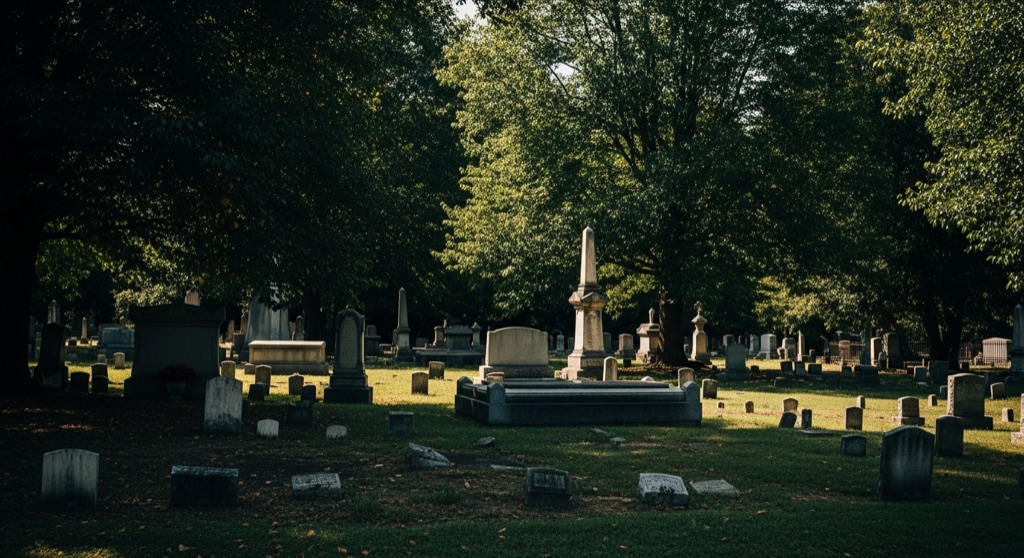
Opened on New Year’s Day 1822 at 4th Avenue South and Oak Street, this is Nashville’s oldest public cemetery—a 22,000-person ledger carved into limestone just south of downtown. Walk past the iron gates and you are looking at the city’s early social hierarchy laid out in grid work. Prominent city founders, politicians, and military figures occupy tidy rows marked by grand Victorian monuments and obelisks, interspersed with Confederate-era reinterments.
The most critical history, however, sits in the blank spaces. An estimated 6,000 of the cemetery’s inhabitants were African American—many of them enslaved Nashvillians buried in a segregated section historically set aside as the 'Colored Ground.' For generations, these plots lacked carved stones or formal documentation, left effectively unmapped while the rest of the cemetery was maintained. The Nashville City Cemetery Association and city historians are actively conducting archival research and field mapping to identify and memorialize the thousands buried in these unmarked spaces.
Because it operated as a municipal burial ground rather than a private churchyard, the site took in anyone who died in the city regardless of wealth, making it the single most accurate physical cross-section of 19th-century Nashville. Walking these grounds isn't just a lesson in tombstone architecture; it's a direct look at how the city decided who was remembered in stone and who was relegated to forgotten turf.
What it's like
Visiting is quiet, free, and starkly self-directed. You step off 4th Avenue South near the edge of Wedgewood-Houston into an open expanse of weather-worn limestone monuments and mature trees. Grab a self-guided walking map from the cemetery association website before you arrive—without one, it is easy to walk right past the transition between ornate family vaults and the quiet grassy fields that cover thousands of unmarked graves. Keep in mind that grounds hours can fluctuate, so confirm operating times before heading out, and wear sturdy shoes for navigating uneven turf.
The move: Grab the self-guided walking-tour brochure and trace the cemetery's segregated sections together — founders' row, the Confederate-era exhumations, the unmarked ground — then talk through what surprised you over coffee a few blocks away.
- 📍 Wedgewood-Houston / South Nashville
- 💸 $$
- ⚡ Up for anything
- 🌗 Indoors
Where: 1001 4th Ave S, Nashville, TN 37210
Hours: Added 2026-07-20 — confirm current hours before you go.
Pair it with
- Fort Negley — Located less than half a mile away, Fort Negley provides an essential historical counterpoint regarding the conscripted Black Nashvillians who built the fort and those buried in the cemetery's unmarked ground.
- Sudekum Planetarium at Adventure Science Center — Located just up Old Saint Cloud Hill, the planetarium offers an expansive cosmic reset right after walking through 19th-century headstones.
- COOP Gallery — Head into Wedgewood-Houston's industrial district to shift from forgotten local history to challenging contemporary art inside The Packing Plant.
More weird in Nashville

Good to know
Is there an entrance fee to tour the grounds?
No, access to the cemetery is completely free to the public.
Where exactly is the cemetery located?
It is located at 1001 4th Avenue South, at the corner of Oak Street in the Wedgewood-Houston / South Nashville area.
Why are thousands of burials unmarked?
An estimated 6,000 African American Nashvillians, many enslaved, were buried in segregated sections without stone markers; historians and cemetery advocates are currently working to document and honor these unmapped plots.
When did the cemetery open?
It opened on January 1, 1822, making it Nashville's oldest public burying ground.
Plan a visit & invite your people →
Further reading: Official site · Wikipedia
last checked: 2026-07-20