Entry No. 67 — the Los Angeles file — filed under: ruins
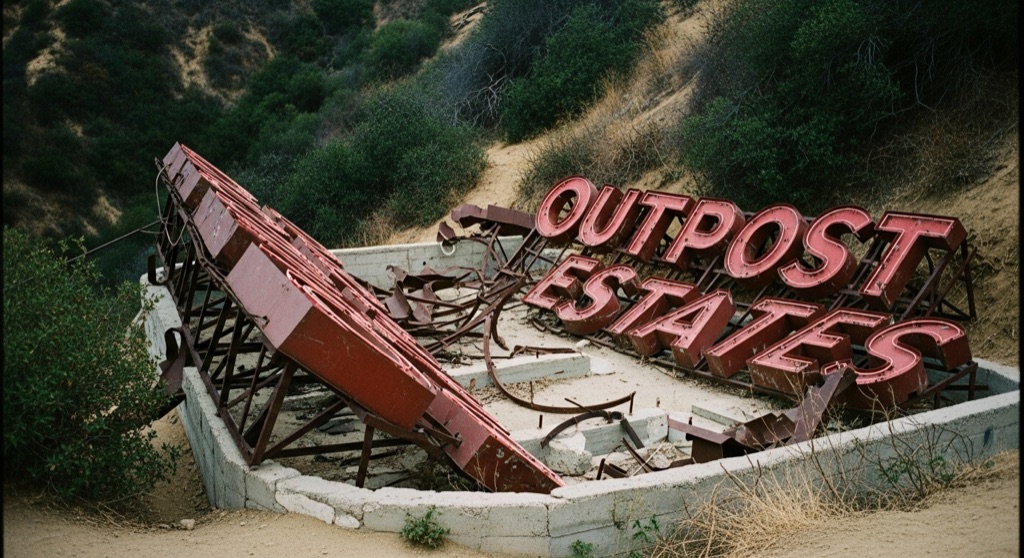
Outpost Sign Ruins
Erected in the late 1920s by developer Charles E. Toberman, this massive 30-foot-tall red neon sign was built to advertise the upscale Outpost Estates and rival the nearby Hollywoodland sign. The lights were permanently extinguished during World War II blackout orders, and the structure eventually collapsed and was forgotten. Today, its twisted, rusted steel wreckage and concrete foundations lie scattered in the brush along the hiking trails of Runyon Canyon Park.
→ Three more abandoned & forgotten places in Los Angeles — never the same twice
The story
In the late 1920s, real estate developer Charles E. Toberman wanted everyone driving through the basin to know about his new luxury subdivision, Outpost Estates. Not content to let the nearby Hollywoodland sign hog the skyline, Toberman erected a colossal 30-foot-tall red neon sign right on the ridge above what is now Runyon Canyon. At night, it blazed across the dark hillside—a massive glowing flex designed to lure wealthy buyers and movie stars into his Spanish Colonial development.
Then came World War II. Following the attack on Pearl Harbor, mandatory blackout orders swept the West Coast to prevent enemy forces from targeting Los Angeles landmarks from the air or sea. The Outpost sign was switched off alongside the rest of the city's neon lights. But unlike its famous competitor down the ridge, Toberman's sign was never re-lit. Decades of wind, brushfires, and sheer neglect took their toll until the thirty-foot steel structure collapsed, breaking apart and vanishing under thick hillside chaparral.
What remains today isn't a preserved historical site—it's genuine structural wreckage. If you know where to look off the dirt trails in Runyon Canyon Park, you'll stumble across twisted, rusted steel framing and crumbling concrete foundation blocks half-buried in the dirt. It's a quiet, forgotten graveyard for a piece of 1920s real estate hubris, rusting away in plain sight just feet from where thousands of joggers pass by daily.
What it's like
Runyon Canyon is usually buzzing with runners, unleashed dogs, and tourists, but almost nobody on the trail realizes what's rusting in the brush. To spot the wreckage, hike the park's East Trail up toward the ridge. You aren't looking for an official landmark with a bronze plaque; you're scanning the hillside chaparral for orange-rusted steel beams, bent metal framework, and concrete footings embedded in the earth. Wear sturdy shoes for the dusty, uneven trail, bring plenty of water, and go early in the morning if you want to avoid peak crowds and heavy heat.
The move: Hike the scenic East Trail of Runyon Canyon Park to spot the rusted metal ruins of this forgotten 1920s landmark while enjoying sweeping views of the Los Angeles basin.
📍 Before you go The ruins are located on public land within Runyon Canyon Park and can be freely viewed and accessed from the park's hiking trails.
- 📍 Los Angeles
- 💸 Free
- ⚡ Low-key
- 🌗 Outdoors
Where: 2091 Outpost Dr, Los Angeles, CA 90068, USA
Hours: Added 2026-07-20 — confirm current access before you go.
Pair it with
- The Wisdom Tree, Cahuenga Peak — Pair this rusted real-estate ruin with another iconic Hollywood Hills trek to the solitary pine atop Cahuenga Peak.
- Bronson Caves (the Batcave) — Follow up one set of forgotten hillside ruins with a short hike into the man-made quarry tunnel that served as the 1960s TV Batcave.
- Good Times at Davey Wayne's — Swap dusty 1920s hillside steel wreckage for a drink behind a secret garage refrigerator door in Hollywood.
More weird in Los Angeles

Good to know
Where inside Runyon Canyon Park can you find the sign ruins?
The rusted steel wreckage and concrete footings are scattered in the hillside brush along the park's East Trail near the upper ridgeline.
Is there an admission fee or permit required to visit?
No. The ruins lie on public land inside Runyon Canyon Park and can be accessed freely during normal park operating hours.
Why was the Outpost sign abandoned?
It was turned off during World War II military blackout orders. After the war, it was never turned back on or maintained, leaving the heavy steel frame to eventually collapse into the brush.
How big was the original sign compared to the Hollywood sign?
The Outpost sign stood 30 feet tall and featured red neon lighting, built specifically by developer Charles E. Toberman to compete with the nearby Hollywoodland sign.
Plan a visit & invite your people →
Further reading: laist.com · latimes.com · pbssocal.org
last checked: 2026-07-20