Entry No. 27 — the Los Angeles file — filed under: art-immersive
Grandma Prisbrey's Bottle Village
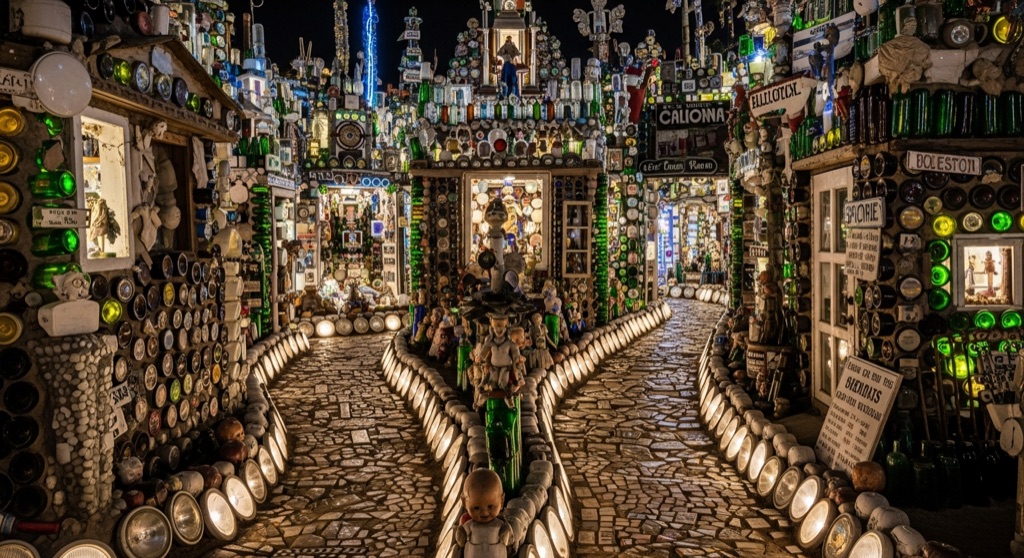
Starting in 1956, Tressa "Grandma" Prisbrey hand-built sixteen structures from bottles, mortar, and discards hauled from the local dump, originally to house her enormous pencil collection. The result is a walk-through village of bottle-walled houses and shrines glowing when light passes through the glass, threaded with mosaic paths of headlights, dolls and odd salvage. It is one of California's most important outsider-art environments and a registered historic landmark. Restoration is ongoing and access is tour-only.
→ Three more unusual museums & collections in Los Angeles — never the same twice
The story
In 1956, Tressa "Grandma" Prisbrey was sixty years old and needed somewhere to display her collection of tens of thousands of pencils. Instead of buying display cases, she hitched up a trailer, drove to the local Simi Valley dump, and began hauling back thousands of discarded glass bottles and salvaged trash. She mixed mortar in small batches and started laying bottles side-by-side. What began as a single storage shed grew over two decades into a sprawling one-woman complex of sixteen distinct structures, winding mosaic walkways, and eccentric shrines.
What makes the site remarkable isn't just the sheer labor of building sixteen structures out of garbage, but how light transforms the space. Step inside one of the bottle houses and you're surrounded by thick walls of glass—green wine bottles, clear soda glass, brown beer bottles—held in dark gray cement mortar. Sunbeams filter through the glass, casting colored light across dirt floors threaded with pathways paved in smashed headlights, broken porcelain, and salvaged tile.
What it's like
Visiting isn't a casual drop-in affair. Because the fragile site is undergoing ongoing preservation, access is strictly limited to scheduled docent tours, usually starting around 1pm on select dates. You'll need to reserve your spot ahead of time, bring around $10 cash for admission, and wear soft-soled shoes so you don't crack the delicate mosaic pathways underfoot. The docent-led walk takes you through the remaining bottle structures and shrines while laying out Prisbrey's story of building an outsider-art landmark out of mid-century California waste.
The move: Reserve a spot on a tour day and walk the glittering bottle houses together while a docent tells Prisbrey's story of building beauty from garbage.
📍 Before you go Open by scheduled tour only, on limited dates with required reservations; tours typically start at 1pm and cost around $10 cash. Wear soft-soled shoes. Confirm the next open date before driving out (~40 miles northwest of DTLA).
- 📍 Simi Valley
- 💸 $$
- ⚡ Up for anything
- 🌗 Indoors
Where: 4595 Cochran St, Simi Valley, CA 93063
Hours: Added 2026-06-23 — confirm current hours before you go.
⚠ Seasonal or scheduled — always check before you go.
Pair it with
- Coquina Mine — Pair Prisbrey's dump-salvaged bottle architecture with a hike to this abandoned 1930s open-pit limestone shell mine hidden in Simi Valley.
- Adam's Forge — Match Prisbrey's raw, self-taught folk construction with a workshop visit to this working blacksmithing shop just down the road.
- Concrete ruins of the St. Francis Dam — Follow up one woman's surviving glass-and-cement sanctuary with a trek out to the massive, historic concrete ruins of William Mulholland's failed 1920s dam.
More weird in Los Angeles
Good to know
Can I visit Bottle Village anytime?
No. The site is open by scheduled tour only on limited dates, so you must confirm open dates and book a reservation online before driving out.
How much does the tour cost and how do I pay?
Tours typically cost around $10 per person, payable in cash upon arrival.
Why did Grandma Prisbrey build the village?
She started in 1956 to build a shed to house her massive pencil collection, using free bottles and cheap mortar from the local dump when lumber proved too expensive.
What should I wear for the tour?
Soft-soled shoes are required to prevent damage to the delicate paved mosaic walkways throughout the compound.
Plan a visit & invite your people →
Further reading: Wikipedia · makcenter.org · Atlas Obscura · visitsimivalley.com
last checked: 2026-06-23