Entry No. 28 — the Los Angeles file — filed under: roadside-oddity
Watts Towers of Simon Rodia
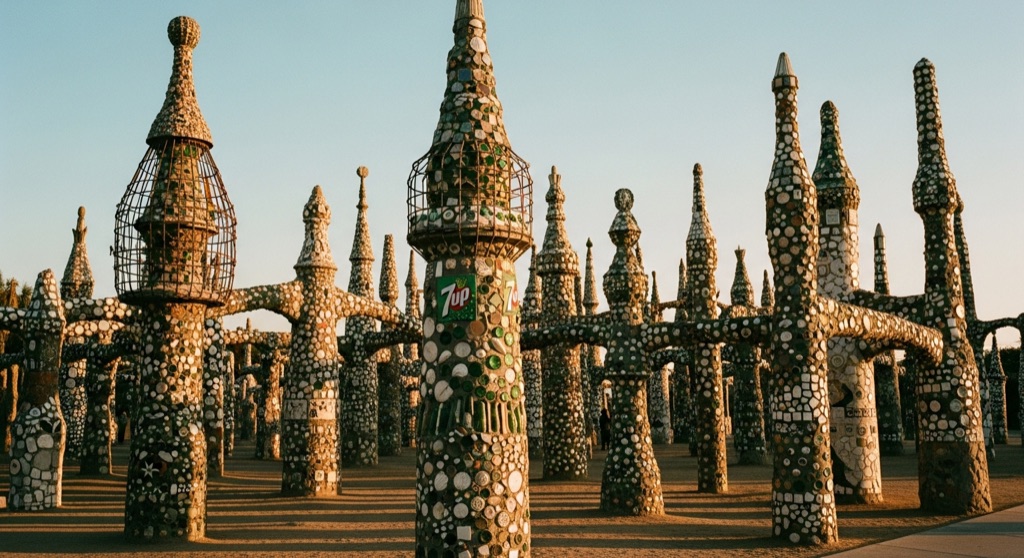
Italian immigrant tile-setter Simon Rodia spent 33 years (1921-1954) building these seventeen interlocking spires by hand, the tallest reaching nearly 100 feet, using no scaffolding, bolts, rivets, or welds. The skeletal steel armatures are wrapped in wire mesh and mortar and studded with broken glass, seashells, pottery shards, tile, and bottle bottoms he scavenged. In 1955 Rodia gave the property away and walked off, never returning. As of June 2026 the on-site guided tours and arts center are paused for campus renovations (set to resume in July 2026), but the towers themselves loom over the neighborhood and are easily seen from the surrounding sidewalk.
→ Three more weird outdoor & roadside oddities in Los Angeles — never the same twice
The story
In 1921, an Italian immigrant tile-setter named Sabato 'Simon' Rodia bought a triangular residential lot on East 107th Street in Watts and began building. For 33 years, working entirely alone without scaffolding, blueprints, bolts, rivets, or welds, he assembled seventeen interlocking steel spires by hand. The tallest reaches nearly 100 feet into the air. He climbed the skeletal frames using simple harnesses, bending rebar, wrapping it in wire mesh, and smearing it with cement mortar before pressing scavenged items directly into the wet surface.
Look closely at the lattice and you will see mid-century Los Angeles frozen in concrete: green 7-Up and Canada Dry bottle bottoms, broken ceramic tiles, china plates, seashells, and salvaged glass shards. Rodia called his creation *Nuestro Pueblo* ('Our Town'). He didn't build it for an art gallery or a city commission; he built it because he couldn't stop.
Then, in 1955, Rodia simply walked away. He gave the deed to his property to a neighbor, packed his belongings, and left Watts, never returning to see his masterpiece again. Today, the spires stand as one of the world's most impressive outsider art environments—a massive skeletal monument to three decades of unyielding personal obsession.
What it's like
Pull up along East 107th Street in daylight and park on the street. While official on-site guided tours inside the gate are paused through June 2026 for campus renovations (scheduled to resume in July 2026), you lose almost nothing by viewing from the public fence. Walk the perimeter sidewalk slowly—aim for golden hour, when the setting sun catches the embedded green 7-Up bottle bottoms and glinting seashells set into the mortar.
The move: Walk the perimeter fence together at golden hour, picking out the embedded green 7-Up glass and seashells glinting in Rodia's mortar.
📍 Before you go Guided gate tours paused as of June 2026 for renovation; towers remain viewable from the public sidewalk. Park on the street in daylight.
- 📍 Watts, Los Angeles
- 💸 Free
- ⚡ Up for anything
- 🌗 Outdoors
Where: 1727 E 107th St, Los Angeles, CA 90002
Hours: Added 2026-06-23 — confirm current hours before you go.
⚠ Seasonal or scheduled — always check before you go.
Pair it with
- Phantasma Gloria — Pair LA's ultimate steel-and-mortar folk art monument with Echo Park's residential front-yard grid of glass bottles and rebar.
- Pico House at El Pueblo — Trade one man's 33-year backyard obsession for the 19th-century Victorian hotel built by Alta California's last Mexican governor.
- EightyTwo — Head north to the Arts District after your architectural walk to swap handmade steel spires for restored vintage arcade mechanics.
More weird in Los Angeles
Good to know
Can you walk inside or climb the towers?
Climbing is strictly prohibited. When active, guided tours allow visitors inside the enclosed courtyard, though on-site gate tours are paused for renovations through June 2026 (set to resume in July 2026). The entire structure remains fully visible from the surrounding public sidewalk.
How did Simon Rodia construct them without scaffolding?
Rodia climbed the structure like a telephone pole worker, securing himself to the rebar armatures with a window-washer's belt. He bent steel pipes and track rails by hand, using nearby railroad tracks as leverage.
How long did construction take?
Rodia worked on the towers solo for 33 years, from 1921 to 1954. In 1955, he gave the property away and moved to Northern California, never returning to the site.
When is the best time to visit?
Visit during daylight hours, ideally during golden hour shortly before sunset when the low light illuminates the thousands of glass shards, pottery fragments, and seashells embedded in the concrete.
Plan a visit & invite your people →
Further reading: Wikipedia · parks.ca.gov · Official site · Atlas Obscura
last checked: 2026-06-23