Entry No. 160 — the Denver file — filed under: floor painting
The Face on the Barroom Floor
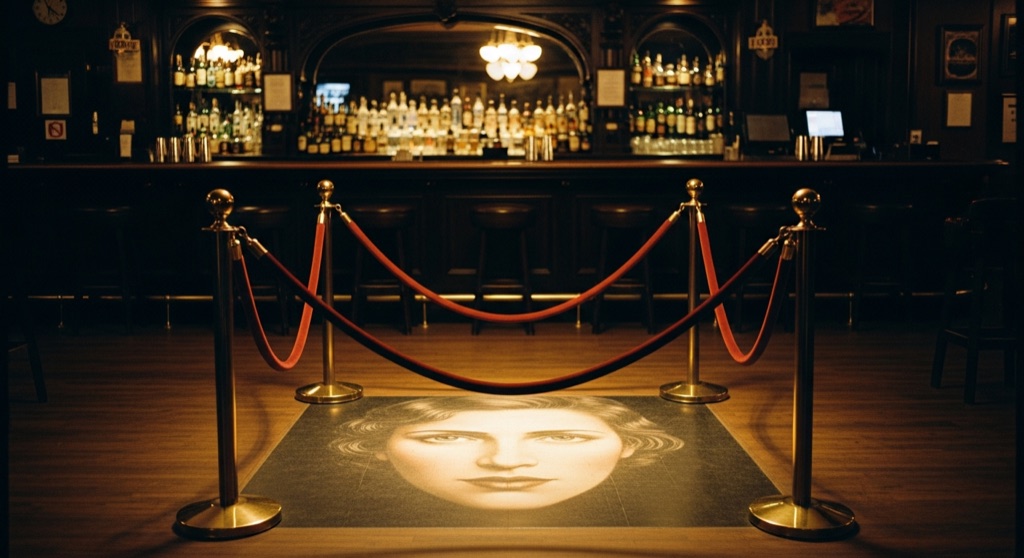
In 1936, Denver artist Herndon Davis — furious after a fight with his project director — snuck into the Teller House saloon after midnight and painted a woman's face on the barroom floor, finishing at 3am; the model was his own wife, though the bar cryptically credited the work to a 19th-century poet for decades. Today the mysterious face is roped off with stanchions inside the historic Face Bar, a genuine oddity of Colorado history and a perennial stop on the Central City trail.
→ Three more hidden bars & speakeasies in Denver — never the same twice
The story
You're looking at what might be Colorado's purest piece of workplace spite art. In 1936, Denver illustrator Herndon Davis was hired by project director Anne Evans and the Central City Opera House Association to paint sketches documenting the old gold-rush town. After getting into a roaring argument with Evans over how his work was being executed, Davis was told he was about to be fired. Instead of quietly packing his brushes, Davis persuaded bellboy Jimmy Libby to sneak him into the Teller House saloon after midnight. While Libby held a candle in the dark, Davis dropped to his knees on the wooden floor and painted his wife, Edna Juanita 'Nita' Davis, in oil directly onto the barroom pine. He finished at 3 a.m. and slipped away into the night.
When management discovered the artful graffiti the next morning, they didn't scrub the floor—they capitalized on it. Rather than admitting a disgruntled painter had vandalized the bar, the owners tied the portrait to an 1887 ballad by Hugh Antoine D'Arcy titled 'The Face Upon the Floor,' about a tragic drunk drawing his lost love Madeline on a saloon floor. For decades, the bar cryptically credited the work to the 19th-century poem, letting tourists believe it was a relic of heartbroken gold-rush lore while Davis himself saw no credit or royalties for his midnight prank.
Today, the portrait remains in the exact spot Davis painted it, sealed under protective coating and cordoned off by stanchions inside the Face Bar. It is a genuine piece of 1930s graffiti that outlived the fight that birthed it, outlived its creator, and accidentally became one of the most famous roadside stops in Colorado mining history.
What it's like
Walk into the Teller House on Eureka Street during the summer opera season and you'll find a functioning bar where the main attraction is on the floorboards under brass stanchions. The atmosphere feels like a stepped-back-in-time Victorian saloon, where you can order a drink at the counter, lean over the rope, and look straight down into Nita Davis's painted eyes before heading up the block for a performance. The key detail to know before driving 45 minutes west of Denver is seasonality: the bar operates publicly during the summer opera festival (roughly late June through August), but during the rest of the year you can only see the face by booking a guided Teller House tour with the Gilpin Historical Society. Park for free in the covered garage near the edge of town and walk the sky-bridge straight into the historic core.
The move: Visit the Face Bar at Teller House during the summer opera season (open daily, roughly noon to 9-10pm), peer down at the haunting painted face preserved in the floor, then order drinks at the same bar and debate the legend before catching a Central City Opera performance just up the street.
📍 Before you go The Face Bar sits inside the historic Teller House on Eureka St, in the old mining town of Central City — about 45 minutes west of Denver via I-70 and the scenic Central City Parkway, with a free covered parking garage and sky-bridge into the walkable historic core. Access splits by season: the bar opens during the summer opera season (roughly late June into August), while the rest of the year you reach the face only on a Gilpin Historical Society Teller House tour — a seasonal schedule, so check ahead. Pair it with a Central City Opera performance just up the street, or wander the surrounding casinos.
- 📍 Central City
- 💸 $$
- ⚡ Up for anything
- 🌗 Indoors
Where: 120 Eureka St, Central City, CO 80427
Hours: Mined 2026-06-07 — confirm current hours before you go.
Pair it with
- Central City Opera House — Located just steps away on Eureka Street, this 1878 stone theater is the reason Herndon Davis was commissioned in Central City in the first place.
- Central City Masonic Cemetery (Woman in Black) — A mile up the hill, this 1860s cemetery holds 373 graves of miners and Freemasons, extending the town's eerie Victorian lore beyond the barroom.
- Knights of Pythias Cemetery — Situated 1.1 miles away in Black Hawk, this secluded fraternal graveyard features iron-fenced plots that make a quiet follow-up to the saloon legend.
- Edgar Experimental Mine — Down the mountain in Idaho Springs, swap historic barroom spite art for an underground tour of the Colorado School of Mines' working research facility.
More weird in Denver
Good to know
Who actually painted the face, and when?
Denver artist Herndon Davis painted it after midnight in 1936, finishing around 3 a.m. after getting into a fight with project director Anne Evans.
Who was the woman in the portrait?
The model was Davis's wife, Edna Juanita 'Nita' Davis, though the bar spent decades attributing the portrait to 'Madeline' from Hugh Antoine D'Arcy's 1887 poem.
How can I see the Face on the Barroom Floor?
During the summer opera season (roughly late June to August), the Face Bar is open daily as a bar. Off-season, the face is accessible via Gilpin Historical Society Teller House tours.
Where do I park when visiting Central City?
There is a free covered parking garage in Central City with a sky-bridge connecting directly to the walkable historic core on Eureka Street.
Plan a visit & invite your people →
Further reading: Atlas Obscura · Roadside America · Yelp · Wikipedia
last checked: 2026-06-07