Entry No. 26 — the Coeur d'Alene file — filed under: outdoor
Cataldo Mission, Old Mission State Park
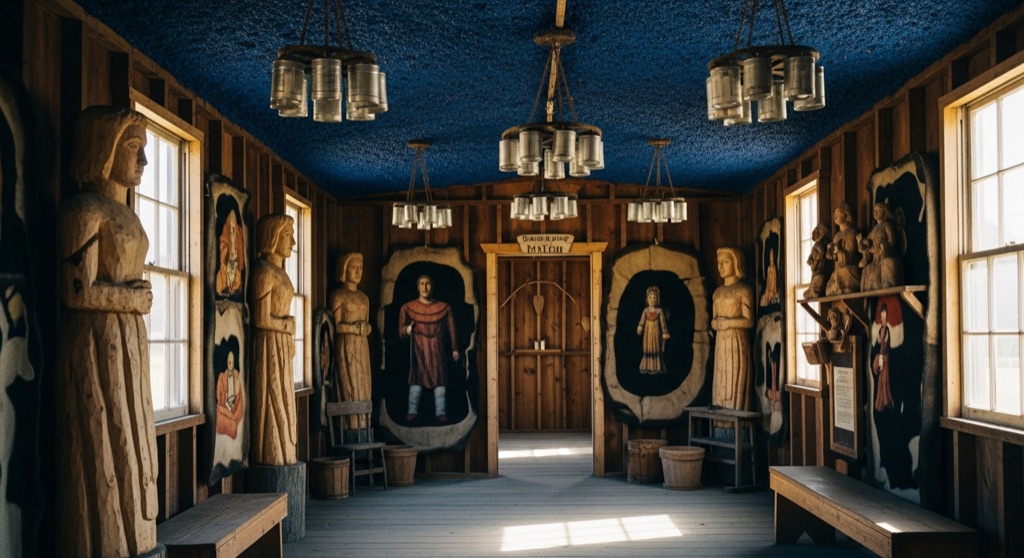
Idaho's oldest standing building, this 1850s mission was raised by Catholic missionaries and Coeur d'Alene tribal members using wooden pegs instead of nails. The improvised interior is the weird part: walls dressed in Hudson's Bay fabric, faux-marble statues hand-carved with a knife, tin cans rigged into mock chandeliers, and a ceiling stained blue with hand-pressed huckleberries. It anchors a state park with interpretive grounds along the river.
→ Three more weird outdoor & roadside oddities in Coeur d'Alene — never the same twice
The story
Look closely at the timber framing before you look at the altar. When Italian Jesuit Antonio Ravalli and members of the Coeur d'Alene Tribe raised the Mission of the Sacred Heart on a bluff above the river between 1850 and 1853, they had no iron nails, no draft animals, and no sawmill. They felled trees with broadaxes, bored timber with hand augers, and locked the frame together using mortise-and-tenon joints held tight with wooden pegs. For the walls, they wove saplings and slathered them with river mud and dried grass—the medieval wattle-and-daub technique—constructing Idaho's oldest standing building out of materials gathered right off the forest floor.
The real weirdness is what happens inside. Lacking imported European church trim, Ravalli and the tribal artisans pulled off a feat of frontier illusion. The blue ceiling overhead isn't painted with imported cobalt; it was stained using juice squeezed by hand from wild local huckleberries. The wall coverings aren't silk, but printed Philadelphia newspapers and wool fabric bought from the Hudson's Bay Company. The chandeliers hanging from the timber rafters were upcycled out of discarded tin tin cans cut and bent to catch candlelight, while the statues of St. Mary and St. John were carved from local wood using a pocket knife and hand-painted with white graining to pass as real marble.
It served as a central crossroads for tribal life, missionary work, and river traffic long before silver miners flooded the valley. Today, the mission sits preserved on state park land down to its hand-hewn floor planks, standing as a quiet monument to raw material ingenuity.
What it's like
Approaching the church on its elevated grassy hill, you get a quick sense of how isolated this river bluff was in the 1850s. Step inside the sanctuary and the light catches the coarse texture of the mud walls and the lingering blue tint on the huckleberry ceiling; if you look close at the wall fabric, you can still trace bits of 1800s newspaper print beneath the dye. While the modern visitor center down the slope holds the official historical exhibits, the chapel itself remains hushed and unheated. Idaho day-use parking fees apply at the gate, and while the state park grounds stay open daily, the interior of the church and parish house keep strict seasonal hours, so check ahead before driving out if you want to walk inside rather than peer through the windows.
The move: Tour the nail-free mission to spot the huckleberry-stained ceiling and tin-can chandeliers, then picnic on the park grounds above the river.
📍 Before you go It is a state park, so an Idaho day-use parking fee applies; the parish house and visitor center keep seasonal hours even though the grounds stay open.
- 📍 Cataldo, Idaho
- 💸 $
- ⚡ Up for anything
- 🌗 Indoors
Where: 31732 S Mission Rd, Cataldo, ID 83810
Hours: Added 2026-06-24 — confirm current hours before you go.
Pair it with
- The Snake Pit (Enaville Resort) — Five miles down the road, follow up the territory's oldest mission with Idaho's oldest operating restaurant—an 1880 boomtown tavern where miners swapped mass for whiskey.
- Crystal Gold Mine — Trade wood-and-mud frontier architecture for an authentic 1880s hard-rock gold mine that sat sealed and forgotten for over a century until its 1991 rediscovery.
- Shoshone County Mining & Smelting Museum (Staff House Museum) — Continue east down the Silver Valley to contrast the mission's raw material ingenuity with a 1906 mine manager's three-story executive mansion.
- Chimney Shaped Like Idaho — Head back west toward Coeur d'Alene to trade 19th-century tribal-Jesuit timber craft for a mid-century brick chimney laid out in the precise silhouette of the state.
More weird in Coeur d'Alene
Good to know
Is the building really constructed without a single nail?
Yes. The original 1850s structure relies entirely on mortise-and-tenon wood joints, wooden pegs, and wattle-and-daub mud walls, built without iron nails or draft animals.
How did they color the blue ceiling inside the mission?
Father Antonio Ravalli and Coeur d'Alene tribal builders squeezed juice from wild local huckleberries and stained the wooden ceiling boards by hand.
What other improvised materials are inside the chapel?
Tin cans were repurposed into hanging chandeliers, Philadelphia newspapers and Hudson's Bay Company fabric served as wall coverings, and wooden statues were hand-carved with a pocket knife to look like carved marble.
Do I need to pay to enter Old Mission State Park?
Yes, an Idaho State Parks day-use motor vehicle entry fee applies to park on the grounds.
Plan a visit & invite your people →
Further reading: Wikipedia · parksandrecreation.idaho.gov · idahoarchitectureproject.org · boisedev.com · history.idaho.gov
last checked: 2026-06-24