Entry No. 22 — the Cleveland file — filed under: outdoor
The Bombed Thinker
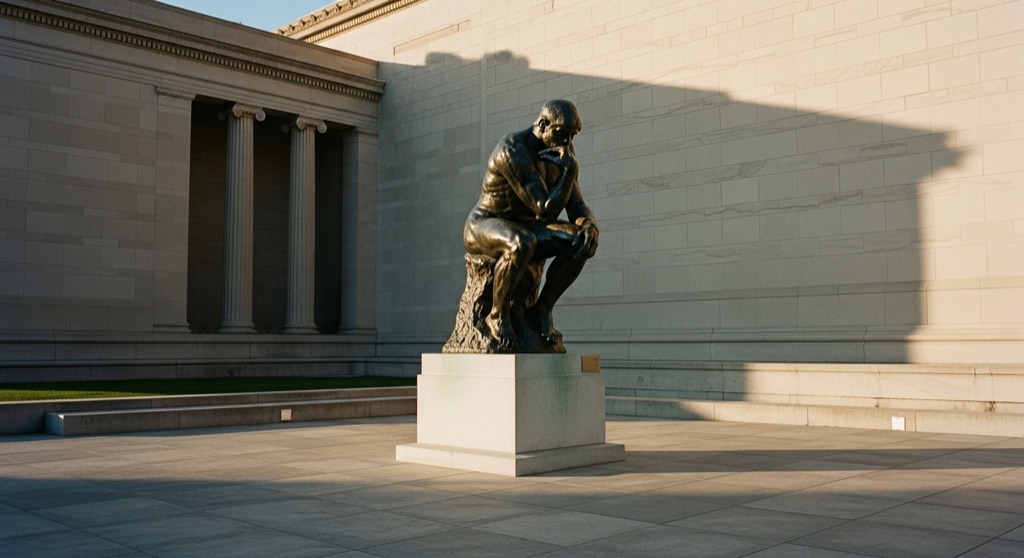
One of the last bronze castings of Rodin's 'The Thinker' made during his lifetime, left permanently damaged after a radical group (believed to be the Weather Underground) bombed its pedestal in March 1970.
→ Three more unusual museums & collections in Cleveland — never the same twice
The story
At roughly 1:00 AM on March 24, 1970, an explosion equal to three sticks of dynamite detonated beneath Auguste Rodin's 'The Thinker' outside the Cleveland Museum of Art. The blast tore off the philosopher's lower legs, peeled the bronze into shredded plumes, and launched metal shrapnel hundreds of feet into Wade Park while blowing out six museum windows. On the pedestal, someone spray-painted 'Off the ruling class.' The FBI and local authorities pointed fingers at a local cell of the Weather Underground protesting the Vietnam War, but no one was ever arrested, and the case sits quietly unsolved.
Cast in 1916 by the Rudier Foundry under Rodin's direct supervision—making it one of the final monumental castings approved before the artist's death—the 2,000-pound statue had greeted visitors on the south plaza since 1917. Confronted with a toppled, mangled figure lying face-down in the dirt, museum officials debated recasting the legs or melting down the bronze entirely. Instead, they made the bold choice to mount the mutilated torso back onto its base completely unrestored.
You didn't hear it from us, but leaving the ruined bronze untouched did something unexpected: it transformed a standard Gilded Age museum acquisition into a permanent, visceral crime scene. Rather than hide the violence, the museum let dynamite co-author the piece, turning a 19th-century French icon into an enduring monument to 1970s American political unrest.
What it's like
Head to the south plaza in front of the museum's historic 1916 white marble facade, looking down toward the Wade Park lagoon. Because the statue sits entirely outdoors, you can walk right up to the base at any hour without paying admission or clearing security. Get close to examine the back legs: the bronze isn't neatly cut, but shredded outward like ripped cardboard, exposing the hollow core of the casting. Visit after dark on a weeknight to inspect the twisted metal under the plaza lights without dodging field trip crowds.
The move: Stand on the south plaza of the Cleveland Museum of Art to examine the shredded, plume-like bronze legs of the statue, which the museum chose not to repair to bear witness to the era's political unrest.
- 📍 University Circle
- 💸 Free
- ⚡ Up for anything
- 🌗 Outdoors
Where: 11150 East Blvd, Cleveland, OH 44106
Hours: Added 2026-07-21 — confirm current hours before you go.
Pair it with
- Dittrick Medical History Center — A two-minute walk across Case Western's campus brings you from damaged external bronze to an indoor cabinet of 19th-century surgical curiosities.
- Judy's Hand Pavilion — Walk less than half a mile down East Boulevard to contrast Rodin's mangled classical realism with a surreal, 21-foot fiberglass hand resting on the grass.
- The Haserot Angel — Drive a mile east into Lake View Cemetery to inspect another famous bronze figure whose face appears to weep black tears from natural oxidation.
- Cleveland Police Museum — Head downtown to pair an unsolved 1970 domestic terror bombing site with the plaster death masks from Cleveland's unsolved 1930s Torso Murders.
More weird in Cleveland
Good to know
Do I need a museum ticket to see The Bombed Thinker?
No ticket is required. The statue sits outside on the south plaza in Wade Park and is accessible to the public 24/7 for free.
Who bombed the statue and were they ever caught?
The March 1970 attack was attributed to the radical anti-war group Weather Underground due to anti-establishment graffiti left at the scene, but no suspects were ever charged.
Why didn't the Cleveland Museum of Art repair the damage?
Museum leadership decided that trying to recast or patch Rodin's original work would ruin its authenticity, choosing instead to preserve what remained and document the era's political unrest.
Where exactly is the statue located on the grounds?
It stands atop the main granite staircase on the south plaza of the Cleveland Museum of Art at 11150 East Blvd, overlooking Wade Park.
Plan a visit & invite your people →
Further reading: Atlas Obscura · clevelandhistorical.org
last checked: 2026-07-21