Entry No. 3 — the Cleveland file — filed under: history
Dittrick Medical History Center
Tucked inside Case Western Reserve University, this museum explores the history of medicine through a vast cabinet of curiosities including 19th-century surgical kits, anatomical models, and the world's most comprehensive collection of historic contraceptive devices.
→ Three at a time, never the same twice — explore weird Cleveland
The story
You don't just stumble into the Dittrick Medical History Center; you take the elevator to the third floor of the 1926 Allen Memorial Medical Library at Euclid and Adelbert, stepping out past quiet university study desks into a quiet archive of human suffering and repair. What started in 1894 as a collection of oddities saved by the Cleveland Medical Library Association was expanded by surgeon Howard Dittrick into a massive historical repository. During World War II, when coastal cities feared enemy bombing raids, the U.S. Surgeon General even quietly stashed thousands of rare medical volumes right inside these limestone walls for safekeeping.
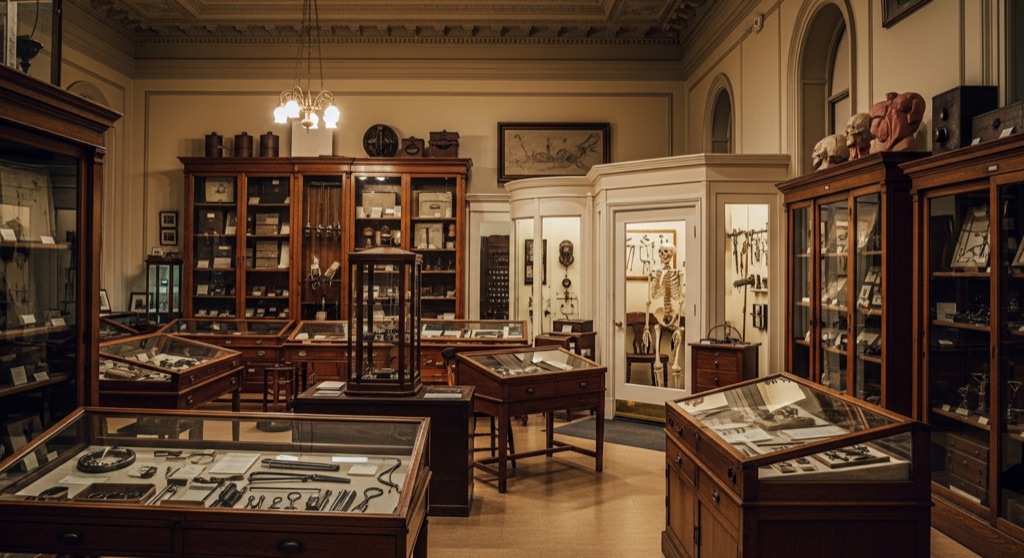
The floor plan reads like a cross between a cabinet of curiosities and a timeline of physical agony. Display cases hold 1861 amputation sets loaded with bone saws, heavy 1890s surgical chairs, early turn-of-the-century x-ray tubes, and doctor Claude Beck's original cardiac defibrillator. If you peer into the detailed reconstruction of an 1875 doctor's office, you'll find an actual human skeleton standing quietly in the corner, surrounded by leather-bound ledgers and blown-glass apothecary jars.
What really separates the Dittrick from standard university collections is the Percy Skuy Collection—widely recognized as the world's most comprehensive archive of historic contraceptive devices. Spanning centuries of human trial and error, the exhibit documents everything from ancient linen and animal-gut sheath precursors to early 20th-century pessaries, intrauterine devices, and primitive birth control packaging.
What it's like
Head up to the third floor and sign in. The galleries are self-guided, eerie, and usually staffed by campus students who will leave you alone to wander past the dimly lit hallway displays. The real trick here isn't dealing with the sight of 19th-century bone chisels—it's timing your visit. The museum operates on tight public hours, usually restricted to Fridays and Saturdays, so check the CWRU calendar before heading up the stairs. Expect to spend 45 to 60 minutes taking in the cases.
The move: Peer into the reconstructed 1875 doctor's office to find the human skeleton tucked in the corner, and marvel at the bizarre, terrifying historical medical instruments.
- 📍 University Circle
- 💸 $$
- ⚡ Up for anything
- 🌗 Indoors
Where: 11000 Euclid Ave, Cleveland, OH 44106
Hours: Added 2026-07-21 — confirm current hours before you go.
Pair it with
- The Bombed Thinker — A three-minute walk across the street puts you in front of Rodin's shrapnel-shattered bronze statue outside the Cleveland Museum of Art, continuing the theme of damaged human forms.
- Judy's Hand Pavilion — Walk 0.3 miles down Euclid Avenue to contrast the medical surgical hands inside the Dittrick with Tony Tasset's surreal, 21-foot fiberglass hand resting on the lawn.
- The Haserot Angel — Drive just over a mile northeast to Lake View Cemetery to trade 19th-century medical tools for Herman Matzen's haunting weeping bronze 'Angel of Death Victorious'.
- Tim Willis' Junkyard Playground — Head 1.3 miles southwest into Fairfax to pivot from antique medical steel to flame-painted kinetic robots built from scrap metal.
More weird in Cleveland

Good to know
Is there an admission fee?
No, admission is completely free for both university students and the general public.
Where inside the building is the museum located?
It sits on the third floor of the Allen Memorial Medical Library at the intersection of Euclid Avenue and Adelbert Road.
Where can I park when visiting?
Visitor parking is available in the attended garage under Severance Music Center (Lot 29 off East Boulevard), or at metered street spots nearby.
How long does a typical visit take?
Because the exhibit spaces are compact and self-guided, most visitors take 45 to 60 minutes to go through the galleries.
Plan a visit & invite your people →
Further reading: artsci.case.edu · Atlas Obscura · Wikipedia · Reddit
last checked: 2026-07-21