Entry No. 46 — the Butte file — filed under: ghost town
Granite Ghost Town State Park
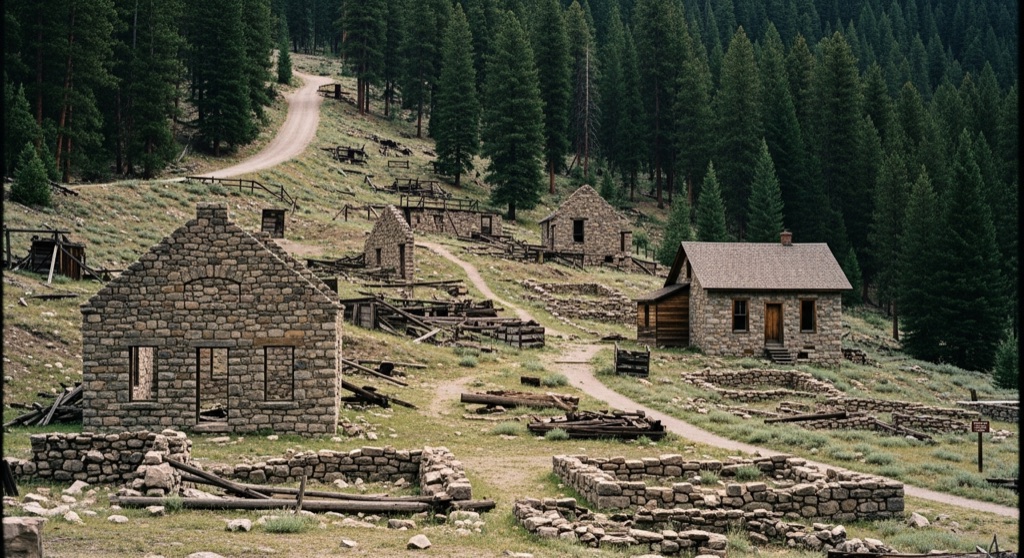
Once known as the 'Silver Queen' of Montana, this remote 1890s boomtown was home to the richest silver mine on Earth before collapsing overnight during the silver panic of 1893. Today, the mountain forest has reclaimed the town, leaving behind the impressive stone ruins of the Miners' Union Hall and the well-preserved superintendent's house. Visitors can hike through the quiet, pine-shaded trails to discover scattered foundations and remnants of this historic mining camp.
→ Three more abandoned & forgotten places in Butte — never the same twice
The story
In 1882, St. Louis investors backing the Granite mine decided the venture was a money pit and cabled a telegram ordering operations to cease immediately. That telegram was delayed. Before the message arrived, miners set off one last blast on the final shift, cracking open what proved to be the richest silver lode on Earth—a vein that ultimately produced $40 million in silver. Almost overnight, a boomtown of 3,000 miners erupted near 7,000 feet in the Flint Creek Range, dubbed the 'Silver Queen' of Montana. The town built 18 saloons, brothels, a school, a newspaper, a soda pop bottling plant, and a roller rink, but notably never built a cemetery: the mountain granite was so rock-hard that residents had to haul every corpse down to Philipsburg for burial.
The silver kingdom collapsed just as fast as it rose. When Congress repealed the Sherman Silver Purchase Act in 1893, silver prices crashed, panic hit the market, and shutdown orders swept through the camp overnight. Within a year, the population plummeted to under 150 people as residents abandoned their homes to the elements. Today, the surrounding pine forest has swallowed most of the original townsite, leaving behind a 0.23-acre state park anchored by two striking remnants: the roofless, three-story stone shell of the Miners' Union Hall and the timber-frame Mine Superintendent's House.
What it's like
Getting to the site is half the ordeal: four miles of narrow, rutted shelf road climbing 1,280 vertical feet out of Philipsburg with zero guardrails and tight single-lane drop-offs. You will need a high-clearance vehicle, dry weather, and steady nerves—a summer downpour turns the track into slick mud, and mountain snow frequently blocks access into late May. Up top, there are no ticket booths, rangers, or entry fees, just high-altitude pine forest, cold mountain air, and massive stone walls standing in silence. Stick strictly to established trails, stay behind the safety fences guarding open mine shafts, and celebrate surviving the drive back down with a cold pint in Philipsburg.
The move: Drive up the steep mountain road together to hike through the quiet pine forest, photographing the towering stone walls of the Miners' Union Hall and enjoying a picnic among the historic ruins.
📍 Before you go The site is a legally accessible Montana State Park with no entry fee. However, the steep, winding dirt road up the mountain requires a high-clearance vehicle and can be impassable in wet or snowy weather, and visitors must stay out of any fenced-off mine shafts.
- 📍 Philipsburg
- 💸 Free
- ⚡ Low-key
- 🌗 Outdoors
Where: Granite State Park, Philipsburg, MT 59858, USA
Hours: Added 2026-07-20 — confirm current access before you go.
Pair it with
- Garnet Ghost Town — Pair Granite's high-mountain stone ruins with Garnet's intact wooden cabins and saloons for a complete contrast in 19th-century Montana mining camps.
- Anaconda Smelter Stack (The Big Stack) — Trace where the region's mountain ore was ultimately processed by visiting this colossal 585-foot brick masonry stack east of Anaconda.
- Fairmont Hot Springs Resort — Soak your driving muscles in hot mineral pools after navigating Granite's steep, rutted shelf road and hiking through the ruins.
More weird in Butte
Good to know
Is there an entrance fee or ticket needed to visit?
No, Granite Ghost Town State Park is free to access and open during daylight hours only, officially operating from Memorial Day through September 30.
What type of vehicle is required for the mountain road?
A high-clearance vehicle is recommended due to steep, narrow, and rutted dirt shelf sections. The road is impassable for RVs, buses, and low-clearance passenger cars.
Can you go inside the old mine shafts or buildings?
No, open mine shafts are strictly fenced off for safety, and visitors must stay outside structural hazards and remain on designated park trails.
What main ruins are still visible at the park?
The primary surviving structures are the three-story stone facade of the Miners' Union Hall and the preserved timber Mine Superintendent's House, along with scattered stone foundations in the trees.
Plan a visit & invite your people →
Further reading: fwp.mt.gov · visitmt.com · Reddit
last checked: 2026-07-20