Entry No. 49 — the Butte file — filed under: ruins
Bell-Diamond Mine
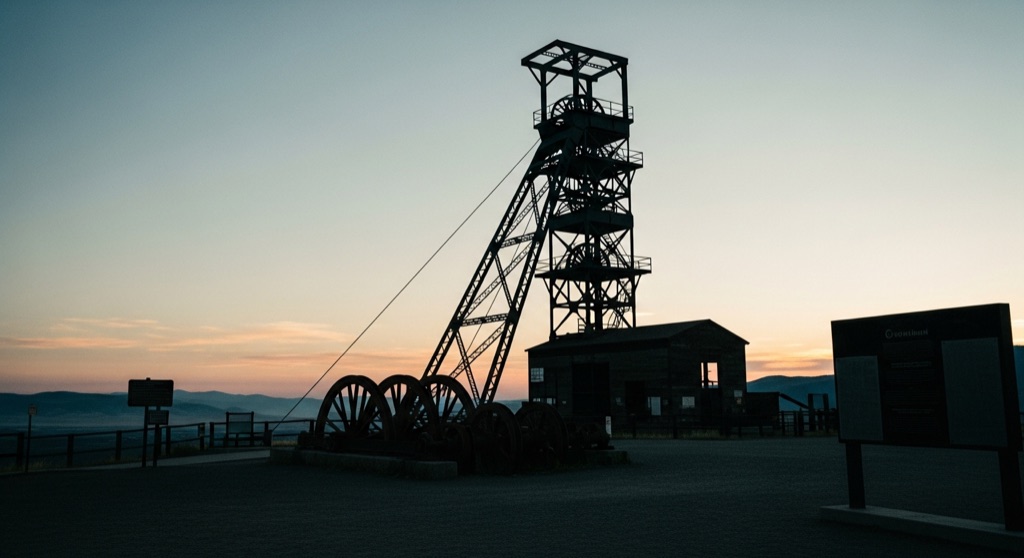
Erected in 1898, the steel headframe of the Diamond Mine is the oldest still standing on Butte Hill, once a prominent battleground in the copper wars between industrial titans William Clark and Marcus Daly. The underground workings reached a depth of over 3,600 feet before operations ceased, and the site was later devastated by a surface explosion in 1962. Today, the towering 100-foot-tall 'gallows frame' and scattered sheave wheels remain as a stark monument overlooking the Berkeley Pit.
→ Three more abandoned & forgotten places in Butte — never the same twice
The story
When a prospector hammered his claim stakes into the hillside above Butte in the late 19th century, he arranged them in the shape of a playing-card diamond. That boundary line grew into a shaft plunging over 3,500 feet into the supergene enrichment zone underground, becoming a coveted pawn in the ruthless copper wars fought between rival tycoons William Clark and Marcus Daly. In 1898, workers erected a towering 100-foot steel headframe over the shaft—a structure that still stands today as the oldest surviving headframe on Butte Hill.
Underground mining ceased around 1928, but the site refused to settle quietly into history. In 1962, a surface explosion tore through the mine yard, destroying surrounding structures and throwing massive steel sheave wheels into the dirt. Today, the skeletal 'gallows frame' sits silent and exposed above the lip of the massive Berkeley Pit, surrounded by the remnants of that mid-century blast.
What it's like
Do not plan on hopping any fences—the mine yard sits on private, restricted land plagued by unreclaimed mine waste and unstable footing. Instead, scope out the site from public ground. Drive up early while the air is cold or aim for sunset, taking in the silhouette from the nearby Mountain Con trail, Montana Street, or the Granite Mountain Memorial overlook.
The move: Take a scenic walk along the nearby Mountain Con trail or drive up to the Granite Mountain Memorial to photograph the historic headframe silhouetted against the Montana sky at sunset.
📍 Before you go The mine yard and headframe are located on fenced private property with no public access due to safety hazards and unreclaimed mine waste, but the structure is highly visible from nearby public roads and walking trails.
- 📍 Butte
- 💸 Free
- ⚡ Low-key
- 🌗 Outdoors
Where: Diamond Mine, Butte, MT 59701, USA
Hours: Added 2026-07-20 — confirm current access before you go.
Pair it with
- Granite Mountain / Speculator Mine Memorial — Drive a tenth of a mile over to the memorial overlook for one of the clearest vantage points looking down at the Bell-Diamond headframe.
- Mountain Con Mine — Walk the public trail around the nearby remediated Mountain Con yard to see how another massive headframe site was reclaimed while keeping line-of-sight to the Bell-Diamond frame.
- Helsinki Bar (Helsinki Yacht Club) — Follow up a cold skyline viewing of the empty gallows frame with a drink inside this historic 1911 sauna-turned-bar from Butte's old Finn Town.
- Butte's Lit Headframes (Gallows Frames) — Include the Bell-Diamond on your night route while tracing the sprawling grid of steel headframes that define the Butte Hill skyline.
More weird in Butte
Good to know
Can you go up to the Bell-Diamond headframe?
No. The headframe and surrounding mine yard sit on fenced private property that is strictly off-limits due to unreclaimed toxic waste and safety hazards.
Where can I get a good view of the headframe?
You can easily view and photograph the structure from nearby public access points, including the Mountain Con trail, Montana Street, or the Granite Mountain Memorial.
How deep were the underground workings?
The shaft plunged to a depth of over 3,500 feet before active mining operations wrapped up in 1928.
Why is it called the Diamond Mine?
The original prospector named the claim after the diamond configuration formed by his initial claim stakes.
Plan a visit & invite your people →
Further reading: storyofbutte.org · 955kmbr.com · commons.wikimedia.org · buttedailyphoto.com
last checked: 2026-07-20