Entry No. 47 — the Butte file — filed under: ruins
Canyon Creek Charcoal Kilns
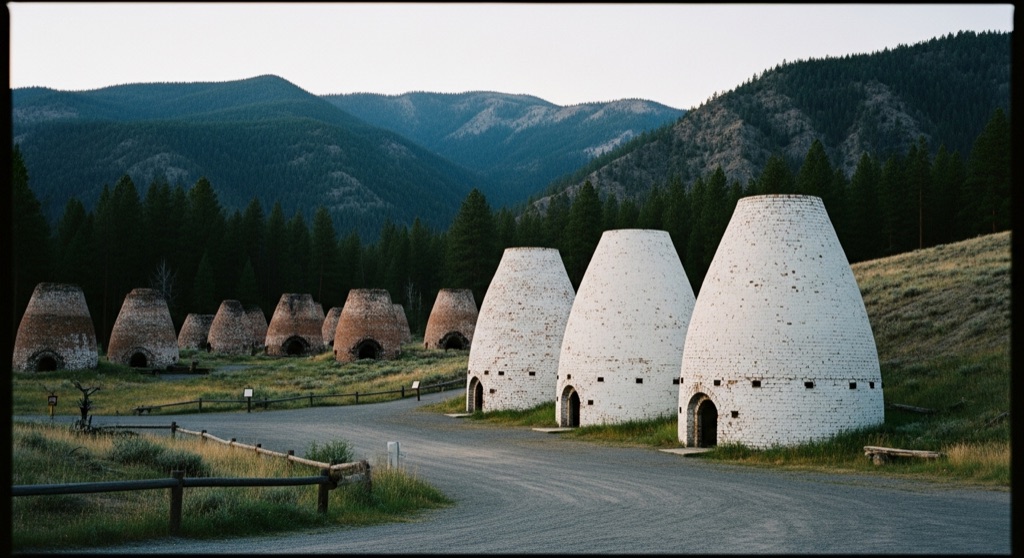
Built in the mid-1880s, these 23 beehive-shaped brick kilns once produced charcoal to fuel the silver smelter in nearby Glendale. Today, the site is managed by the Beaverhead-Deerlodge National Forest, featuring three restored, white-washed kilns alongside twenty others in various states of ruin being reclaimed by nature. Visitors can explore the structures and read interpretive signs detailing the area's massive 19th-century timber-to-charcoal operation.
→ Three more abandoned & forgotten places in Butte — never the same twice
The story
In the mid-1880s, the Hecla Consolidated Mining Company didn't just dig silver out of the Pioneer Mountains—it stripped the surrounding hillsides bare [1.1.6]. To run the 40-ton smelter down in nearby Glendale, workers needed a massive, reliable fuel source. Coal wasn't available locally, so crews clear-cut thousands of acres of timber, hauled the wood into 23 beehive-shaped brick kilns tucked up Canyon Creek, and smoldered it down into pure charcoal.
When Congress repealed the Sherman Silver Purchase Act in 1893, silver prices cratered, and by 1900 the Glendale smelter was dismantled. The kilns were left behind on what is now Beaverhead-Deerlodge National Forest land. Standing in the gulch today, the brick domes look less like 19th-century industrial equipment and more like the forgotten outer complex of an ancient monastic compound.
The Forest Service has stabilized and whitewashed three of the 23 kilns, leaving them intact against the timber line. The other 20 are the real attraction: un-restored brick shells collapsing under decades of mountain snow, arches caving in, and wild lodgepole pines growing straight through the hearth floors. Walk past the official interpretive signs and you'll find the ruins quietly turning back into soil.
What it's like
Drive roughly 11 miles west from Melrose—first along Trapper Creek Road past where the asphalt ends at Salmonfly Fishing Access, then up the dirt two-track of Canyon Creek Road. You arrive in a quiet forested draw where giant brick beehives loom out of the brush. There are no ticket booths or ranger stations, and rarely more than a car or two parked along the loop. You can step directly inside the three restored whitewashed domes to hear your voice echo off the brick or walk into the timber line to inspect the crumbling un-restored structures. Watch your footing around loose mortar, bring water, and download offline maps before turning off I-15—cell service drops out fast in these gulches.
The move: Take a scenic drive from Melrose into the Pioneer Mountains, then walk the interpretive trail to photograph the massive brick beehive kilns and read the educational signs together.
📍 Before you go The site is located on public land within the Beaverhead-Deerlodge National Forest, featuring maintained walking paths, interpretive signs, and public access to the restored kilns.
- 📍 Divide
- 💸 Free
- ⚡ Low-key
- 🌗 Outdoors
Where: Divide, MT 59727, USA
Hours: Added 2026-07-20 — confirm current access before you go.
Pair it with
- Crystal Park — Five miles further into the Pioneer Mountains, follow up industrial timber ruins by digging quartz crystals out of decomposed granite at 7,800 feet.
- Berlin Mine — Located eight miles away in the Melrose mining area, this site offers another look at 19th-century gold, silver, and lead extraction in the district.
- Fairmont Hot Springs Resort — After driving dirt forest roads and exploring brick ruins, head 25 miles north to soak in 100-degree natural mineral waters.
- Old Highland Mine Millsite — Combine these beehive kilns with another set of abandoned 1860s mining ruins tucked in the mountains south of Butte.
More weird in Butte
Good to know
How do I reach the Canyon Creek Charcoal Kilns?
Take Exit 93 off I-15 near Melrose onto Trapper Creek Road [1.1.6]. Follow it 5.5 miles past the pavement's end at Salmonfly Fishing Access, then turn right onto Canyon Creek Road and drive 5.6 miles to the site.
Do I need a four-wheel-drive vehicle?
High clearance or 4WD is strongly recommended, as Canyon Creek Road is an unpaved Forest Service dirt road that can get heavily rutted or muddy.
How many kilns are still at the site?
There are 23 brick kilns total. Three have been fully restored and whitewashed by the Forest Service, while the remaining 20 exist in various states of decay.
Is there an entrance fee or set operating hours?
Access is free and the site is located on public National Forest land open year-round, though snow can close the dirt access road in winter.
Plan a visit & invite your people →
Further reading: southwestmt.com · fs.usda.gov
last checked: 2026-07-20