Entry No. 29 — the Boulder file — filed under: Japanese-American history
Tower of Compassion (Kanemoto Peace Tower)
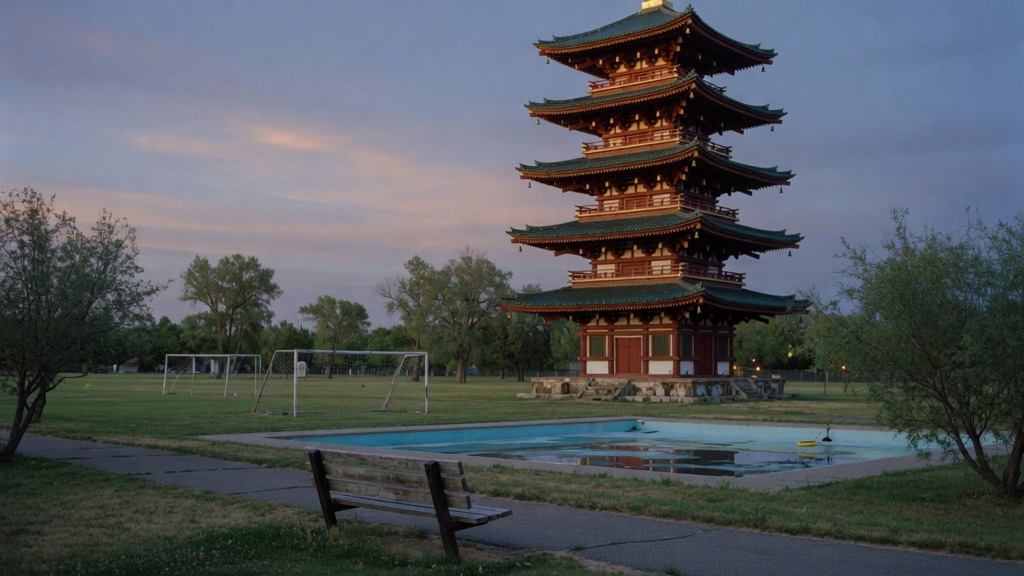
In a quiet Longmont neighborhood park, a five-story traditional Japanese pagoda rises above soccer fields and a splash pool — completely unexpected and entirely genuine. The Kanemoto brothers, Jimmie and George, commissioned it in 1972 as a gift to Longmont, expressing gratitude for a community that refused to turn against their family during WWII. Their father Goroku had emigrated from Hiroshima in 1908 and settled here in 1919; when Japanese internment swept the West, Colorado's Governor Ralph Carr was the only Western governor to resist it, and Longmont held firm. Each of the pagoda's five levels is inscribed with a virtue: Love, Empathy, Understanding, Gratitude, and Selfless Giving. Believed to be one of the first traditional Japanese pagodas built east of California, it was added to the National Register of Historic Places in 2026.
→ Three at a time, never the same twice — explore weird Boulder
The story
You don't expect a five-story Japanese pagoda made of aluminum, steel, and cedar to rise out of a quiet suburban lawn in Longmont, situated right next to elementary school sports fields and a kids' splash pad. But there it stands in Kanemoto Park. The story behind it starts in 1908, when Goroku Kanemoto emigrated from Hiroshima, worked railroad crews, and eventually settled in Longmont in 1919 to lease farm land for sugar beets and vegetables. When World War II broke out and Japanese internment swept across the American West, the federal government reclassified his son Jimmie as an enemy alien—forcing him to surrender his camera, guns, and insurance policy—while over 10,000 Japanese Americans were forcibly incarcerated in camps like Amache in southeastern Colorado.
While anti-Japanese sentiment flared across the country, Colorado Governor Ralph Carr stood alone among Western governors in refusing to support internment, and the people of Longmont held firm in supporting their Japanese neighbors. Decades later, Jimmie and his brother George—who had grown the family business from truck farming at their Freshway Market to building local housing developments—decided to express their gratitude. In 1972, they commissioned this pagoda as a gift to the city. Completed in 1973, it is believed to be one of the first traditional Japanese pagodas constructed east of California.
Look closely at the five tiered levels. Each story represents a specific virtue the family wanted to anchor in the community: Love, Empathy, Understanding, Gratitude, and Selfless Giving. Longmont designated the tower a local landmark, and it was officially added to the National Register of Historic Places in 2026. After surviving the severe 2013 Front Range floods that devastated the creek corridor, the structure was fully restored—a quiet, permanent testament to community decency standing right in the middle of a neighborhood park.
What it's like
Pull into the free lot off South Pratt Parkway near dusk when soccer practice wraps up and the park empties out. You can't climb inside the tower, but you can walk right up to its base, read the bronze plaques, and look up through the tiered roofs as the setting sun hits the cedar and metal trim. The atmosphere is strangely peaceful for a municipal park—you'll hear birds along Left Hand Creek and the occasional train whistle in the distance. For the most scenic arrival, skip the car altogether and ride in via the Left Hand Greenway trail.
The move: Walk the Left Hand Greenway into Kanemoto Park at dusk, when the pagoda catches the last light and the park empties out. Read the plaques on each level, then sit on a bench and talk about the history — it's a surprisingly moving and intimate spot.
📍 Before you go The park is open from one hour before sunrise to one hour after sunset, year-round. No admission, no reservations needed. Free parking in the lot off S. Pratt Parkway. The Left Hand Greenway runs along the southern edge and connects to the St. Vrain Greenway — arriving by bike is easy. Restrooms on site. The activity pool nearby is seasonal (summer only). The park flooded badly in 2013 and was fully restored.
- 📍 Longmont, CO
- 💸 $$
- ⚡ Up for anything
- 🌗 Indoors
Where: 1151 S. Pratt Parkway, Longmont, CO 80501 (Kanemoto Neighborhood Park)
Hours: Added 2026-06-11 — confirm current hours before you go.
Pair it with
- Dougherty Museum — Pair the Kanemoto family's agricultural history in Longmont with this nearby museum housing vintage farm equipment and antique automobiles collected by a local farmer.
- Quarters Bar + Arcade — Trade the quiet, contemplative air of Kanemoto Park for self-serve draft taps and retro arcade games in downtown Longmont.
- Violet Press & Paper — Follow up a monument dedicated to handcrafted architectural detail with a visit to a working print shop running vintage letterpress equipment on Main Street.
- Winner's Circle Colorado — Contrast a thoughtful walk around the pagoda with a round of digitally-scored duckpin bowling or hatchet-throwing just over a mile down the road.
More weird in Boulder
Good to know
Can you go inside or climb up the pagoda?
No, the tower is a sealed outdoor structure meant for viewing from the ground. You can walk right up to its base to read the historical plaques and examine the architecture.
Does it cost anything to visit, or do I need a reservation?
It is completely free and located inside a public municipal park. No tickets, fees, or reservations are required.
How do I get there by bike or on foot?
The Left Hand Greenway runs along the southern edge of Kanemoto Park and connects directly to the St. Vrain Greenway trail system, making it easy to reach by bike.
What do the five levels of the tower represent?
Each tier represents a specific virtue of compassion: Love, Empathy, Understanding, Gratitude, and Selfless Giving.
Plan a visit & invite your people →
Further reading: longmontcolorado.gov · longmontleader.com · boulderweekly.com · Reddit
last checked: 2026-06-11