Entry No. 41 — the Boston file — filed under: cabinet of curiosities
Collection of Historical Scientific Instruments (Putnam Gallery)
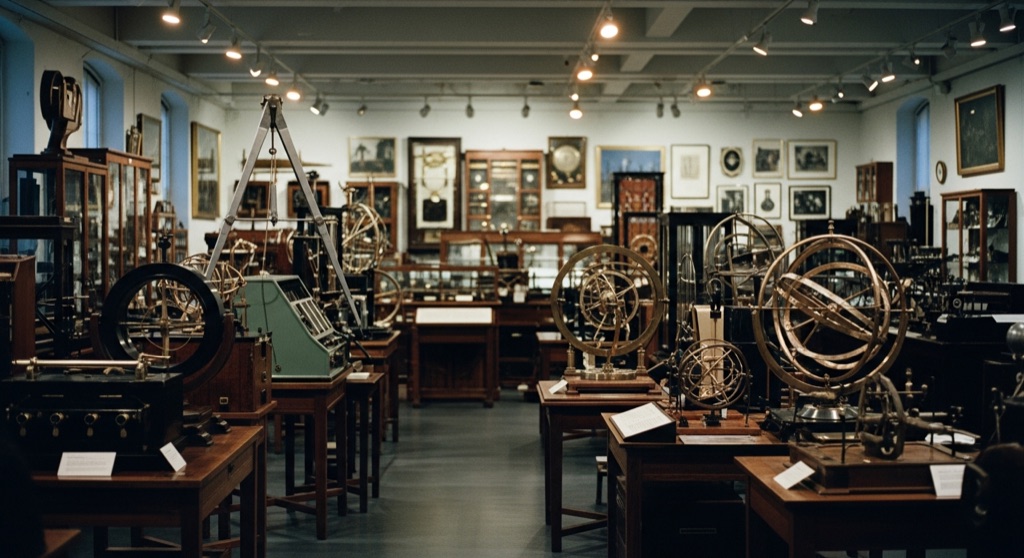
Twenty thousand objects deep — one of the three largest university collections of its kind on earth — the free Putnam Gallery mixes Galileo's own geometric compass with 19th-century electrotherapy machines, orreries, and early X-ray apparatus, a genuine cabinet of scientific curiosities assembled since 1948.
→ Three at a time, never the same twice — explore weird Boston
The story
Tucked inside the concrete maze of the Harvard Science Center at 1 Oxford Street lies a stash of roughly 20,000 scientific artifacts gathered since 1948—one of the three largest university collections of its kind anywhere on Earth. You didn't hear it from us, but while tourists queue up in Harvard Yard to rub the bronze toe of John Harvard, the real prize is this free, low-key cabinet of curiosities hiding inside the Putnam Gallery.
The instruments on display range from high intellectual history to outright eerie medical oddities. You can stand inches from Galileo’s actual brass geometric and military compass, then pivot to face 19th-century electrotherapy machines built to shock human nervous systems back into alignment. Nearby sits an 1787 Grand Orrery—a mechanical model of the solar system built from clockwork gears—alongside early X-ray apparatus and a historic "thunder house," a tabletop demonstration device built to show how lightning rods work by selectively blowing apart tiny wooden roofs.
What it's like
Head into the Harvard Science Center lobby and look for the Putnam Gallery entrance. It is typically quiet, climate-controlled, and completely free of charge, running Sunday through Friday. The atmosphere feels less like a polished high-traffic museum and more like a private vault of high-intellect relics. Give yourself about 45 to 60 minutes to study the brass gearwork and glass tubes before drifting over to Harvard Square to unpack what you just saw.
The move: Wander the free Sunday-through-Friday gallery together picking out the strangest instrument on display, then cross the street to argue about whether it's a torture device or a teaching tool.
- 📍 Harvard Yard, Cambridge
- 💸 $$
- ⚡ Up for anything
- 🌗 Indoors
Where: Harvard Science Center, 1 Oxford St, Cambridge, MA 02138
Hours: Added 2026-07-20 — confirm current hours before you go.
Pair it with
- The Ether Dome — Follow up Harvard's brass gearwork and voltage machines with a visit to the 1821 surgical amphitheater where public ether anesthesia was first demonstrated.
- Warren Anatomical Museum — Extend your survey of odd academic history by viewing Harvard's collection of 15,000 anatomical and medical specimens over in Longwood.
- Seven Stars — Take a short walk down Massachusetts Avenue to move from hard physical science to Central Square's longstanding esoteric bookstore.
More weird in Boston



Good to know
Is the Putnam Gallery free to visit?
Yes, admission to the gallery inside the Harvard Science Center is entirely free, open Sunday through Friday.
What are the key objects on view?
Highlights include Galileo's geometric compass, a c. 1787 Grand Orrery, a historic thunder house lightning rod demonstrator, early X-ray apparatus, and 19th-century electrotherapy devices.
How big is the overall collection?
The broader Harvard Collection of Historical Scientific Instruments contains approximately 20,000 objects, though only a curated selection is on view in the Putnam Gallery at any given time.
Plan a visit & invite your people →
Further reading: Wikipedia · hmsc.harvard.edu · Facebook · Instagram
last checked: 2026-07-20