Entry No. 17 — the Boise file — filed under: offbeat-museum
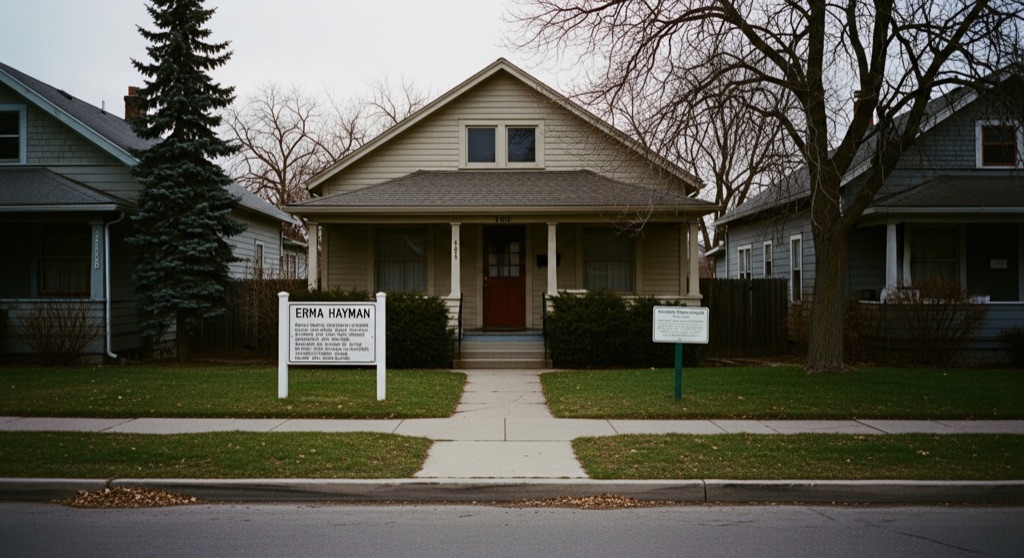
Erma Hayman House
A modest preserved home turned tiny historic-house museum honoring Erma Hayman, who lived here for decades, and the once-diverse, redlined River Street neighborhood that was one of the few places Boise's Black, Basque, and immigrant residents could buy property. The interpretation is intimate and place-specific, centered on a single house and the woman who refused to leave it. It is an easy-to-miss, hyper-local counterpoint to Boise's bigger institutions.
→ Three more oddity shops & curiosities in Boise — never the same twice
The story
While downtown Boise expanded and paved over its past, the corner of Ash and River Streets held out. This was the heart of the River Street neighborhood—a district systematically redlined in the 20th century, rendering it one of the few places where Black, Basque, and immigrant residents were allowed to purchase land. Erma Hayman lived in this modest house for decades, anchoring her family and community while municipal planners rezoned, cleared, and redeveloped almost every surrounding lot. She simply refused to be moved.
Today, the site stands as a hyper-local counterweight to Idaho's mainstream historical monuments. Run by the city's Department of Arts & History, the house isn't styled like a sterile museum or an opulent mansion; it's an intimate, small-scale preservation of one woman's refuge, featuring rotating art and historical exhibits inside her sunroom and residential rooms. You won't find grandiose state plaques here—just the concrete story of who got erased and who managed to hold their ground.
What it's like
Look for a quiet, residential-scale home sitting at the intersection of Ash and River, looking entirely unbothered by the modern construction surrounding it. Inside, the space is small, quiet, and deeply personal—you can easily cover the interior and current exhibition in 20 to 30 minutes. The biggest hurdle is timing: public access is strictly limited to a four-hour window on Tuesdays and Thursdays (11 a.m. to 3 p.m.), so showing up unannounced on any other day means taking in the story entirely from the sidewalk.
The move: Tour the little house, then sit and talk about whose stories your own neighborhood has kept or erased.
📍 Before you go Small house museum with limited open days/hours; verify the current schedule before visiting.
- 📍 Boise (River Street neighborhood)
- 💸 $
- ⚡ Up for anything
- 🌗 Indoors
Where: Corner of Ash & River St, Boise, ID 83702
Hours: Added 2026-06-24 — confirm current hours before you go.
⚠ Seasonal or scheduled — always check before you go.
Pair it with
- Basque Museum & Cultural Center (Cyrus Jacobs-Uberuaga House) — Head half a mile east to explore the Basque Block and see how another group that once lived in River Street preserved its community footprint.
- Neon Grove — Walk three blocks north into the Linen District to view a outdoor strip of rescued and illuminated vintage commercial signs.
- Deja-Moo, the Two-Headed Calf at the Idaho State Museum — Head east toward Julia Davis Park to pivot from grassroots neighborhood preservation to the state museum's official exhibits.
More weird in Boise

Good to know
Is there an admission fee?
No, visiting the Erma Hayman House is entirely free.
When is the house open to the public?
Regular public hours are Tuesdays and Thursdays from 11 a.m. to 3 p.m. Always confirm the schedule on their website before heading out, as hours are limited.
Why is the River Street neighborhood significant?
It was historically one of the only redlined areas in Boise where Black, Basque, and non-white working-class residents were permitted to buy property, making it a crucial center for the city's diverse working-class history.
How long does a visit take?
Because it is a single preserved residence, a detailed walkthrough usually takes between 20 and 30 minutes.
Plan a visit & invite your people →
Further reading: Official site · boisemuseums.org · boisestatepublicradio.org · boisedev.com · aaslh.org
last checked: 2026-06-24