Entry No. 31 — the Boise file — filed under: outdoor-weird
Bruneau Dunes State Park
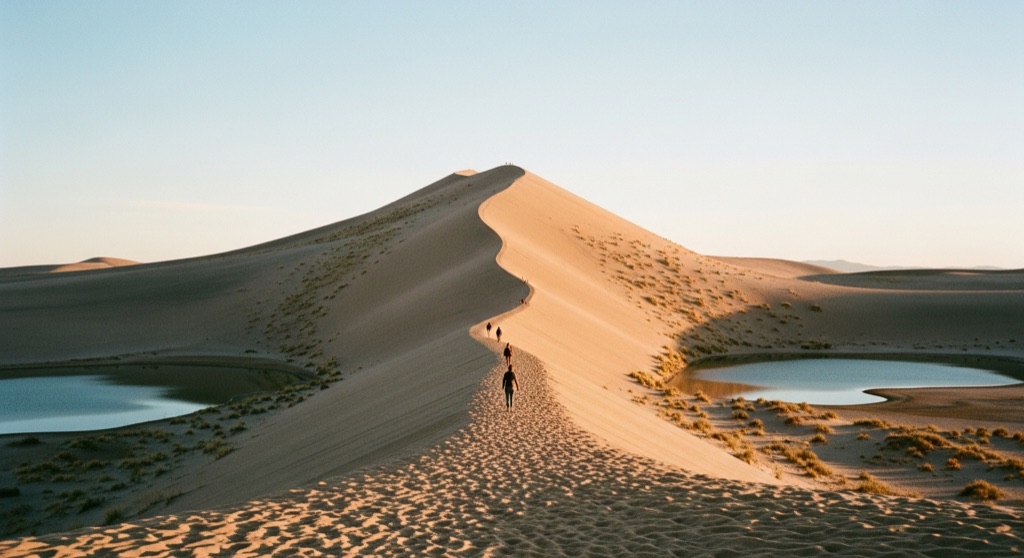
This park holds the tallest single-structured sand dune in North America, a 470-foot mountain of sand rising straight out of the high desert with small lakes pooled at its base. The sand sits in a natural semicircular trap where prevailing winds keep it from drifting away, so the dune just stays put, century after century. After dark the park flips into one of Idaho's best stargazing sites, with a public observatory housing a 25-inch telescope and a Planewave CDK700.
→ Three more after-dark & night-sky spots in Boise — never the same twice
The story
Most sand dunes are nomadic wanderers, creeping across desert basins until they run out of wind. Bruneau doesn't move. Trapped inside a basalt-rimmed depression roughly 64 miles south of Boise, this 470-foot mountain of quartz and feldspar sand has sat in the exact same spot for thousands of years. The initial sand deposits were left behind after ancient floods scoured the region, and prevailing winds now blow from the southeast nearly 30 percent of the time and from the northwest just as often. Those opposing air currents lock the sand into a perpetual stalemate, building North America's tallest single-structured dune right in the middle of the high desert.
Directly beneath the dry 470-foot slip face lie small lakes fed by underground water tables—a strange wetland oasis surrounded by sagebrush and shifting slopes. When night falls, the park transforms into an International Dark Sky Park. Because light pollution from Boise is blocked by distance and terrain, the stars cut sharply against the blackness. The park's on-site public observatory houses a 25-inch Newtonian reflector alongside a Planewave CDK700 telescope to pull planetary rings and distant star clusters into clear view.
If you step onto the sand after dark, bring a low-wavelength ultraviolet flashlight. The high desert floor surrounding the dunes is home to native scorpions that fluoresce a bright neon blue-green under UV light. Between the stationary sand mountain, the sub-surface lakes, and glowing arachnids, Bruneau operates under geological and ecological physics unlike anywhere else in the Snake River Plain.
What it's like
Midday heat turns the sand into a bare-foot furnace by noon, so time your dune climb for early morning or golden hour. Climbing the 470-foot peak is serious physical work—for every two steps up the steep slip face, you slide one step backward in the loose quartz. Sudden wind gusts off the desert floor will pull unanchored gear right out of your campsite, so stake everything down tight. If you plan to stay for weekend observatory stargazing, pack a headlamp and warm layers, as desert temperatures drop rapidly once the sun dips below the horizon.
The move: Climb the giant dune barefoot at golden hour, then stay for a Friday or Saturday night telescope viewing at the observatory.
📍 Before you go $7 vehicle entrance fee; observatory runs weekends mid-March through mid-October, check schedule before driving out. About 64 miles south of Boise.
- 📍 Bruneau
- 💸 Free
- ⚡ Up for anything
- 🌗 Outdoors
Where: 27608 Bruneau Sand Dunes Rd, Bruneau, ID 83604
Hours: Added 2026-06-24 — confirm current hours before you go.
⚠ Seasonal or scheduled — always check before you go.
Pair it with
- Bruneau Dunes State Park Observatory — Located directly inside the park, this facility lets you look through a 25-inch telescope after dark.
- Lawson's Emu-Z-Um (Lawson's Legacy Museum) — Drive 20 miles west to Grand View to inspect a private, sprawling collection of over 50 rooms filled with Old West oddities.
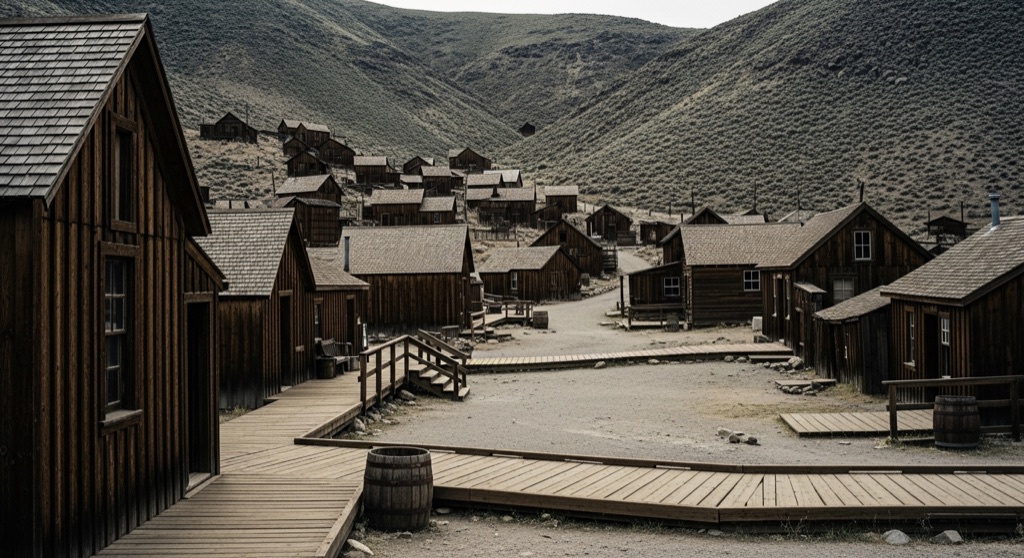
- Silver City — Head into the nearby Owyhee Mountains to explore an un-themed 1800s mining ghost town with dozens of original standing wood structures.
- Big Idaho Potato Hotel — Stop by this retired six-ton steel-and-plaster giant potato on your way back toward Boise.
More weird in Boise
Good to know
How much does it cost to enter Bruneau Dunes State Park?
There is a $7 vehicle entrance fee to enter the state park.
How tall is the main dune at Bruneau Dunes State Park?
The main dune rises approximately 470 feet above the desert floor, making it the tallest single-structured sand dune in North America.
When is the Bruneau Dunes observatory open?
Public observatory viewings run on Friday and Saturday nights from mid-March through mid-October. Always verify current operating hours before driving out.
Why don't the sand dunes drift away over time?
The dunes sit in a natural basin where opposing winds from the southeast and northwest blow sand back and forth, trapping it in the center century after century.
Plan a visit & invite your people →
Further reading: parksandrecreation.idaho.gov · darksky.org · Wikipedia · Reddit
last checked: 2026-06-24