Entry No. 54 — the Boise file — filed under: after-dark
Bruneau Dunes State Park Observatory
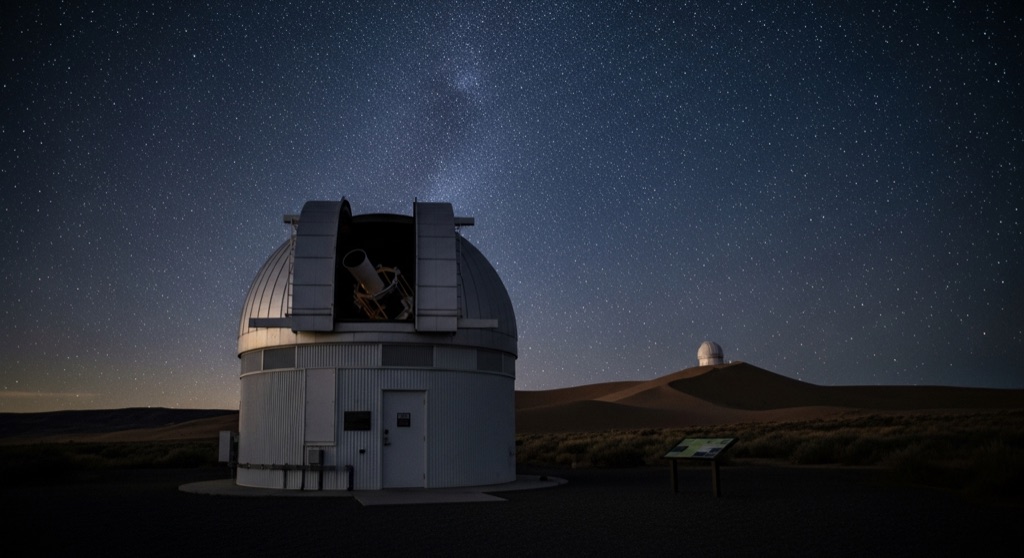
Sixty miles southeast of Boise, this state park sits under skies so dark it earned International Dark Sky Park status, with a domed observatory housing a 25-inch Obsession reflector and a newer 28-inch Planewave CDK700 research telescope. Volunteer astronomers and a park astronomy ranger run public programs on Friday and Saturday nights from spring through mid-fall, starting with solar viewing and a presentation at dusk before turning the big scopes on planets, nebulae, and galaxies after dark. The park also has North America's tallest single-structure sand dune, so you can hike a 470-foot dune by day and stare into the Milky Way the same night.
→ Three more after-dark & night-sky spots in Boise — never the same twice
The story
Drive sixty miles southeast of Boise into Owyhee County, and the desert horizon breaks into a 470-foot mountain of sand trapped inside a ancient geologic basin. For decades, night-sky obsessives made the trek for Class 2 Bortle darkness—skies so devoid of light pollution that the International Dark-Sky Association officially recognized the park. In 1998, the state and the Boise Astronomical Society built a modest public observatory here, anchoring it around a 25-inch Obsession Dobsonian reflector scope that required visitors to climb a stepladder in the dark just to peer into deep space.
In June 2023, the park quietly unveiled a $2.7 million upgrade right beside the old setup. The center piece inside the new climate-controlled Ash Dome is a PlaneWave CDK700 research-grade telescope boasting a 27.56-inch aperture (often cited as 28 inches). Unlike the old ladder-climb scope, this robotic direct-drive system includes video astronomy output for live-stacking composite images onto screens and features an eyepiece position low enough for wheelchair users. The park didn't throw out the original 25-inch Obsession either—volunteer astronomers and park rangers still wheel out the old glass alongside solar scopes during public sessions.
What it's like
Plan your trip for a Friday or Saturday evening between mid-March and mid-October, and arrive before dusk while the desert heat starts to break. Programs typically open with solar viewing through specialized hydrogen-alpha filters before turning to dusk presentations and deep-sky targeting. The atmosphere feels equal parts grassroots science project and night-desert tailgate: families, volunteer stargazers with red-lens flashlights, and lines of visitors taking turns looking at Saturn's rings or distant nebulae. Bring warm outer layers regardless of daytime temps—the high desert drops rapidly after dark—pack bug spray if you're near the park's small lakes, and bring a UV light to hunt for scorpions glowing neon-green in the sand between telescope rotations.
The move: Drive out for a Friday-night program, walk the giant dune at sunset, then take turns at the 24-inch telescope hunting Saturn's rings.
📍 Before you go Programs run roughly March through October, Friday and Saturday nights only and weather-dependent; check the park site before driving the ~60 miles.
- 📍 Bruneau
- 💸 $
- ⚡ Low-key
- 🌗 Outdoors
Where: 27608 Sand Dunes Rd, Bruneau, ID 83604
Hours: Added 2026-06-24 — confirm current hours before you go.
⚠ Seasonal or scheduled — always check before you go.
Pair it with
- Bruneau Dunes State Park — Hike the 470-foot sand dune before sunset, then head straight to the observatory lot as dusk sets in.
- Lawson's Emu-Z-Um (Lawson's Legacy Museum) — Stop in nearby Grand View before your night-sky program to wander a 50-room private museum stuffed with Old West artifacts.
- Big Idaho Potato Hotel — Book a stay in a 28-foot concrete potato in South Boise farmland on your drive back from the dark sky park.
- Silver City — Take a dirt-road detour into the Owyhee Mountains to explore a preserved 1800s mining ghost town before your night at the dunes.
More weird in Boise
Good to know
When are astronomy programs held at the observatory?
Public observatory programs run on Friday and Saturday nights from mid-March through mid-October, weather permitting, starting around dusk.
Do I need to pay to view through the telescopes?
You'll pay the standard $7 motor vehicle entrance fee to enter the park, plus a small per-person fee (around $3–$5 for adults/students) for nighttime telescope viewing.
Is the observatory accessible for wheelchair users?
Yes. The 2023 observatory facility and its PlaneWave CDK700 telescope were specifically engineered for ADA accessibility, eliminating the ladder climbs required by the legacy Dobsonian scope.
What happens if it gets cloudy or rains?
If clouds obscure the sky, staff host alternative indoor presentations inside the dome, projecting recorded astronomical images, video animations, and audio effects onto the ceiling.
Plan a visit & invite your people →
Further reading: parksandrecreation.idaho.gov · darksky.org · ktvb.com · nightsky.jpl.nasa.gov · seawestobservatories.com
last checked: 2026-06-24