Entry No. 75 — the Wichita file — filed under: after-dark
Quivira National Wildlife Refuge Night Skies
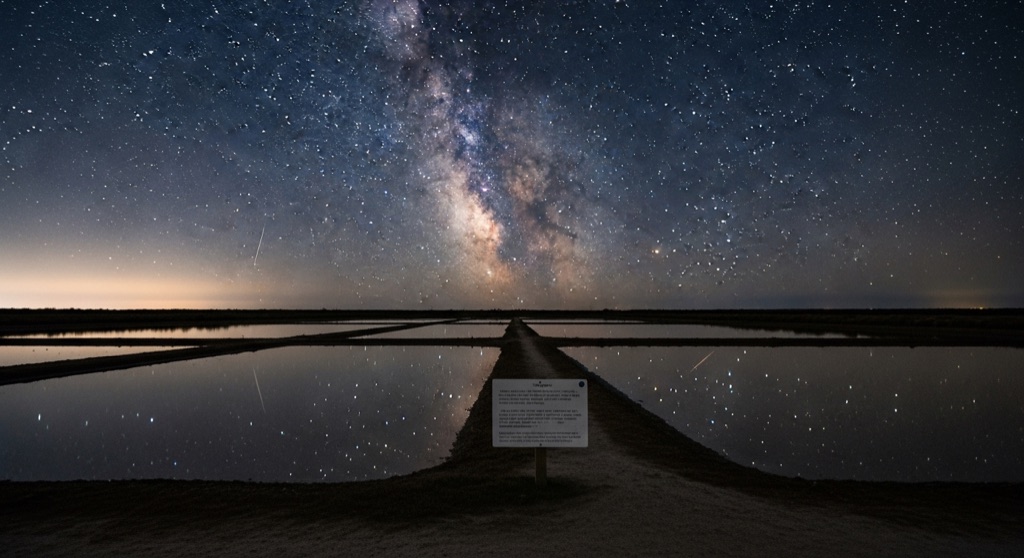
This 22,000-acre inland salt-marsh refuge in south-central Kansas is famous for birding, but its remote location far from city glow also makes it one of the genuinely dark skies within day-trip range of Wichita. On a calm, windless night the shallow salt pools mirror the sky, so the Milky Way and meteors appear to reflect back up from the water. Note the refuge is only open from about 1.5 hours before sunrise to 1.5 hours after sunset, so the magic happens in the deep-dusk and pre-dawn windows: photographers come for the Milky Way reflected in the wetlands. Bring bug spray.
→ Three more after-dark & night-sky spots in Wichita — never the same twice
The story
Birdwatchers know Quivira National Wildlife Refuge for its 22,000 acres of inland salt marsh and stopping-point waterfowl, but night-sky chasers know it for an optical trick of prairie geography. Sitting roughly 75 miles northwest of Wichita in Stafford County, far outside the light dome of any major city, the refuge offers some of the darkest skies achievable within a reasonable drive. When the prairie wind drops to absolute zero on a calm night, the shallow, mineral-crusted salt pools turn into massive, dark mirrors.
The result is a double-sided horizon. You don't just look up at the band of the Milky Way or a August meteor shower; you look down at the exact same starfields reflected off the still surface of the marsh. For a few minutes around deep dusk or pre-dawn, the boundary between the water and the sky completely dissolves.
The catch is federal regulation and timing. The refuge is strictly open from 1.5 hours before sunrise to 1.5 hours after sunset. That leaves a precise, highly cinematic window where true astronomical twilight overlaps with legal access. Photographers and stargazers track the wind forecasts and moon phases down to the hour just to catch 45 minutes of complete stillness over the water.
What it's like
Expect a dead-quiet drive down unpaved, low-lying rural roads that get soft and slick quickly after rain. Once inside the refuge, pull off near the larger open water impoundments as twilight fades. You will hear the squawks of roosting water birds, the buzz of thick marsh mosquitoes—bug spray is non-negotiable—and almost nothing else. Bring a red-light flashlight so you don't blow out your night vision, and check the moon phase before you leave home; a bright moon will wash out the water reflections.
The move: Pack a blanket and drive out after sunset to watch the Milky Way (or a meteor shower) blaze overhead and double itself in the still marsh water.
📍 Before you go No formal night programming - this is self-guided wild stargazing about 70-75 miles northwest of Wichita. Bring bug spray, check moon phase for darkest skies, and watch for soft, low-lying roads after rain.
- 📍 Stafford (near Hudson)
- 💸 $
- ⚡ Low-key
- 🌗 Outdoors
Where: 1434 NE 80th St, Stafford, KS 67578
Hours: Added 2026-06-23 — confirm current hours before you go.
Pair it with
- Ellinwood Underground Tunnels & Wolf Hotel Speakeasy — Tour an abandoned 19th-century underground town under the sidewalks of Ellinwood before driving out into the open prairie dark.
- Strataca - Kansas Underground Salt Museum — Descend 650 feet into ancient subterranean salt beds during the day, then head to Quivira's surface salt marshes by night.
- Cosmosphere — Examine real Apollo-era space hardware in Hutchinson before watching the real cosmos streak overhead far out in the marsh.
More weird in Wichita
Good to know
Can you stay in the refuge overnight?
No. Refuge hours run strictly from 1.5 hours before sunrise to 1.5 hours after sunset. You have to timing-gate your trip around deep dusk or pre-dawn to legally see the dark skies.
How far is it from Wichita?
It is about 70 to 75 miles northwest of Wichita, roughly a 1.5-hour drive past Hutchinson toward Hudson.
Are there formal stargazing events or telescopes provided?
No. This is entirely self-guided wild stargazing with zero staff on hand after dark. You bring your own gear, blankets, and flashlights.
What is the best time of year to visit for dark skies?
Clear, windless nights during a new moon offer the absolute darkest conditions, with late summer and autumn bringing the core of the Milky Way squarely overhead.
Plan a visit & invite your people →
Further reading: fws.gov · mickeyshannon.com · travelks.com
last checked: 2026-06-23