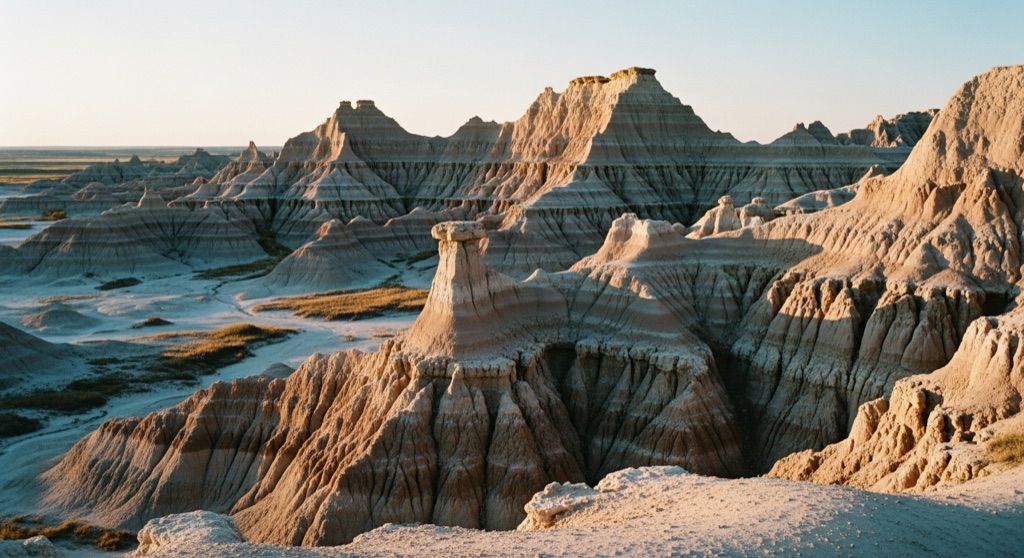
Entry No. 48 — the Wichita file — filed under: badlands
Little Jerusalem Badlands State Park
Kansas's largest exposed Niobrara chalk badlands — colorful spires and miniature canyons rising out of flat prairie, a stark, almost desert landscape hidden in the western part of the state.
→ Three more weird outdoor & roadside oddities in Wichita — never the same twice
The story
Drive far enough west on US-83 past Scott City and you'll swear the prairie is playing tricks on you. Turn off the asphalt onto county gravel, rumble past the cattle guards, and the flat high plains suddenly tear open into a silent, mile-long labyrinth of 100-foot chalk spires and miniature box canyons. Eighty million years ago, this land sat beneath the Western Interior Seaway, collecting trillions of microscopic calcified shells that slowly compressed into soft Niobrara chalk. As the sea retreated and centuries of wind and rain scoured the exposed ocean floor, it carved out a stark, pale badlands that looks entirely alien to the surrounding wheat fields.
For generations, this hidden canyon system sat privately tucked away on ranch land owned by The Nature Conservancy. When it officially opened as Kansas's newest state park, conservationists drew a hard line: the chalk is so soft it literally crumbles like blackboard chalk under a heavy boot heel. Stepping off the trail doesn't just erode thousands of years of wind-carved history in an instant—it threatens rare endemic rock plants like the Great Plains wild buckwheat that cling to the chalk faces.
It is one of the quietest places in the state. Stand near the rim in the late afternoon and you'll watch the pale ivory cliffs shift from blinding bone-white to soft yellow, orange, and dusty pink. If you keep your eyes on the ridge lines down in the draw, you're almost guaranteed to spot mule deer picking their way through the dry washes below.
What it's like
Getting here is an actual expedition: figure on a four-hour haul west from Wichita, ending with three and a half miles of county gravel on Gold Road and Road 400 that turn into greasy, tire-spinning clay after a rainstorm. Pay for your Kansas state park vehicle permit at the self-serve kiosk before pulling into the natural-surface lot. Once parked, your foot travel is strictly confined to two crushed-rock paths—the quick half-mile Overlook out-and-back or the 2.4-mile Life on the Rocks loop. Stay on the gravel; park staff actively enforce the off-trail ban, and the only way to step into the canyon floor is by booking a scheduled guided hike with a ranger. There is zero shade on the rim, so bring a water bottle, dodge the midday sun, and pair your trip with Historic Lake Scott State Park seven miles south.
The move: Hike the Overlook and Life on the Rocks trails at golden hour to watch the chalk formations glow, scanning for mule deer along the rim.
📍 Before you go This is a real expedition from Wichita — the park sits off US-83 between Scott City and Oakley, with the last stretch on county gravel (Gold Road west about 3.5 miles, then north on 400 Road) to a natural-surface lot that turns sloppy after rain. A Kansas state park vehicle permit is required; hit the pay station before the gate into the parking area. The fragile chalk is off-limits except from two designated trails — the half-mile Overlook out-and-back and the 2.4-mile Life on the Rocks loop, both crushed rock with gentle grades — and off-trail access happens only on scheduled staff-guided hikes. Pair it with Historic Lake Scott State Park about seven miles south, or the trail loops at The Nature Conservancy's adjacent Smoky Valley Ranch.
- 📍 Scott County (near Scott City)
- 💸 Free
- ⚡ Up for anything
- 🌗 Outdoors
Hours: Added 2026-06-09 — confirm current hours before you go.
Pair it with
- Gyp Hills Wildlife Area (Gypsum Hills) — Compare Western Kansas's pale Niobrara chalk spires with the stark, rusty-red gypsum mesas and hidden canyons of south-central Kansas.
- World's Largest Collection of World's Smallest Versions of World's Largest Things — Balance a massive, ancient geological anomaly with a delightfully eccentric indoor showcase of hand-crafted miniature roadside monuments.
- Ellinwood Underground Tunnels & Wolf Hotel Speakeasy — Break up your long return drive to Wichita by trading the open western sky for subterranean 19th-century tunnels beneath the prairie.
More weird in Wichita



Good to know
How far is Little Jerusalem from Wichita, and how do I get there?
It sits in Scott County roughly 230 miles (about a 3.5-to-4-hour drive) west of Wichita. Head west on US-50/400 toward Scott City, go north on US-83, then head west on Gold Road for 3.5 miles and north on 400 Road to the park entrance.
Can you walk among the chalk spires?
No. The chalk is extremely fragile and prone to crumbling. Visitors must remain on the designated crushed-rock trails unless participating in an official staff-guided off-trail hike.
What are the park hours and admission requirements?
The park is open daily from sunup to sundown year-round. A valid Kansas State Parks daily or annual vehicle permit is required and can be purchased at the self-pay station at the parking area.
What should I pack or prepare for before visiting?
Pack plenty of drinking water, sun protection, and sturdy walking shoes. There are no shaded trees along the rim trails, and rain can make the last stretch of gravel road slick and messy.
Plan a visit & invite your people →
Further reading: kansastravel.org · geoparks.ksu.edu
last checked: 2026-06-09