Entry No. 83 — the Wichita file — filed under: ruins
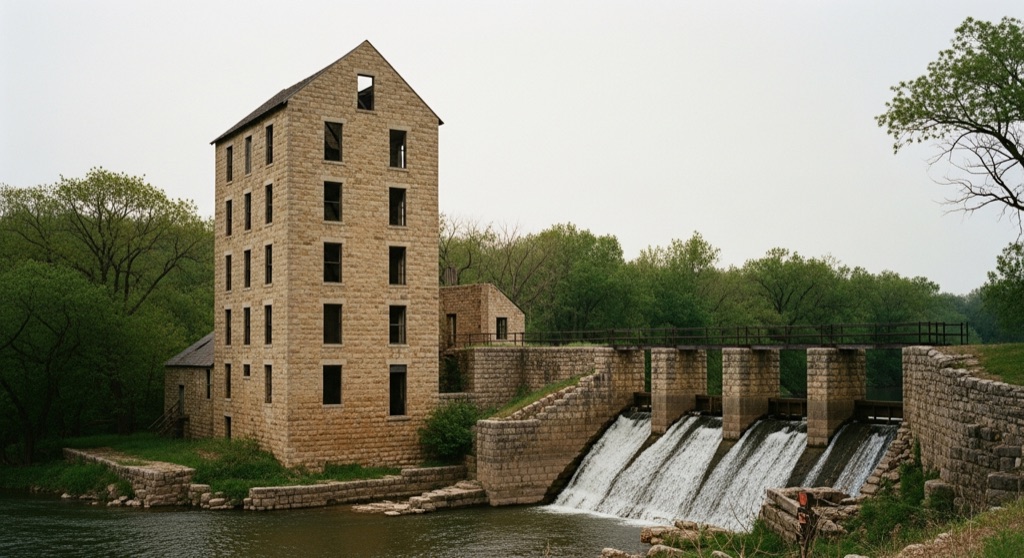
Cedar Point Mill
Completed in 1875, this striking three-story limestone grist mill replaced an earlier wooden sawmill that was swept away by a flood. It ground flour and cattle feed along the Cottonwood River for over a century before falling silent, leaving behind a crumbling shell and an adjacent stone dam. While a 2015 restoration effort attempted to save the structure, work has halted and the vacant landmark is currently listed for sale.
→ Three at a time, never the same twice — explore weird Wichita
The story
Drive out into Chase County where the Flint Hills start to flatten into silence, and you'll find the three-story limestone hulk of the Drinkwater & Schriver Mill standing squarely on the bank of the Cottonwood River. Settlement in Cedar Point began with a timber sawmill built on this riverbank in 1867, but after floodwaters tore that wooden frame off its foundations, locals rebuilt in 1875 using heavy blocks of native Kansas limestone. For more than a century, the mill ground wheat flour and livestock feed using water routed straight through its adjacent stone dam.
Eventually, commercial milling moved on and the gears fell silent, leaving the structure as practically the only surviving anchor in the quiet town. A non-profit group and a Wichita doctor stepped in around 2000 to stabilize the shell and halt the rot, but restoration work eventually stalled out. Today, the three-story ghost of 19th-century agrarian industry sits vacant and listed for sale, waiting for whoever comes next.
What it's like
You'll pull up along 1st Street, where the towering stone walls drop almost directly into the river channel. Keep your feet on the public roadside or down along the riverbank—the interior timbers and flooring are structurally compromised and genuinely dangerous, so going inside isn't an option. The payoff here is watching the Cottonwood River cascade over the historic curved stone mill dam right next to the ruin, giving you clean line-of-sight for photos without crossing onto private or hazardous ground.
The move: Take a scenic drive to the quiet town of Cedar Point to photograph the towering limestone mill and its historic stone dam from the safety of the riverbank.
📍 Before you go The interior of the mill is structurally compromised and dangerous to enter, but the exterior and the adjacent stone dam can be safely viewed and photographed from the public roadside and riverbank.
- 📍 Cedar Point
- 💸 Free
- ⚡ Low-key
- 🌗 Outdoors
Where: 1st St, Cedar Point, KS 66843, USA
Hours: Added 2026-07-20 — confirm current access before you go.
Pair it with
- Belle Vista Cemetery (Clara Wiley's grave) — Pair this isolated Chase County river ruin with a 30-mile drive south to El Dorado's historic 1887 cemetery to track down a famously eerie, rumored-unphotographable headstone.
- World's Tallest Mennonite (Mennonite Settler Statue) — Trade an 1875 limestone grist mill for a 17-foot limestone farmer built by the WPA in 1942 over in Newton.
- Psychedelic Beatles Mural — Contrast the muted, abandoned stone aesthetic of Cedar Point with the bright 1960s pop-art wall painted on the side of a Newton furniture warehouse.
More weird in Wichita

Good to know
Can you tour the inside of Cedar Point Mill?
No. The interior of the building is structurally compromised, decaying, and off-limits for safety reasons. You can safely view and photograph the exterior and the stone dam from public riverbanks and the adjacent road.
What is the waterfall next to the mill?
It is Cedar Point Falls, created by the historic hand-built stone dam that once diverted water from the Cottonwood River to power the mill's grinding equipment.
Who owns the mill today?
The property was acquired around 2000 by Dr. Bruce McMullen and managed via the non-profit Drinkwater & Schriver Mill Inc. to prevent collapse, though restoration efforts have halted and the building has been listed for sale.
Plan a visit & invite your people →
Further reading: Wikipedia · kansastravel.org · gregdisch.com · heartoftheflinthills.com
last checked: 2026-07-20