Entry No. 29 — the Spokane file — filed under: outdoor-weird
Turnbull National Wildlife Refuge Mima Mounds
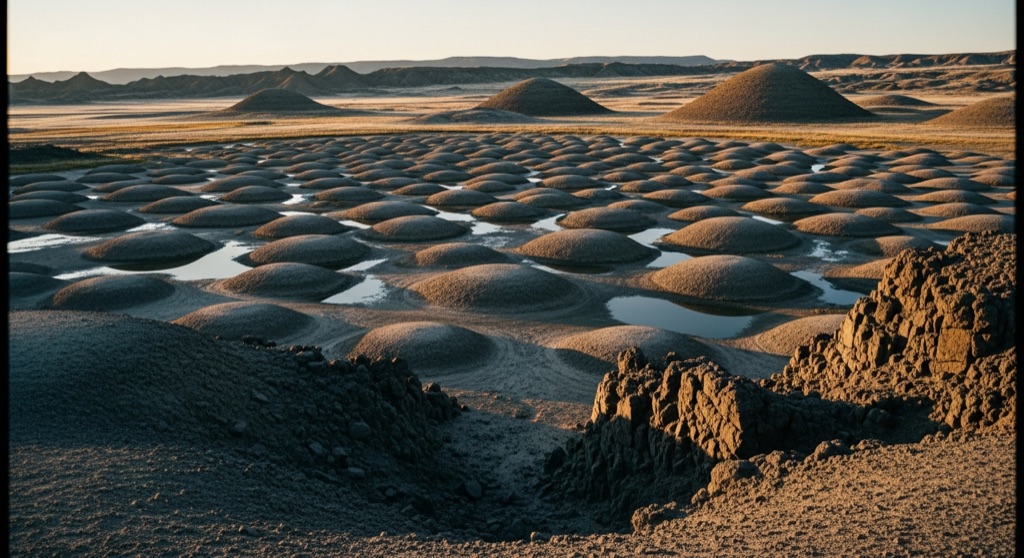
About four miles south of Cheney, the prairie here is studded with hundreds of low, oval domes of earth called Mima mounds, regularly spaced like something planted by giants. Geologists have argued for over a century about how they formed, blaming everything from pocket gophers to ancient earthquakes, and still have no consensus. The refuge sits inside the Channeled Scablands, scoured down to bare basalt by Ice Age megafloods, so the mounds rise from a landscape of pothole wetlands and rugged volcanic rock. A 5.5-mile one-way scenic auto tour route and miles of trails let you get out and walk among them.
→ Three more weird outdoor & roadside oddities in Spokane — never the same twice
The story
Geologists have spent over a century staring at these regularly spaced earth swells and failing to agree on how they got here. The mounds—low, oval domes of soil sitting on raw volcanic rock—look strangely organized, almost like something laid down on a grid by giant hands. Depending on which scientist you ask, they were pushed into shape by endless generations of pocket gophers, vibrated into mounds by ancient seismic shockwaves, or molded by glacial freeze-and-thaw cycles. None of those theories has managed to permanently kill off the others.
What makes Turnbull’s mounds particularly eerie is their bedrock context. The refuge sits square inside the Channeled Scablands, a region torn open and scoured down to naked basalt by catastrophic Ice Age megafloods. Yet somehow, riding right on top of this violently stripped volcanic floor, hundreds of these soft, symmetrical earthen mounds sit undisturbed among pothole wetlands and ponderosa pines.
Covering over 16,000 acres just four miles south of Cheney, the refuge preserves a rare pocket of this low-elevation scabland steppe. While Mima mounds occur in a few other pockets across Washington, coming here gives you miles of auto tour route and walking trails to observe them without the usual crowds.
What it's like
Expect a quiet, slow-paced outing roughly 30 minutes south of Spokane. The primary way to see the earthworks is the 5.5-mile one-way scenic auto tour, which loops past basalt outcrops, pothole marshes, and open grassland. Low sun at dawn or dusk provides side-lighting that makes the regular contours of the mounds pop against the prairie—and happens to align with when moose, elk, and waterfowl move through the wetlands. Bring a couple of dollars or a pass for the small day-use fee, pull off to hike the trail loops among the domes, and take your time.
The move: Drive the auto tour loop at dawn or dusk, then wander out onto the prairie to stand among the unexplained mounds while moose and waterfowl move through the wetlands.
📍 Before you go Small day-use fee; auto tour route is best for the mounds. Roughly 30 minutes from Spokane.
- 📍 Cheney
- 💸 Free
- ⚡ Up for anything
- 🌗 Outdoors
Where: 26010 S Smith Rd, Cheney, WA 99004
Hours: Added 2026-06-24 — confirm current hours before you go.
Pair it with
- Way Out West Statue Farm — Follow up unexplained geological earthworks with a bizarre roadside field off I-90 featuring a 16-foot T-rex, a brontosaurus, and cows in a boat.
- Spokane Astronomical Society Star Parties at Fishtrap — Double down on scabland solitude by heading west to Fishtrap Lake to stare into deep space with local amateur astronomers.
- Baby Bar — Trade the open prairie and basalt scablands for a microscopic, red-lit cocktail lounge hidden behind a burrito counter in downtown Spokane.
More weird in Spokane
Good to know
What actually are Mima mounds?
They are low, oval domes of soil spaced with strange regularity across prairie terrain. Named after Mima Prairie in western Washington, their origin remains unproven, with theories citing pocket gophers, seismic shaking, or ice-age frost heaving.
How do I reach the mounds at Turnbull?
The refuge is located at 26010 S Smith Rd, about four miles south of Cheney. You can see the mounds directly from the 5.5-mile one-way scenic auto tour route or by walking the loop trails that pass through them.
Is there an entry fee?
Yes, Turnbull charges a small day-use fee per vehicle, though federal recreation passes are accepted.
What wildlife lives around the mounds?
The refuge's pothole wetlands and scabland forests support resident moose, elk, coyotes, beaver, and abundant breeding waterfowl.
Plan a visit & invite your people →
Further reading: fws.gov · spokesman.com · wta.org
last checked: 2026-06-24