Entry No. 51 — the Spokane file — filed under: after-dark
Spokane Astronomical Society Star Parties at Fishtrap
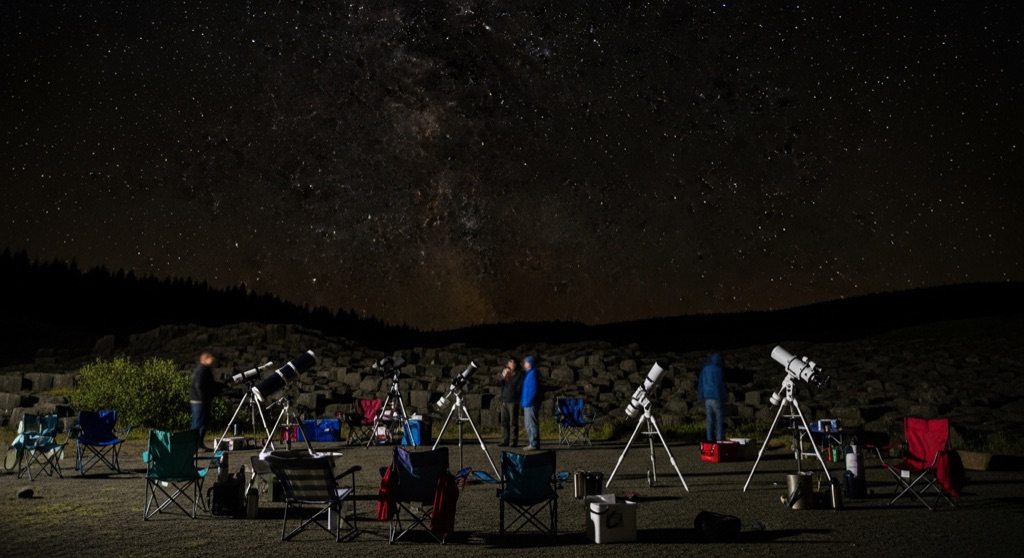
One of the oldest astronomy clubs in the United States hauls its telescopes out to a stretch of BLM scabland near Fishtrap Lake, timed to the weekend nearest each new moon so the sky goes genuinely black. Members and curious newcomers set up on the channeled basalt and trade views through other people's scopes; the club also lends gear to $25/year members. The drive is almost entirely paved except the last mile or two of gravel.
→ Three more after-dark & night-sky spots in Spokane — never the same twice
The story
Thirty-three miles southwest of Spokane, down I-90 and off onto Bureau of Land Management land near Fishtrap Lake, the Spokane Astronomical Society—one of the oldest astronomy clubs in the country—turns a stretch of scabland into an open-air observatory. They schedule these outings specifically around the weekend nearest each new moon, when light pollution drops to near zero and the Eastern Washington night sky goes properly dark.
The terrain itself is channeled basalt scoured clean by Ice Age floods, creating a flat, desolate platform for aiming serious optics into deep space. Society members haul out everything from modest backyard refractors to massive light-buckets, setting up on the rock to track nebulae, star clusters, and planetary rings. You don't need a degree or expensive glass to show up; the members routinely let curious visitors peer through their eyepieces. If you decide to pay the $25 annual membership fee, the society will even let you borrow gear from their equipment library.
What it's like
The drive out is paved right up until the final mile or two of unpaved gravel leading into the BLM recreation area. If you arrive after dark, dim your headlights down to parking lights so you don't destroy everyone's night vision—astronomers are serious about dark adaptation. Bring camp chairs, a heavy blanket or jacket (scabland nights get cold quickly), a thermos, and a red-lens flashlight to navigate the gravel without blinding people operating long-exposure setups. The vibe is quiet, informal, and generous, with strangers taking turns pointing out Saturn's rings over low-key conversation.
The move: Pack camp chairs and a thermos, drive out for a new-moon star party, and let a stranger show you Saturn's rings through a backyard telescope.
- 📍 Sprague / Fishtrap Recreation Area
- 💸 $
- ⚡ Low-key
- 🌗 Outdoors
Where: Fishtrap Recreation Area (BLM land), off I-90 ~33 miles SW of Spokane
Hours: Added 2026-06-24 — confirm current hours before you go.
⚠ Seasonal or scheduled — always check before you go.
Pair it with
- Turnbull National Wildlife Refuge Mima Mounds — Explore the strange, regularly spaced earth mounds at Turnbull during the day before heading further southwest to Fishtrap for nighttime stargazing.
- Way Out West Statue Farm — Pass by giant roadside dinosaurs off I-90 on your way out toward the dark skies of the Fishtrap scablands.
- Baby Bar — Cap off a night of staring into deep space by heading back into downtown Spokane for a drink in this tiny, red-lit spot hidden behind a burrito counter.
More weird in Spokane
Good to know
Is there an admission fee to attend a star party?
No, attending the public star party at Fishtrap is free. If you choose to become an official Spokane Astronomical Society member, it costs $25 per year, which gives you access to the club's telescope loaner program.
Do I need to bring my own telescope?
Not at all. Club members bring their own equipment and share views through their eyepieces with anyone who stops by. Just bring camp chairs and warm gear.
What are the road conditions getting there?
The route off I-90 is paved almost the entire way, except for the last mile or two of gravel and dirt roads inside the Fishtrap Recreation Area.
When do the star parties take place?
They are held on the weekend closest to the new moon each month to ensure maximum darkness, but you should always confirm the club's schedule online before driving out.
Plan a visit & invite your people →
Further reading: Official site · nightsky.jpl.nasa.gov · seattletimes.com · Reddit
last checked: 2026-06-24