Entry No. 55 — the Seattle file — filed under: history
Iron Goat Trail / Wellington Ghost Town
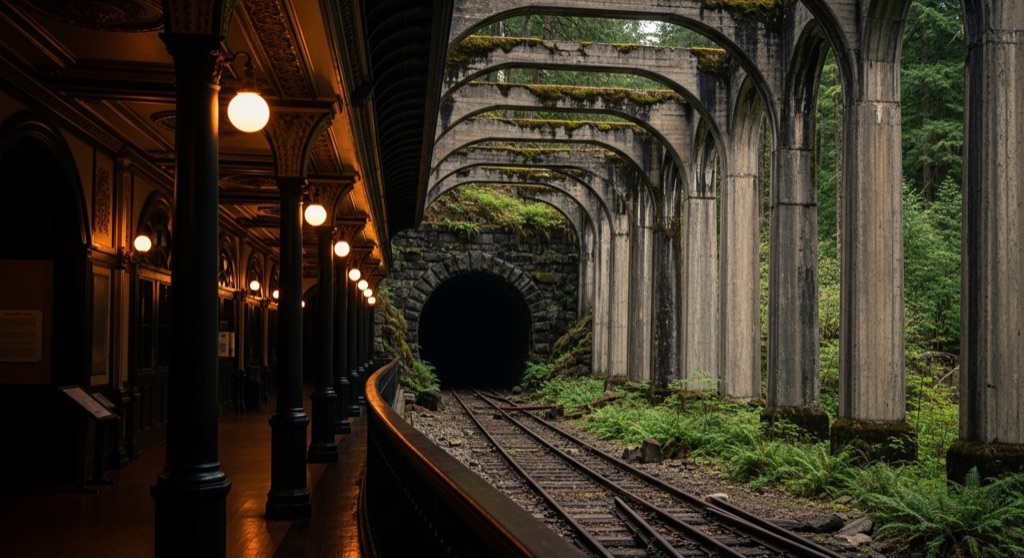
This gentle railroad-grade trail follows the abandoned Great Northern route over Stevens Pass to the ghost-town site of Wellington, where in 1910 an avalanche swept two trains off the mountain and killed 96 people, the deadliest avalanche in U.S. history. What remains is genuinely eerie: the dark, eroding mouth of an old tunnel and the long, curving concrete pillars of a collapsing snowshed receding into the forest. There's no townsite left, just ruins, ferns, and the weight of what happened here.
→ Three more abandoned & forgotten places in Seattle — never the same twice
The story
In late February 1910, two Great Northern Railway trains—a passenger train and a fast mail train—were pinned against the slope of Windy Mountain by relentless snowdrifts. They sat trapped for nine days at Wellington, a small railway depot town near Stevens Pass. In the early hours of March 1, a thunderstorm rolled over the ridge and triggered a slab avalanche from the cleared timber slope above. The avalanche swept both trains, the water tower, and the local coal chute 150 feet down into the Tye River canyon, killing 96 people in the deadliest avalanche in United States history.
Shaken by the disaster, the railroad tried to scrub Wellington's name from the maps, quickly renaming the depot "Tye" and constructing massive concrete snowsheds over the tracks to prevent another catastrophe. The fix was temporary. By 1929, Great Northern opened a lower, eight-mile tunnel through the mountain that bypassed this perilous stretch entirely. The depot at Wellington was abandoned and dismantled, leaving only concrete foundations, drainage systems, and structural shells behind in the rainforest.
Today, the former railbed forms the Iron Goat Trail—named after the Great Northern Railway's iconic mountain goat logo. There are no wooden pioneer buildings here; what remains is far stranger. A long, curving row of mossy concrete pillars from the decaying 1911 snowshed recedes into the hemlock forest, and cold, damp draft air constantly spills from the dark, gated mouth of the original 1893 tunnel.
What it's like
Walking the upper trail feels disarmingly easy given the history underneath your boots. Because locomotives required a shallow grade, the trail is wide, smooth, and barely rises at a 2.2 percent incline through lush ferns and old growth. Parking at the Wellington site off the Old Cascade Highway places you right next to the historic plaques and the long concrete snowshed ruins. Bring a jacket even in summer, as the mountain air off the old tunnel portals stays cold, and pack a headlamp if you want to inspect the ruins up close. Check trail conditions before setting out, as heavy winter snow closes the road well into late spring.
The move: Hike the easy grade out to the Wellington snowshed ruins and read the avalanche history plaques together where the trains were lost.
📍 Before you go Trail is snow-free roughly late spring through fall; check WTA conditions. A Northwest Forest Pass may be needed at the trailhead.
- 📍 Stevens Pass (near Skykomish), WA
- 💸 Free
- ⚡ Up for anything
- 🌗 Outdoors
Where: Old Cascade Highway, Iron Goat Trailhead, near Scenic, WA
Hours: Added 2026-06-24 — confirm current hours before you go.
⚠ Seasonal or scheduled — always check before you go.
Pair it with
- Fortson Mill — Pair this high-mountain rail disaster with another stretch of decaying 1900s Washington industrial ruins hidden in the trees at Arlington's former lumber mill.
- Franklin Ghost Town — Continue your tour of early 20th-century Pacific Northwest industrial ghost towns at this abandoned 1880s coal mining site.
- Goldmyer Hot Springs — Follow up a chilly walk through mossy concrete ruins with an backcountry wilderness soak deeper in the Cascades.
More weird in Seattle
Good to know
Are there standing buildings at Wellington Ghost Town?
No. All wooden structures were removed or destroyed after the railroad bypassed the line in 1929. The ghost town consists entirely of concrete ruins, tunnel mouths, foundations, and overgrown stone retention walls.
How difficult is the hike?
It is an easy, low-grade hike. Because it follows an abandoned railroad bed, the path maintains a flat, gentle grade that is suitable for families and casual walkers.
Can you walk inside the old train tunnels?
No. The tunnel entrances are gated off or collapsed due to structural instability, active cave-ins, and deep standing water inside.
Do I need a parking pass at the trailhead?
Yes, a Northwest Forest Pass or an America the Beautiful interagency pass is required at the trailhead parking lots.
Plan a visit & invite your people →
Further reading: wta.org · historylink.org · seattletimes.com · Wikipedia
last checked: 2026-06-24