Entry No. 37 — the Savannah file — filed under: haunted
Stoney Baynard Ruins
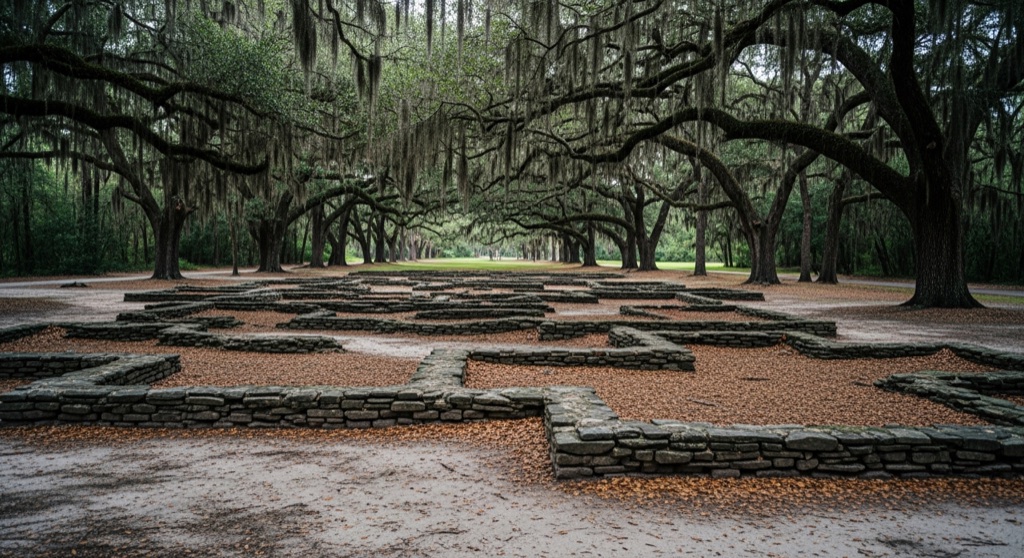
Constructed in the late 1790s by Captain Jack Stoney, this antebellum plantation mansion was built using tabby, a traditional Lowcountry mixture of crushed oyster shells, lime, and sand. After being seized by Union forces during the Civil War, the main house was burned to the ground, leaving behind only skeletal remains. Today, visitors can wander the moss-draped six-acre site to view the preserved foundations of the main house, slave quarters, and outbuildings.
→ Three at a time, never the same twice — explore weird Savannah
The story
In the late 1790s, Captain Jack Stoney built an 1,885-square-foot plantation home out of tabby—the Lowcountry's brutal, ingenious response to a lack of local building stone. Workers burned oyster shells to create lime, mixed it with sand, water, and whole crushed shells, and poured the aggregate into wooden forms. Wood burns and rots, but tabby calcifies into a rough, bone-colored masonry that outlives almost everything built around it.
When Union forces seized Hilton Head Island during the Civil War, the main plantation house was torched, burning the timber framework to ash. What survived were the skeletal foundations of the main hall, outbuildings, and slave quarters. Today, the six-acre site sits in strange, quiet contrast to the suburban hyper-development surrounding it, held together by crushed shells that harvested marine life over two centuries ago.
What it's like
Getting to the site requires navigating the gate line at the Sea Pines Resort community, where you will need to pay a daily vehicle gate fee just to enter the residential enclave. Once past the gatehouse, drive down Plantation Drive to the unstaffed six-acre lot. The ruins sit beneath heavy shade trees draped in Spanish moss, marked by simple interpretive displays. It is a quiet, self-guided walk with no gift shops or crowds—just open foundations, calcified oyster walls, and coastal breezes.
The move: Pay the gate fee to enter the scenic Sea Pines community, then take a romantic, shaded walk under the Spanish moss to photograph the historic tabby ruins and read the interpretive displays.
📍 Before you go The ruins are located within the gated Sea Pines Resort community, which requires a small daily vehicle gate fee to enter, but the historic site itself is free and open to the public for self-guided walking tours daily from dawn to dusk.
- 📍 Hilton Head Island
- 💸 Free
- ⚡ Low-key
- 🌗 Outdoors
Where: Plantation Dr, Hilton Head Island, SC 29928, USA
Hours: Added 2026-07-20 — confirm current access before you go.
Pair it with
- Little Gracie Watson Monument (Bonaventure Cemetery) — Trade the calcified plantation ruins of Hilton Head for Savannah's iconic Victorian funerary monument under the live oaks at Bonaventure.
- The Pirates' House — Continue your tour of surviving 18th-century Lowcountry structures by grabbing a meal at a site built around Savannah's 1734 Herb House.
- Graveface Museum — If the skeletal ruin of an antebellum plantation leaves you in a macabre mood, head across the river into Savannah for true crime artifacts and oddities.
More weird in Savannah
Good to know
Is there an entrance fee to see the Stoney Baynard Ruins?
The historic site itself is free and open to the public, but because it sits inside the gated Sea Pines Resort community, you must pay a daily vehicle gate fee at the resort entrance.
What are the site's operating hours?
The site is open daily from dawn to dusk for self-guided walking tours.
What is tabby made of?
Tabby is a traditional coastal Lowcountry concrete made from equal parts slaked lime (from burned oyster shells), sand, water, and crushed oyster shells.
Plan a visit & invite your people →
Further reading: Wikipedia · scpictureproject.org · seapines.com · hiltonhead.com
last checked: 2026-07-20