Entry No. 20 — the Santa Fe file — filed under: land art
The Lightning Field
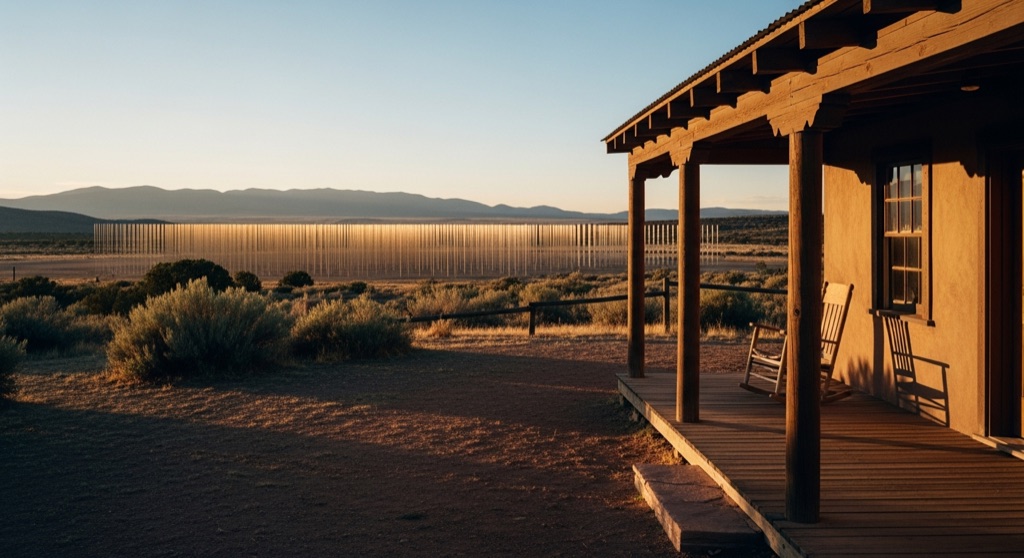
In 1977 Walter De Maria planted 400 polished stainless-steel poles in a precise mile-by-kilometer grid on an empty high-desert plain; you can't just drive up and look — visitors meet in Quemado, get driven to the site, and sleep overnight in a restored homestead cabin, watching the poles ignite at sunset and, with luck, catch actual lightning.
→ Three at a time, never the same twice — explore weird Santa Fe
The story
In 1977, sculptor Walter De Maria drove 400 solid-tipped stainless steel poles into a secluded high-desert plain in Catron County. The grid is strictly geometric: one mile long by one kilometer wide, with each shaft spaced 220 feet apart. Because the terrain gently rolls, De Maria had the pole lengths custom-calibrated so that their tips form a perfectly level, flat horizontal plane suspended above the sagebrush.
The Dia Art Foundation, which commissioned and maintains the piece, guards the exact coordinates carefully. You cannot map your way there, nor can you drop by for an afternoon photo. Access requires booking a slot months ahead for the May-through-October season, arriving at an unassuming pickup location in Quemado, and letting a Dia driver shuttle you down unpaved ranch roads into the wilderness.
Once dropped off, you are left at a restored 1930s log homestead cabin alongside no more than five other visitors. There are no docents, paved paths, or gift shops. Around mid-day, the thin steel shafts virtually vanish under the harsh high-desert sun, only to ignite as brilliant needles of light at dawn and sunset.
What it's like
Your driver leaves you at the cabin with simple meals provided for your overnight stay. Expect total isolation, zero cell service, and long stretches spent walking the perimeter of the grid. At dusk and dawn, the metal tips gather the horizontal light and glow against the dark soil; if a summer storm rolls in, electric charges in the sky transform the field entirely. Bring warm, durable gear, as temperatures drop rapidly in the high desert after sundown.
The move: Reserve the overnight stay together, watch the pole grid flare gold at sunset from the cabin porch, then stay up hoping for a real electrical storm to strike the field you're standing in.
- 📍 Catron County, near Quemado
- 💸 Free
- ⚡ Up for anything
- 🌗 Outdoors
Where: Meeting point in Quemado, NM 87829 (site itself is a remote high-desert plain in Catron County)
Hours: Added 2026-07-20 — confirm current hours before you go.
⚠ Seasonal or scheduled — always check before you go.
Pair it with
- La Cieneguilla Petroglyph Site — Pair De Maria's minimalist 1970s grid with centuries-old rock art pecked directly into high-desert basalt escarpments.
- Ojo Santa Fe Spa Resort — After 24 hours of rustic isolation in a Catron County cabin, clean off the desert dust in hot spring-fed soaking pools.
- Encaustic Art Institute — Follow up an overnight land art pilgrimage with a stop in near-ghost-town Cerrillos to see hundreds of molten beeswax artworks.
More weird in Santa Fe
Good to know
How do you get to the actual installation?
You meet a Dia Art Foundation representative in Quemado, New Mexico, who drives you in a company vehicle to the undisclosed site in Catron County.
When is The Lightning Field open to visitors?
Visits are strictly overnight and operate seasonally from May 1 through October 31. Advance reservations through Dia Art Foundation are required.
Where do visitors stay during the trip?
Guests spend the night in a restored 1930s log cabin located right on the edge of the field, accommodating a maximum of six people per night.
Are you guaranteed to see lightning hit the poles?
No. Lightning strikes are rare events; the installation was primarily built as an artwork meant to be experienced over 24 hours as natural light changes across the grid.
Plan a visit & invite your people →
Further reading: Wikipedia · diaart.org · fathomaway.com
last checked: 2026-07-20