Entry No. 17 — the Santa Fe file — filed under: paleontology
Ruth Hall Museum of Paleontology at Ghost Ranch
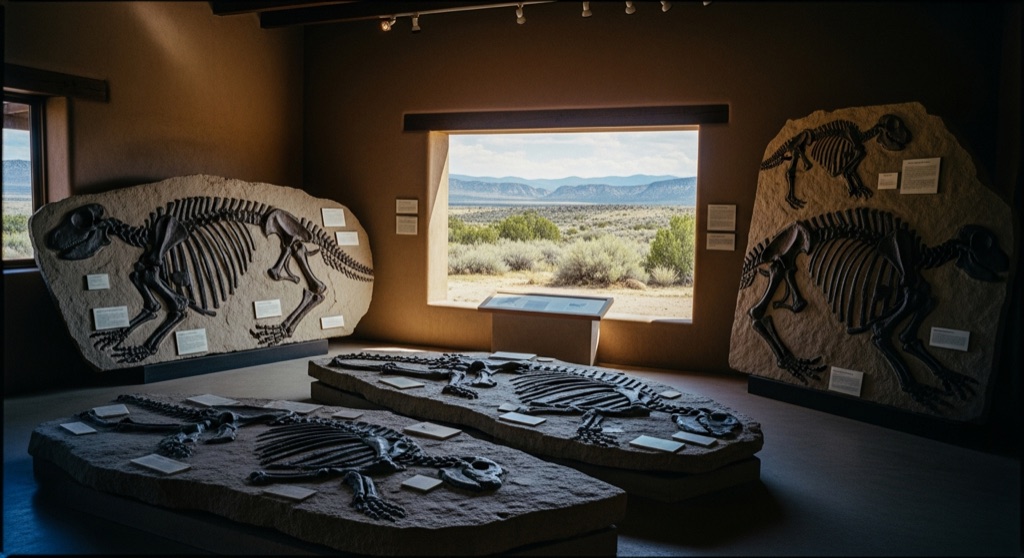
A one-species shrine to Coelophysis, a small Triassic predator whose bones turned up by the hundreds in a single quarry on the ranch's own land — including specimens pulled from an 8-ton plaster jacket that had to be crane-lifted onto a flatbed truck in 1985. The actual mass-death quarry, now a National Natural Landmark, is a short hike from the museum door.
→ Three at a time, never the same twice — explore weird Santa Fe
The story
Most natural history museums present deep time as an orderly parade of single skeletons standing under spotlights. The Ruth Hall Museum of Paleontology does something far weirder: it puts you face-to-face with a single catastrophe. The star here is *Coelophysis*, a lean, hollow-boned Triassic predator that met its end alongside hundreds of its kind in a sudden mass-death event right on the ranch’s land. Instead of clean, isolated bone reconstructions, you are looking at tangled, chaotic slabs of rock where ribs, claws, and delicate bird-like skulls overlap in a dark red matrix.
The density of the bed is staggering. In 1985, paleontologists encasing a portion of the dig site had to construct an eight-ton plaster jacket just to move a single block, using a crane to hoist it onto a flatbed truck. Inside the room, those preserved blocks sit alongside other regional Triassic and Pleistocene finds—including armored phytosaur skeletons—proving that before these red rocks were high desert, they were a choked, muddy floodplain.
What makes the site remarkable isn't just what sits under glass indoors; it's the fact that the original crime scene is right outside. The actual mass-death quarry, now designated a National Natural Landmark, sits just a short walk from the museum door. You can study the bone slabs inside, then step outside into the glare of the canyon and walk directly to the dirt where they lay buried for over 200 million years.
What it's like
Drive past the sandstone bluffs of Abiquiu, buy your ranch day pass at the main gate, and head for the low-slung museum building. The room inside feels like a cross between an active field lab and a quiet chapel to a single species, centered on heavy fossil slabs that preserve the panicked final moments of early dinosaurs. Once you've inspected the indoor specimens and the story of the 1985 block lift, lace up your boots and take the short trail out to the actual excavated quarry before heading up toward Kitchen Mesa.
The move: Buy the day pass, study the Coelophysis slabs indoors, then hike Kitchen Mesa Trail together to stand at the real excavated quarry before the museum closes.
- 📍 Abiquiu, NM (Ghost Ranch)
- 💸 $
- ⚡ Up for anything
- 🌗 Indoors
Where: 280 Private Drive 1708, Abiquiu, NM 87510
Hours: Added 2026-07-20 — confirm current hours before you go.
Pair it with
- The Crow's Nest Oddities — Pair a day trip spent studying ancient Triassic bone beds with a stop in South Capitol to inspect mummified specimens and desktop curiosities.
- Ark Books — Follow up a trip into deep geological time with a quiet browse through metaphysical texts inside a 1980s adobe bookstore in Santa Fe.
- Jean Cocteau Cinema — After hiking out to a Triassic mass grave in Abiquiu, head into the Santa Fe Railyard for a movie and a drink at George R.R. Martin's single-screen theater.
- The Matador — Trade the quiet red-rock canyons of Ghost Ranch for a dark, cash-only subterranean dive bar tucked below downtown Santa Fe.
More weird in Santa Fe
Good to know
Do I need a ticket or permit to visit the museum?
You will need to buy a Ghost Ranch day pass at the property entrance to access the grounds, trails, and the museum building.
What is Coelophysis?
Coelophysis is a small, agile Triassic theropod dinosaur and the state fossil of New Mexico. Ghost Ranch contains one of the dense mass-mortality quarries ever found for the species.
Can you see the real quarry where the fossils were dug up?
Yes. The excavated bone bed is a designated National Natural Landmark located just a short hike from the museum doors on the ranch grounds.
Are there other fossils on display besides Coelophysis?
While Coelophysis dominates the hall, the museum also houses other regional Triassic and Pleistocene fossils, including phytosaur skeletons unearthed in northern New Mexico.
Plan a visit & invite your people →
Further reading: Official site · insidesantafe.com · earthathome.org · landscapes-revealed.net
last checked: 2026-07-20