Entry No. 26 — the Santa Barbara file — filed under: buried film set
The Lost City of Cecil B. DeMille — Dunes Center
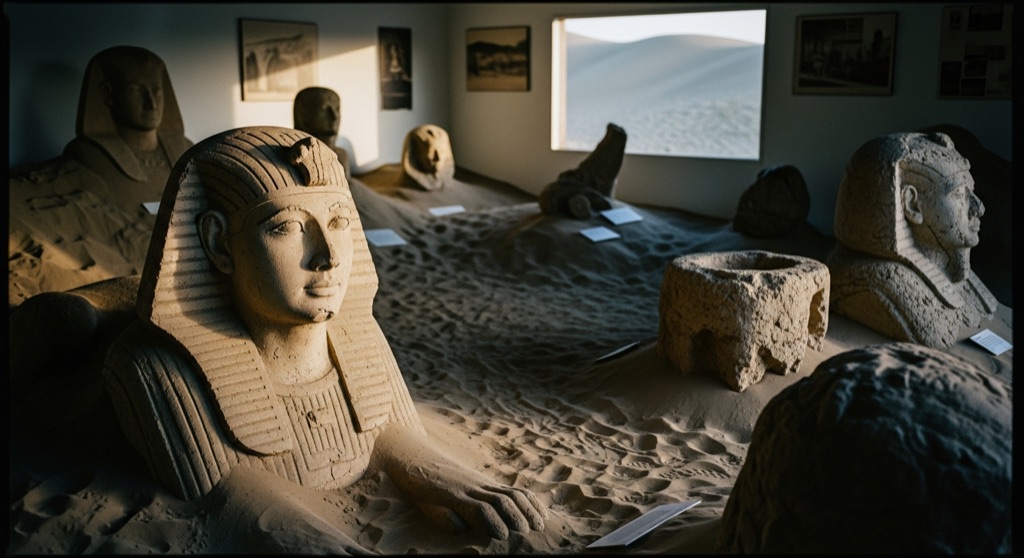
In 1923 Cecil B. DeMille built a full-scale plaster Egyptian city on the dunes for the silent "Ten Commandments" and left it buried when filming wrapped — legend says the sets were dynamited so rivals couldn't reuse them, though the shifting dunes did most of the burying. A sphinx surfaced during a 2014 dig (a head had emerged in 2012), and recovered pieces of the buried film city are now on display at this small nonprofit dunes center.
→ Three at a time, never the same twice — explore weird Santa Barbara
The story
In 1923, Cecil B. DeMille decided that building a miniature set for his silent epic "The Ten Commandments" was for amateurs. Instead, he hired French designer Paul Iribe to erect a full-scale Egyptian city on the shifting sand of the Guadalupe-Nipomo Dunes—complete with 110-foot plaster gates, giant pharaoh statues, and twenty-one plaster sphinxes lining a grand avenue. When filming wrapped, hauling hundreds of tons of plaster, horsehair, and timber back to Los Angeles was absurdly expensive. Legend claims DeMille blew the set to pieces with dynamite so rival filmmakers couldn't reuse his masterpiece, but the reality was simpler and cheaper: crew members bulldozed the plaster city into trenches in the dunes and let the coastal winds bury the rest.
For over sixty years, "Pharaoh's City" lived on as a Hollywood urban legend—a colossal fake city rotting beneath the dunes off Highway 1. Film buffs rediscovered the location in the 1980s, but excavating plaster of Paris after decades under damp coastal sand was an archaeological nightmare. When excavation teams finally mounted digs in the 2010s, they recovered surprisingly intact plaster sphinx heads and body sections (including major finds in 2012 and 2014). Sand and wind had buried the fragile shells, turning trash from silent film history into genuine California antiquity.
You won't find the set sitting open on the beach—most of it remains safely entombed under the dunes to protect what's left. Instead, the surviving fragments live at the Dunes Center, a small nonprofit housed in a restored Craftsman building in downtown Guadalupe. There, behind glass cases, you can stare down the hollow, painted face of a century-old plaster sphinx and appreciate Hollywood's grandest secret landfill.
What it's like
Pull up to 1065 Guadalupe Street and you'll find a quiet storefront museum staffed by local docents who know every detail of DeMille's grand experiment. Inside, the exhibition centers on the dramatic, fragile remains hauled out of the sand—cracked plaster sphinx faces, horsehair reinforcement fibers, and vintage set photos showing how massive the structure once was. It's a focused, intimate visit that takes under an hour. Once you've examined the artifacts, drive ten minutes west to the Guadalupe-Nipomo Dunes themselves and walk out onto the sand trails, knowing the un-excavated half of DeMille's Egypt is still buried somewhere beneath your boots.
The move: Tour the exhibit on the buried set (Tue–Sat, 10am–3pm), then walk out into the Guadalupe-Nipomo Dunes themselves, where more of DeMille's Egypt is still entombed somewhere under the sand nearby.
- 📍 Guadalupe
- 💸 Free
- ⚡ Up for anything
- 🌗 Outdoors
Where: 1065 Guadalupe St, Guadalupe, CA 93434
Hours: Added 2026-07-20 — confirm current hours before you go.
Pair it with
- Bizarre Antiques & Oddities — Drive 22 miles north to San Luis Obispo to trade Hollywood plaster ruins for taxidermy, curiosities, and macabre antiques.
- La Purisima Mission — Head 22 miles south to Lompoc to contrast Hollywood's fake plaster Egypt with a fully reconstructed 19th-century Spanish colonial mission.
- Benjamin Foxen Adobe Ruins — Travel 24 miles east to Santa Maria to see another set of forgotten Central Coast ruins—the decaying adobe walls of an 1837 rancho.
More weird in Santa Barbara

Good to know
Can I dig up movie set pieces in the sand dunes myself?
No. The dunes are a protected wildlife area and archaeological site, making unauthorized digging illegal. You can see the unearthed artifacts at the Dunes Center and walk the public dune trails nearby.
Why did Cecil B. DeMille bury the set instead of taking it down?
Hauling hundreds of tons of heavy plaster and timber 170 miles back to Los Angeles was cost-prohibitive. Bulldozing the set into sand trenches was cheap, and Hollywood lore says DeMille wanted to prevent rival studios from reusing his set.
What artifacts are actually on display at the Dunes Center?
You'll see recovered plaster sphinx heads and body fragments, plaster reliefs, vintage behind-the-scenes photography, and tools used during the 2010s excavations.
What are the hours for the museum?
The Dunes Center is generally open Tuesday through Saturday from 10:00 AM to 3:00 PM, but operating hours can change, so call or check online before visiting.
Plan a visit & invite your people →
Further reading: Official site · Wikipedia · bbc.com · kqed.org · la-explorer.com · noozhawk.com
last checked: 2026-07-20