Entry No. 41 — the Santa Barbara file — filed under: ruins
Benjamin Foxen Adobe Ruins
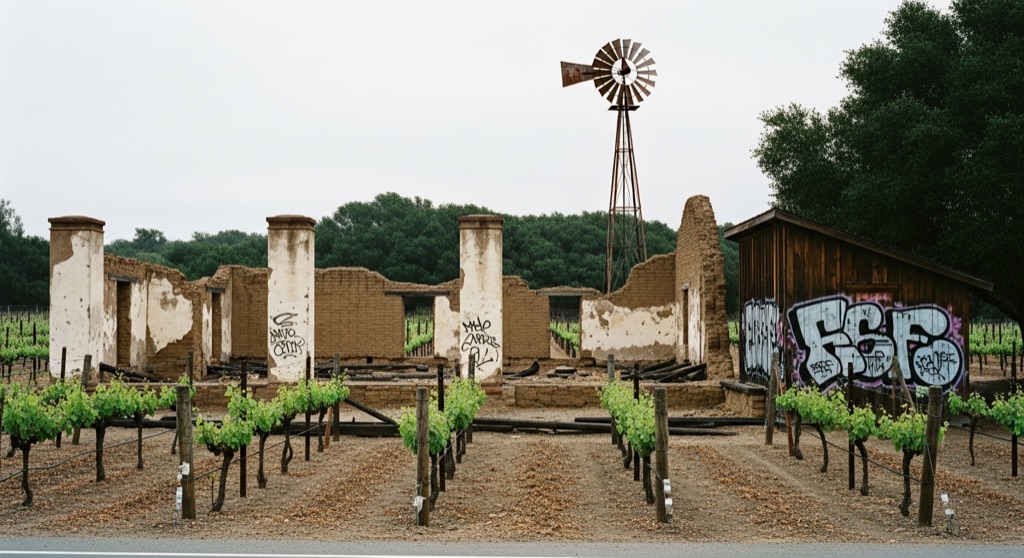
Built in 1837 by English sea captain Benjamin Foxen, this historic adobe home once served as the heart of the 8,874-acre Rancho Tinaquaic. Today, only melted adobe pillars, charred foundations, a rusty windmill, and a graffiti-covered wooden shack remain on the site. The ruins are located within the private Old Adobe Vineyard and are designated as Santa Barbara County Historical Landmark No. 7.
→ Three at a time, never the same twice — explore weird Santa Barbara
The story
In 1837, an English sea captain named Benjamin Foxen traded the ocean for an 8,874-acre Mexican land grant named Rancho Tinaquaic. He raised his homestead out of local sun-dried mud bricks right in the belly of the canyon that now carries his name. Nearly two centuries later, fire, rain, and gravity have steadily dragged the sprawling ranch house back into the dirt it was pulled from.
What remains isn't a manicured historical monument with velvet ropes or a gift shop—it's a phantom stranded in the middle of a working wine estate. Look across the fence and you'll spot melted adobe pillars slumping like sea stacks, charred foundation footprints, a leaning wooden shack tagged with spray paint, and a rusty windmill rising above the grapevines. It holds official status as Santa Barbara County Historical Landmark No. 7, but no one is out there sweeping the threshold.
What it's like
This is a brief, atmospheric roadside stop on a quiet country drive along Foxen Canyon Road. The ruins sit behind a perimeter fence inside the active Old Adobe Vineyard (owned by Lucas & Lewellen), so you won't be treading on the earthen floors yourself. Pull off safely onto the gravel shoulder, snap your photos of the melting mud pillars and rusted windmill through the fence, and keep moving down the canyon.
The move: Take a scenic drive along the Foxen Canyon Wine Trail, stopping to safely view and photograph the historic adobe ruins and rusty windmill from the roadside before heading to a nearby winery for a tasting.
📍 Before you go The ruins are located on private property within the active Old Adobe Vineyard (owned by Lucas & Lewellen) and are fenced off, but they can be easily viewed and photographed from Foxen Canyon Road.
- 📍 Santa Maria
- 💸 Free
- ⚡ Low-key
- 🌗 Outdoors
Where: Foxen Canyon Rd, Santa Maria, CA 93454, USA
Hours: Added 2026-07-20 — confirm current access before you go.
Pair it with
- Asphaltum Mine — Pair two bits of decaying 19th-century backcountry history by visiting this late-1890s natural bitumen mining site just four miles away.
- La Purisima Mission — Contrast Foxen's melted mud walls with a visit to Lompoc to walk through California's only fully reconstructed, un-roped mission complex.
- The Lost City of Cecil B. DeMille — Dunes Center — Trade 1830s ranch ruins for another set of forgotten regional walls—the plaster Egyptian ruins left behind by Cecil B. DeMille in 1923.
More weird in Santa Barbara


Good to know
Can you walk up to or touch the adobe ruins?
No. The ruins are enclosed by a fence on private vineyard property owned by Lucas & Lewellen. You can easily see and photograph the entire site from the edge of Foxen Canyon Road.
What is the history behind the site?
English sea captain Benjamin Foxen built the adobe in 1837 as the center of Rancho Tinaquaic, an 8,874-acre grant. Fire and decades of weathering eventually destroyed the home, turning it into Santa Barbara County Historical Landmark No. 7.
What exact structures are still visible from the road?
You can clearly see melted adobe earthen pillars, charred foundation lines, a weathered wooden shack marked with graffiti, and an ancient, rusty windmill.
Plan a visit & invite your people →
Further reading: independent.com · llwine.com · ne.maptons.com
last checked: 2026-07-20