Entry No. 6 — the Santa Barbara file — filed under: observatory
Palmer Observatory (Santa Barbara Museum of Natural History)
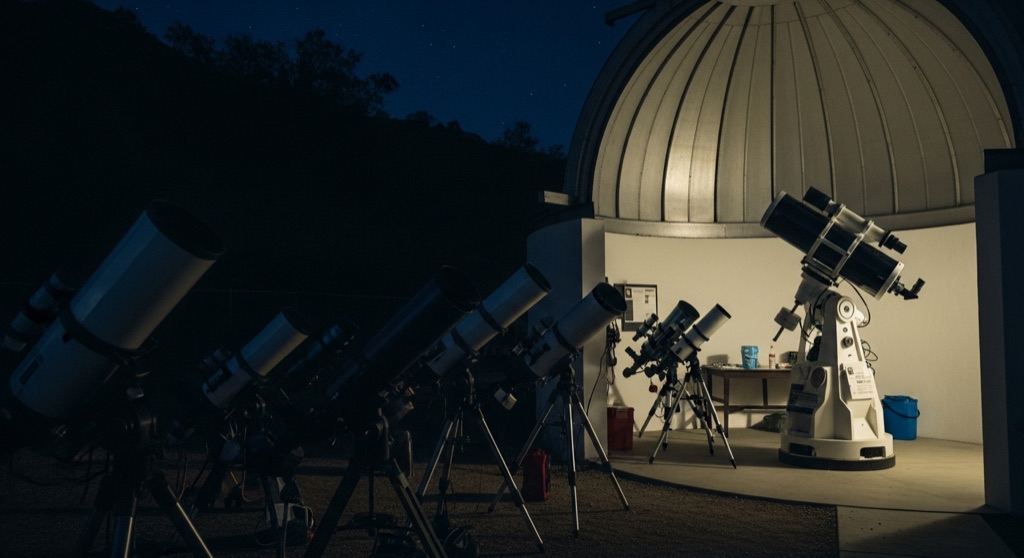
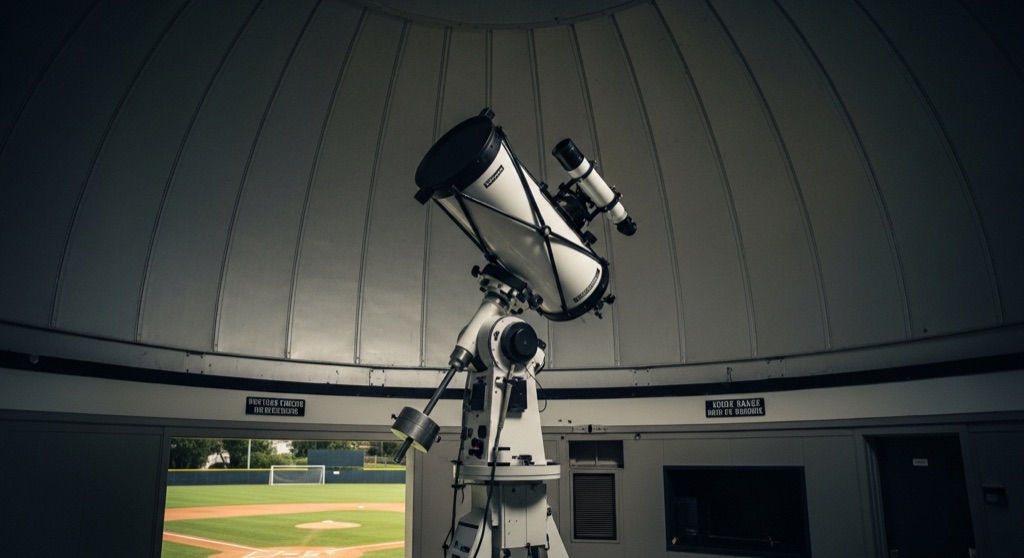
A 20-inch RCOS Ritchey-Chrétien telescope donated by Las Cumbres Observatory Global Telescope Network sits under a repurposed Ash-Dome (installed 2013), in the museum's Doris Faye Palmer Observatory, which opened August 1, 1968.
→ Three more after-dark & night-sky spots in Santa Barbara — never the same twice
The story
Tucked in the oak-canopied woods of Mission Canyon behind the main museum complex, the Doris Faye Palmer Observatory opened on August 1, 1968, though its current incarnation feels distinctly modern. Underneath a motorized Ash-Dome installed in 2013 sits a high-grade 20-inch Ritchey-Chrétien telescope—a serious piece of glass donated by the Las Cumbres Observatory Global Telescope Network.
What makes the place worth knowing about isn't just the main dome's optics, but the monthly ritual that happens around it. On the second Saturday of every month, members of the Santa Barbara Astronomical Unit set up a gauntlet of personally customized, privately owned telescopes along the museum's dark courtyard pathways, creating an open-air laboratory under the canyon shadows.
Because the museum sits far enough back into Mission Canyon to escape the worst of State Street's light spill, you get surprisingly crisp views of planetary detail. You'll spend five minutes looking at Saturn's Cassini division through a giant setup brought in on the back of someone's pickup, then pivot to the main dome to stare down an ancient globular cluster.
What it's like
Arrive right around dusk on a second Saturday and follow the dim red flashlights up the creek-adjacent paths to the observatory. The crowd is a mix of barefoot canyon locals, university undergrads, and retirees who know the precise focal length of every piece of brass on the lawn. Lines for the main 20-inch dome move steadily, but the secret is spending time chatting up the amateur astronomers outside—they will happily tweak their gear to show you faint nebulae or double stars you'd otherwise miss.
The move: Show up on the second Saturday of the month for the free Star Party (dusk to 10pm, co-run with the Santa Barbara Astronomical Unit), take turns at the museum's 20-inch scope and a row of volunteer-brought telescopes aimed at Saturn's rings or a globular cluster, then wander the dark, empty museum grounds afterward.
- 📍 Mission Canyon, Santa Barbara
- 💸 $
- ⚡ Low-key
- 🌗 Outdoors
Where: 2559 Puesta del Sol, Santa Barbara, CA 93105
Hours: Added 2026-07-20 — confirm current hours before you go.
Pair it with
- Old Mission Santa Barbara Cemetery & Mausoleum — Located just down the canyon road from the museum, this quiet historic site offers a solemn, historic contrast to an evening spent gazing at distant galaxies.
- Westmont College Observatory — If one night of stargazing isn't enough, compare the museum's 20-inch scope with Westmont's 24-inch Cassegrain reflector during their third-Friday public viewings.
- Arlington Theatre — the indoor starry ceiling — Swap real canyon constellations for the projected night sky painted above the classic 1931 Spanish courtyard set inside this historic downtown theatre.
More weird in Santa Barbara
Good to know
How much does it cost to attend the Star Party?
The monthly second Saturday Star Parties are completely free and open to the public from dusk until 10:00 PM.
What happens if it's cloudy or overcast?
Heavy cloud cover or fog in Mission Canyon means telescopes won't be able to target faint objects, so check local sky conditions before driving up.
Where is the observatory located on the museum grounds?
It sits toward the back of the Santa Barbara Museum of Natural History campus at 2559 Puesta del Sol, tucked into the woods near Mission Creek.
Plan a visit & invite your people →
Further reading: sbnature.org · sbau.org
last checked: 2026-07-20