Entry No. 31 — the San Francisco file — filed under: cemetery
Cypress Lawn Memorial Park
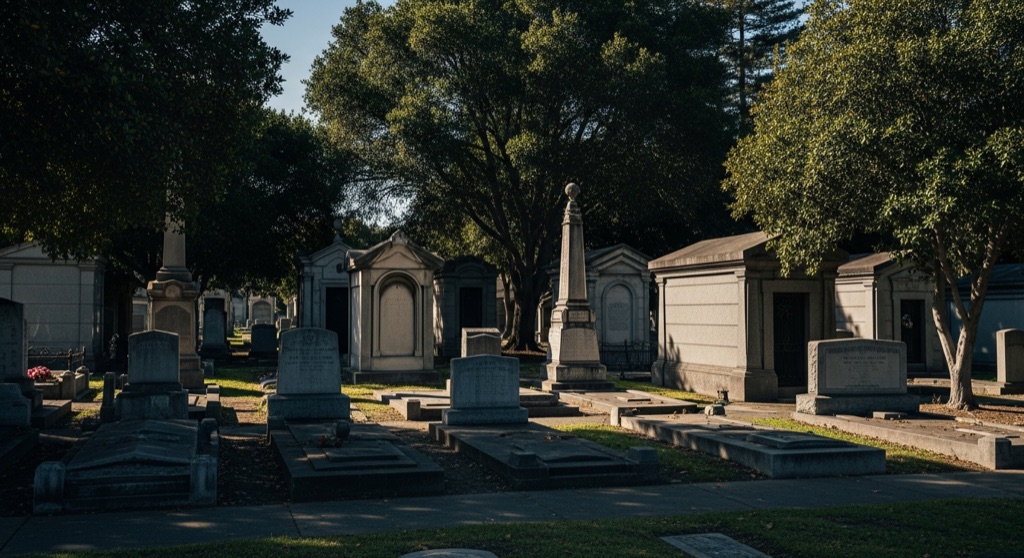
Founded in 1892 as San Francisco emptied its city cemeteries into this Peninsula town, Cypress Lawn is 148 acres of Gilded Age excess: a Mission Revival gate, a 1921 public mausoleum with catacombs designed by Bernard Cahill (the same architect behind SF's Columbarium), and a mound holding remains relocated from the old Lone Mountain Cemetery complex, marked with a 1993 obelisk. William Randolph Hearst and Willie McCovey are both buried here.
→ Three more haunted places & dark-history spots in San Francisco — never the same twice
The story
In 1900, San Francisco declared the dead an unacceptable drain on municipal real estate and banned all future burials within city limits. By the 1920s, city officials began systematically digging up existing graveyards and shipping their occupants south across the San Mateo County line. Hamden Holmes Noble saw it coming: he established Cypress Lawn in 1892, turning a 148-acre stretch of Colma into a high-end necropolis designed to receive San Francisco’s exiled past.
The grounds are built like a Gilded Age luxury subdivision for the deceased, complete with a Mission Revival entry gate, manicured lawns, and an arboretum of century-old Monterey cypress and exotic specimens. Architect Bernard Cahill—the man behind the copper-domed San Francisco Columbarium—designed the 1921 public mausoleum here, outfitting its subterranean catacombs with intricate stained glass and marble corridors. The roster of residents spans Bay Area aristocracy and pop culture, from newspaper kingpin William Randolph Hearst to SF Giants legend Willie McCovey.
Not everyone arrived with an individual plot and a private marble mausoleum. Tucked into the grounds is a grassy mound marked by a simple 1993 obelisk. Beneath it lie the commingled remains of tens of thousands of San Franciscans whose original graves in the old Lone Mountain and Laurel Hill cemetery complexes were bulldozed between 1920 and 1941 to make way for residential neighborhoods.
What it's like
Cruising down El Camino Real, the sheer scale hits you immediately: Cypress Lawn is cut into sprawling, quiet quadrants bisected by paved roads and giant mature trees. You can grab a map for the self-guided arboretum tour, but the real pull is stepping inside the public mausoleum complex, where colored light filters through stained glass onto rows of marble crypts and glass-front cremation niches. It’s remarkably quiet, save for the occasional roar of traffic off the boulevard and the distant hum of lawnmowers constantly manicuring the turf.
The move: Take the cemetery's self-guided arboretum walk past century-old Monterey cypress and the stained-glass-lit catacombs of the public mausoleum, then find the Lone Mountain relocation obelisk and talk about the 150,000 bodies San Francisco quietly moved out of the city between 1920 and 1941.
- 📍 Colma, CA
- 💸 $$
- ⚡ Up for anything
- 🌗 Indoors
Where: 1370 El Camino Real, Colma, CA 94014
Hours: Added 2026-07-20 — confirm current hours before you go.
Pair it with
- Hills of Eternity Memorial Park — Continue your Colma cemetery deep-dive right across the way at this 1889 Jewish burial ground, another direct outcome of San Francisco's graveyard bans.
- San Francisco Columbarium — Track down Bernard Cahill's original San Francisco masterpiece—a neoclassical rotunda tucked inside the Richmond District that survived the city's cemetery sweep.
- St. Francis of the Guns — Head north into the city to view Beniamino Bufano's bronze saint, cast from melted handguns collected during a late-1960s city buyback.
More weird in San Francisco

Good to know
Why is Cypress Lawn located in Colma instead of San Francisco?
San Francisco banned burials within city limits in 1900 and ordered existing cemeteries evicted in the 1920s. Colma was established specifically as a necropolis south of the city line to absorb more than 150,000 displaced bodies.
Who designed the public mausoleum at Cypress Lawn?
Architect Bernard Cahill designed the 1921 public mausoleum and catacombs. He is the same architect responsible for the San Francisco Columbarium in the Richmond District.
Where are the relocated remains from San Francisco buried?
Thousands of mass-relocated remains from SF's old Lone Mountain and Laurel Hill cemeteries rest beneath a marked earth mound inside Cypress Lawn, commemorated by a 1993 obelisk.
Can you tour the trees on the property?
Yes. Cypress Lawn doubles as a recognized arboretum, featuring self-guided walking tours past century-old Monterey cypresses and rare tree species from around the world.
Plan a visit & invite your people →
Further reading: Wikipedia · Official site · findagrave.com
last checked: 2026-07-20