Entry No. 18 — the San Diego file — filed under: repurposed water tank
Centro Cultural de la Raza
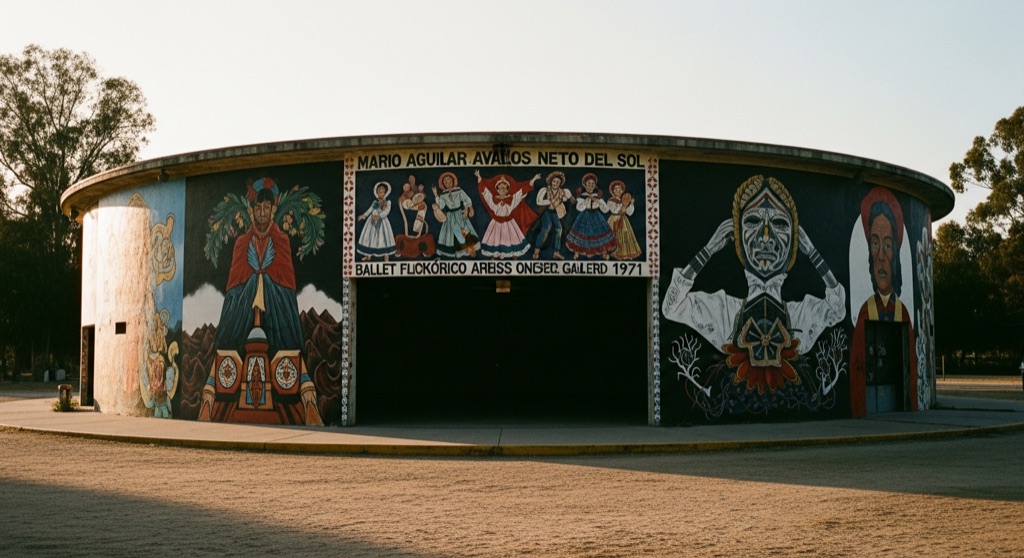
A circular 1914 water tank that sat abandoned until Chicano artists occupied it in 1971, painted the interior with murals like 'La Dualidad' and ringed the exterior with works by Mario Aguilar, David Avalos, and Neto del Sol — the drum-shaped shell now holds a 150-seat performance hall and gallery.
→ Three more haunted places & dark-history spots in San Diego — never the same twice
The story
If you walk along the eastern rim of Balboa Park, past the formal Spanish Revival arcades and manicured lawns, you’ll hit a massive concrete cylinder that once held municipal water. Built in 1914, the tank sat idle for decades until 1970, when a collective of Chicano and Indigenous artists—briefly operating out of the park’s Ford Building—decided to carve out their own autonomous space. On July 11, 1971, they inaugurated the Centro Cultural de la Raza inside the drum, reclaiming municipal infrastructure as a home for Chicano, Mexicano, Latino, and Indigenous art.
Instead of hiding or demolishing the brutalist concrete shell, the artists treated every curved foot of it as a canvas. Outside, a continuous band of murals rings the exterior, featuring works by artists like Mario Aguilar, David Avalos, and Neto del Sol. Inside the cylinder's hollow belly, monumental works like 'La Dualidad' wrap around a circular gallery and a 150-seat performance space, turning the echo of an old water vault into a stage for theater, dance, and grassroots organizing.
What it's like
Take a slow 360-degree walk around the exterior walls before you ever step through the doorway—the ring of outdoor murals is an open-air archive that sets the stage for what's inside. Step through the entrance and the circular geometry immediately throws off your sense of direction; you're standing in a rounded gallery with thick concrete walls and unique acoustics. Because programming is community-run, the indoor space flips between art exhibitions, Ballet Folklórico rehearsals, film screenings, and the Tianguis de la Raza artisan market—check their calendar online before going so you don't hit a closed door.
The move: Walk the mural-ringed exterior at golden hour, then check the calendar for a Ballet Folklórico performance or the Tianguis de la Raza market inside the old tank's round gallery.
- 📍 Balboa Park
- 💸 $$
- ⚡ Up for anything
- 🌗 Indoors
Where: 2004 Park Blvd, San Diego, CA 92101
Hours: Added 2026-07-19 — confirm current hours before you go.
⚠ Seasonal or scheduled — always check before you go.
Pair it with
- WorldBeat Cultural Center — Walk a few steps over to WorldBeat, another repurposed Balboa Park municipal water tower transformed into an autonomous community arts space.
- San Diego Model Railroad Museum — Contrast Centro's political mural legacy with 27,000 square feet of meticulously engineered model train layouts built by rival local clubs inside the park.
- Mothership — Head down Park Boulevard into South Park for a sci-fi tiki cocktail inside a simulated crashed spaceship after exploring the historic water tank.
More weird in San Diego
Good to know
Where is the Centro Cultural de la Raza located?
It is located at 2004 Park Blvd, along the eastern edge of Balboa Park in San Diego.
What was the building before it became an arts center?
It was originally built in 1914 as a city water tank before sitting abandoned and eventually being reoccupied by Chicano artists in 1971.
What can you see inside?
Inside the converted circular tank is a 150-seat performance hall, a round gallery space featuring Chicano, Mexicano, Latino, and Indigenous art, and interior murals including 'La Dualidad'.
Do you need tickets to visit?
Walking the exterior mural ring is free and accessible anytime; entry to the interior gallery, performances, or markets varies by event, so confirm hours and schedule before you head over.
Plan a visit & invite your people →
Further reading: Wikipedia · kpbs.org · Official site · sandiegomuseumcouncil.org · balboapark.org
last checked: 2026-07-19