Entry No. 36 — the San Antonio file — filed under: history
Miraflores Park
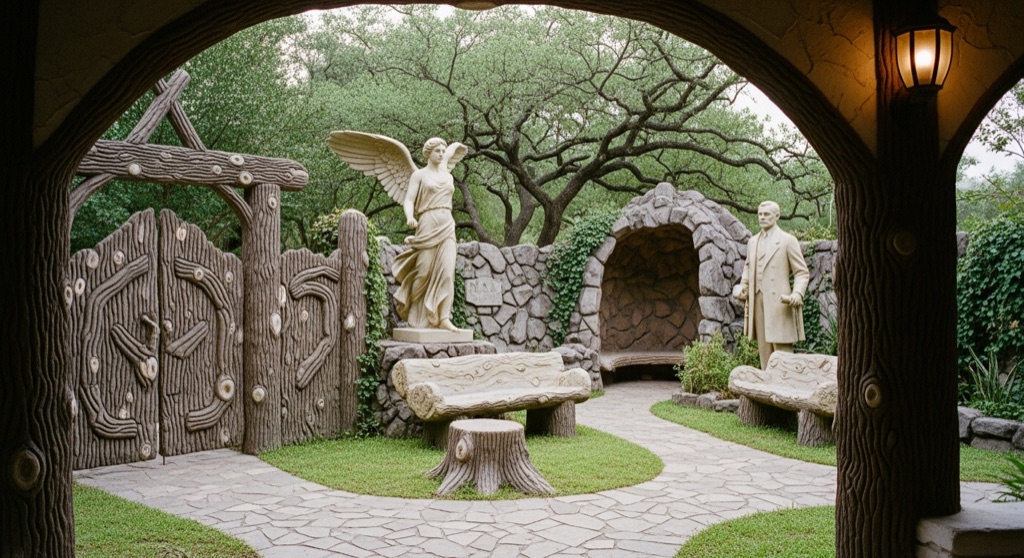
A forgotten 1920s private garden built by Dr. Aureliano Urrutia, a surgeon who fled the Mexican Revolution, modeled on his native Xochimilco — faux-bois "wood" gates, a covered bench, and a grotto poured entirely from tinted concrete by Dionicio Rodríguez, plus a life-size statue of the doctor and a Winged Victory replica.
→ Three more weird outdoor & roadside oddities in San Antonio — never the same twice
The story
In 1914, Dr. Aureliano Urrutia—a prominent surgeon—fled Mexico City during the upheaval of the Mexican Revolution and settled in San Antonio. Homesick for the floating gardens of Xochimilco, he bought a five-acre plot along Hildebrand Avenue in the 1920s and set about building a personal, surreal sanctuary. He populated the grounds with classical statuary, including a replica of the Winged Victory of Samothrace and a life-size statue of himself, weaving water features and tile work through dense plantings to construct a physical memory of the homeland he lost.
The garden’s true structural genius, however, came from Mexican artisan Dionicio Rodríguez. Employing the technique known as *el trabajo rústico*, Rodríguez manipulated wet, tinted concrete to imitate timber, rotting tree bark, knotholes, and mossy stumps. At Miraflores, Rodríguez poured and sculpted an ornate grotto, entry gates, and a covered bench—structures that look entirely like hand-hewn wood until you touch them and feel cold, indestructible concrete.
Over the decades, the private garden fell into disrepair, swallowed by brush and forgotten behind heavy traffic corridors. While the site was eventually placed on the National Register of Historic Places and has undergone recent archaeological research and path restoration, it retains its quiet, secretive atmospheric charge tucked away off the main road.
What it's like
Pull off Hildebrand Avenue and you'll find a quiet five-acre pocket where the city noise fades remarkably fast. As you follow the restored walking paths, pay close attention to the hardscaping: almost every 'wooden' bench, gate post, and grotto surface you see is actually century-old concrete molded by hand. It is a slow, atmospheric walk that doesn't take long to cover, but access and open hours can be unpredictable—make sure to verify site availability before you go.
The move: Walk the quiet, recently restored paths off Hildebrand and try to spot which "logs," stumps, and stonework are actually century-old concrete illusions.
- 📍 Near Brackenridge Park / Hildebrand corridor
- 💸 Free
- ⚡ Up for anything
- 🌗 Outdoors
Where: 800 Hildebrand Ave, San Antonio, TX 78212
Hours: Added 2026-07-20 — confirm current hours before you go.
Pair it with
- Dionicio Rodríguez's Faux-Bois Bridge & Torii Gate, Brackenridge Park — Walk half a mile into neighboring Brackenridge Park to examine more faux-bois concrete illusions built by the exact same artisan, Dionicio Rodríguez.
- Portland Cement Plant Ruins — Located just 0.6 miles away, these 1880s industrial ruins provided the regional concrete backbone that artists like Rodríguez later sculpted into art.
- Jazz, TX — Pair Dr. Urrutia's 1920s exiled sanctuary with a basement 1920s speakeasy session down the street at the Pearl.
More weird in San Antonio

Good to know
Who built Miraflores Park?
It was created in the 1920s by Dr. Aureliano Urrutia, a Mexican surgeon who fled to San Antonio in 1914 during the Mexican Revolution.
What is faux-bois concrete?
It is an art form (*el trabajo rústico*) where wet, tinted concrete is hand-carved and detailed to look precisely like natural wood logs, bark, and stone. Master artisan Dionicio Rodríguez crafted the grotto, gates, and bench here.
Are there actual statues in the park?
Yes, Dr. Urrutia installed classical art pieces throughout the grounds, including a Winged Victory replica and a life-size statue of himself.
Plan a visit & invite your people →
Further reading: Wikipedia · tclf.org · texasstandard.org · ksat.com · mysanantonio.com
last checked: 2026-07-20