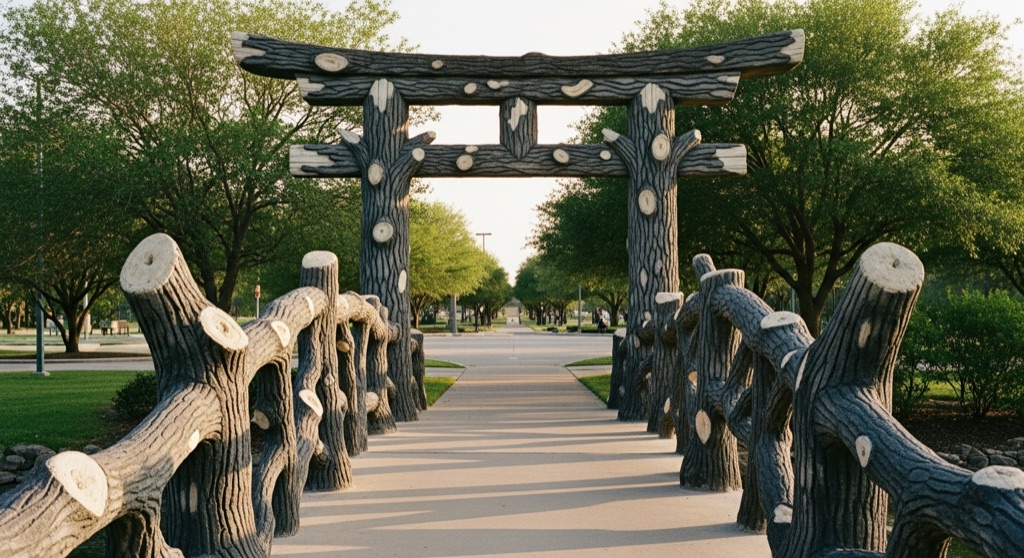
Entry No. 28 — the San Antonio file — filed under: outdoor
Dionicio Rodríguez's Faux-Bois Bridge & Torii Gate, Brackenridge Park
A pedestrian bridge that looks assembled from gnarled tree limbs, complete with fake bark, knotholes, and broken branch stubs, is actually cast concrete — one of Mexican folk artist Dionicio Rodríguez's 1920s "faux bois" illusions, done with the same trompe-l'oeil technique he used on the garden's torii-style entrance gate.
→ Three more weird outdoor & roadside oddities in San Antonio — never the same twice
The story
In the 1920s, Mexican artisan Dionicio Rodríguez arrived in San Antonio carrying steel rebar, buckets of cement, and secret chemical formulas for stains that he guarded so fiercely he often worked behind canvas tarps to keep onlookers from stealing his process. What he built in Brackenridge Park looks like decaying timber frozen in time: a pedestrian bridge constructed from what appears to be gnarled cedar limbs, complete with split knotholes, fake bark texture, and broken branch stubs. Walk up to it and rap your knuckles against the wood grain—it’s solid, hand-molded reinforced concrete.
The craft is known as *trabajo rústico* (or *faux bois*), and Rodríguez was its master. Instead of carving finished stone, he sculpted wet mortar over iron frameworks using simple hand tools, twigs, and tin cans, treating the concrete like clay before applying washes of copper, lye, and iron to replicate raw wood tones. Just up the trail at the entrance to the Japanese Tea Garden, Rodríguez and collaborator Máximo Cortés built a sweeping torii gate using the exact same trick, pulling off an uncanny architectural trompe-l'oeil hiding in broad daylight.
What it's like
Skip the main zoo entrance lines and head directly for the river loop near the park's golf course edge to find the bridge. There are no velvet ropes, fences, or loud brass plaques forcing you along a turnstile; it just sits there acting like a fallen log crossing a drainage creek until you touch the cold stone surface. Further up at the Tea Garden, the entrance gate looks like giant bamboo and cedar trunks bound together. Go on a quiet weekday morning when fog hangs over the park—that's when the organic decay illusion feels most convincing.
The move: Skip the zoo and Tea Garden lines; walk the golf-course loop along the river specifically to find the bridge and run your hand over the "bark" to feel it's stone-cold concrete.
- 📍 Brackenridge Park
- 💸 Free
- ⚡ Up for anything
- 🌗 Outdoors
Where: 3700 N St Mary's St, San Antonio, TX 78209
Hours: Added 2026-07-20 — confirm current hours before you go.
Pair it with
- Miraflores Park — Located just half a mile away, Dr. Urrutia's former private estate features more of Dionicio Rodríguez's early faux-bois stonework hidden among Xochimilco-inspired garden ruins.
- Portland Cement Plant Ruins — A 0.4-mile walk brings you to the crumbling 1880s industrial site that kickstarted the local cement industry Rodríguez relied on for his concrete sculptures.
- Holy Diver Tiki Lounge — Trade Rodríguez's concrete wood illusions for mid-century tropical theatricality by heading 1.2 miles down St. Mary's Strip to this hidden upstairs tiki lounge.
More weird in San Antonio

Good to know
Where in the park are the bridge and torii gate located?
The footbridge spans a small channel along the walking loop near the golf course inside Brackenridge Park, while the faux-bois torii gate marks the main entrance to the adjacent Japanese Tea Garden at 3700 N St Mary's St.
What is faux bois / trabajo rústico?
It is the art of sculpting wet concrete over metal armatures to imitate natural wood. Rodríguez shaped the wet cement by hand and tinted it with chemical stains to mimic bark, knots, and weathered timber.
How much does it cost to visit?
Nothing. Both Brackenridge Park and the entrance grounds to the Japanese Tea Garden are free and open to the public.
Did Dionicio Rodríguez really keep his cement formulas secret?
Yes. He mixed his own chemical pigments and cement additives without recording them on paper, taking his precise recipes for realistic wood finishes to his grave in 1955.
Plan a visit & invite your people →
Further reading: Wikipedia · tshaonline.org · penick.net · sanantonioreport.org · sah-archipedia.org
last checked: 2026-07-20