Entry No. 28 — the Portland file — filed under: cabinet of curiosities
The Zymoglyphic Museum
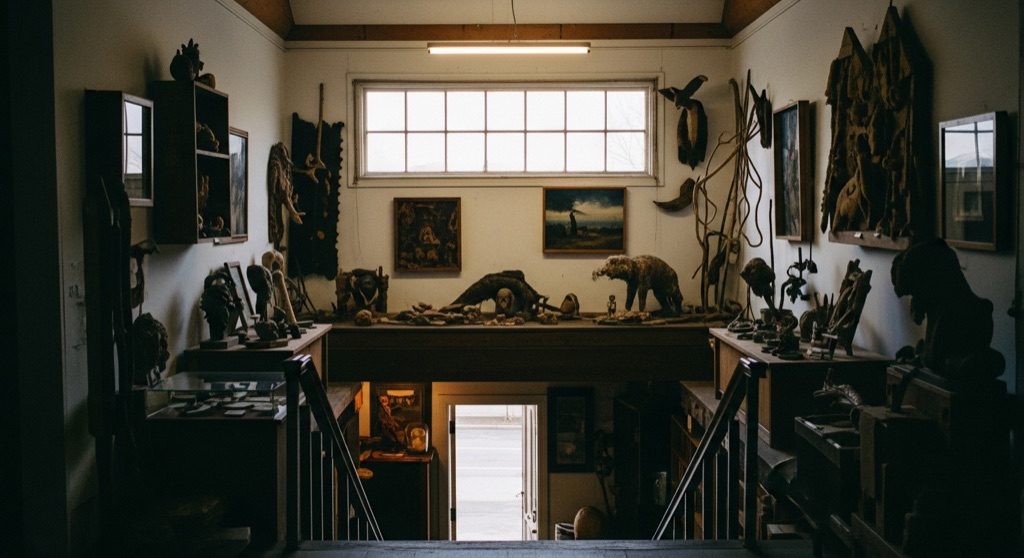
A converted garage turned into 'the world's only institution dedicated to the study and display of art, artifacts, and natural history from the Zymoglyphic region' — a wholly invented land whose fictional taxidermy, decay-themed 'Rust Age' displays, and resin silicate gardens read as a cabinet of curiosities for a place that never existed.
→ Three more oddity shops & curiosities in Portland — never the same twice
The story
Tucked behind a quiet residential home near Mount Tabor sits a second-floor space above a converted garage that houses an institution dedicated entirely to a place that does not exist. Created by artist Jim Stewart, the Zymoglyphic Museum presents itself with the unblinking, scholarly gravity of a 19th-century natural history repository—complete with velvet-lined shadow boxes, glass cloches, and cataloged field specimens. The catch is that every relic on display hails from the Zymoglyphic region, a completely fabricated world rendered with total devotion to its own internal logic.
Walk the small room and you will find artifacts categorized by era, including crusty corrosion-heavy relics from the region's "Rust Age" and delicate silicate flora locked in resin. The specimens are intricate works of assemblage art and rogue taxidermy: dried seed pods, weathered animal bones, marine shells, tarnished brass, and insect limbs spliced into realistic crustaceans, desert-dwelling organisms, and biomechanical beasts. The museum treats these impossible creatures not as surreal art, but as bone-dry zoological fact.
What it's like
You will pull up to a residential block on SE Alder Street, walk past the main house, and head up the exterior stairs to the small gallery above the garage. Admission is free, but open hours are tight—typically a four-hour window on the second and fourth Sundays of the month between 11am and 3pm. Stewart is often right there in the room, ready to answer questions. Give yourself a slow half hour to lean in close and read the meticulously typed museum labels; the fun is trying to trace where real natural elements end and invented taxonomy begins.
The move: Show up on a 2nd or 4th Sunday between 11am and 3pm — the only hours it opens — climb the stairs to the second-floor space, and spend a slow half hour picking apart which specimens are 'real' before it closes for the week.
- 📍 Mount Tabor / Southeast Portland
- 💸 $$
- ⚡ Up for anything
- 🌗 Indoors
Where: 6225 SE Alder St, Portland, OR 97215
Hours: Added 2026-07-20 — confirm current hours before you go.
Pair it with
- Roosevelt's Terrariums — Walk less than a mile west to swap fabricated botanical anomalies for real miniature moss ecosystems built inside glass vessels.
- Artemisia: Collage with Nature — Continue the focus on organic textures by visiting this SE 28th scent bar and natural art workshop.
- Lone Fir Cemetery — Block 14 — Follow up an afternoon of fictional decay and natural history with a walk through Portland's oldest Victorian burial ground.
- Joseph Wood Hill Park at Rocky Butte — Head northeast to an extinct volcanic cinder cone to take in real panoramic city views after exploring invented geography.
More weird in Portland
Good to know
Where is the Zymoglyphic Museum located?
It is located in a converted space above a garage at 6225 SE Alder St in the Mount Tabor neighborhood of Southeast Portland.
How much does it cost to visit?
Admission is completely free.
When is the museum open?
Public access is limited, typically opening on the 2nd and 4th Sundays of the month from 11:00 am to 3:00 pm. Always double-check current hours on their official site before visiting.
Are the taxidermy and artifacts real?
The physical materials—bones, seed pods, shells, metal, and resin—are real physical assemblage pieces, but they represent organisms and artifacts from an entirely fictional continent.
Plan a visit & invite your people →
Further reading: Official site · thatoregonlife.com · Roadside America · Atlas Obscura · wweek.com
last checked: 2026-07-20