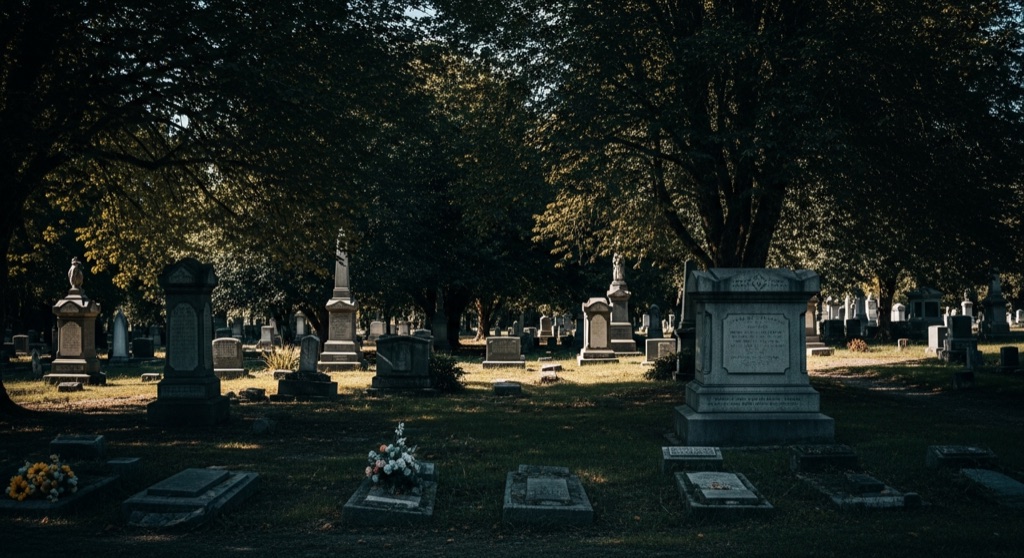
Entry No. 16 — the Portland file — filed under: cemetery
Lone Fir Cemetery — Block 14
Portland's second-largest arboretum doubles as its most quietly disturbing burial ground: the southwest corner, Block 14, holds an unmarked mass grave of Chinese railroad laborers whose remains were bulldozed over in 1948, plus 132 forgotten patients of the Oregon Hospital for the Insane, buried at $5 a body and rediscovered only in 2004 via ground-penetrating radar under what had become a county building and parking lot.
→ Three at a time, never the same twice — explore weird Portland
The story
Lone Fir looks like a peaceful municipal arboretum on the surface—sprawling shade trees, mossy Victorian headstones, inner-Eastside dog walkers—but you didn't come here for the scenery. Head directly to the southwest corner at Block 14 to see where Portland literally paved over its own forgotten history.
In the late 19th century, this plot was set aside as the Old Chinese Burial Ground for immigrant railroad laborers, alongside 132 patients from the Oregon Hospital for the Insane whose interments were contracted out by the state for five dollars a corpse. Instead of preserving the cemetery, Multnomah County bulldozed the grave markers in 1948, put down asphalt, and built a county road maintenance shop directly over the human remains.
County service trucks parked over the mass grave for over five decades until 2004, when ground-penetrating radar confirmed hundreds of bodies were still resting beneath the pavement. The county eventually demolished the shop, issued formal apologies for the historic harm, and began work on a Cultural Heritage Garden to finally acknowledge the people buried underfoot.
What it's like
Walking into Lone Fir feels like strolling through a quiet, tree-heavy neighborhood sanctuary, but Block 14 stands out immediately for what isn't there. Instead of ornate 19th-century granite monuments, this southwest corner is an open, understated space transitioning into a dedicated memorial garden. Hit the free self-guided 'Stories in Stone' trail around dusk when the shadows stretch through the Douglas firs—it's a heavy, sobering stop that strips away any sanitized rose-colored myths about Portland's early days.
The move: Walk the free self-guided Stories in Stone trail at dusk, then find the Cultural Heritage Garden memorial marking where the asylum patients and Chinese laborers were finally acknowledged.
- 📍 Buckman / Southeast Portland
- 💸 $$
- ⚡ Up for anything
- 🌗 Indoors
Where: 2115 SE Morrison St, Portland, OR 97214
Hours: Added 2026-07-20 — confirm current hours before you go.
Pair it with
- Scotch Lodge — After processing the heavy historical gravity of Block 14, walk less than a mile west to this dark, windowless whiskey bar for a quiet drink.
- Artemisia: Collage with Nature — Balance out a heavy walk through Portland's historic burial grounds by crafting a custom botanical scent at this natural perfumery four blocks away.
- Clinton Street Theater — Rocky Horror at 11pm — If you are exploring Lone Fir at dusk on a Saturday, head a mile south to catch a midnight screening at one of the country's longest-running cult film revivals.
More weird in Portland

Good to know
Where in the cemetery is Block 14 located?
Block 14 sits in the far southwest corner of Lone Fir Cemetery, near the intersection of SE 20th Avenue and SE Morrison Street.
How much does it cost to visit?
It is completely free to enter Lone Fir Cemetery and walk the self-guided grounds.
Who was buried in Block 14?
The block holds Chinese immigrant workers and railroad laborers, along with 132 patients from the Oregon Hospital for the Insane who died while institutionalized.
Why were there no headstones on Block 14 for so many years?
Multnomah County bulldozed the site in 1948 to build a public works facility and parking lot over the graves, which remained until ground-penetrating radar exposed the site in 2004.
Plan a visit & invite your people →
Further reading: Wikipedia · oregonarchive.org · Official site · oregonmetro.gov · opb.org · multco.us
last checked: 2026-07-20