Entry No. 11 — the Phoenix file — filed under: history
Arcosanti
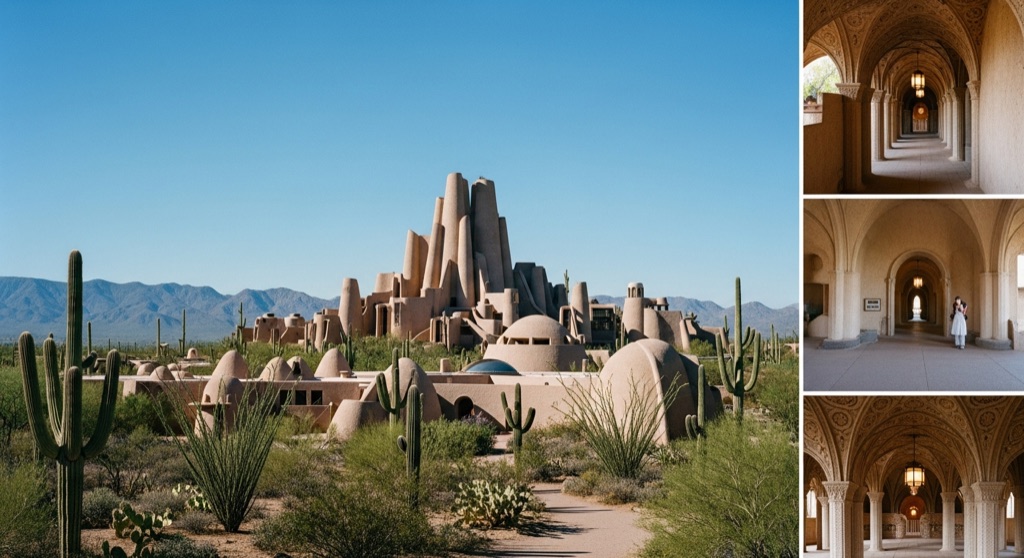
Paolo Soleri's half-built utopian 'arcology' city rises out of the mesquite 70 miles north of Phoenix — poured-concrete apses cast with local silt, a bronze foundry, and a skyline meant to eventually house 5,000 people but which has topped out around 50-150 residents since 1970.
→ Three more weird outdoor & roadside oddities in Phoenix — never the same twice
The story
In 1970, Italian architect Paolo Soleri—a former apprentice of Frank Lloyd Wright—drove 70 miles north of Phoenix into the high desert basalt mesa near Cordes Junction and started pouring concrete directly into the earth. Soleri called his grand experiment 'arcology,' a hyper-dense fusion of architecture and ecology designed to wipe out suburban sprawl. His construction method was as odd as the premise: workers carved deep molds directly into the desert silt, poured reinforced concrete over the mounds, and dug out the dirt underneath once the shell cured, leaving behind massive, scoop-shaped apses built directly out of the ground.
Over fifty years later, Arcosanti is less than five percent complete. The high-density retro-futurist city meant to house 5,000 people topped out at a resident count hovering between 50 and 150 people. What remains is a quiet, half-built concrete monument stuck between a 1970s sci-fi commune and an active artisanal workshop. The entire site keeps its lights on partly through an open-air foundry, where residents pour molten bronze into silt molds to produce Soleri's famous wind bells for tourists.
What it's like
Turn off I-17 onto a dirt road and follow it to the edge of the canyon. To see anything beyond the visitor center and cafe, you need to be on one of the resident-led guided tours—otherwise, most of the residential terraces and vault spaces are off-limits. Expect a lot of stairs, steep concrete paths, and open ledges without defensive guardrails. If you visit on a weekday morning, you might catch the foundry crew pouring 2,000-degree bronze into earth molds, filling the canyon air with the smell of scorched silt and furnace smoke. Wear solid walking shoes and grab lunch at the on-site cafe overlooking the Agua Fria canyon before heading back to the highway.
The move: Book the 9:30, 11:00, or 2:00 resident-led tour Thursday through Sunday, wander the half-finished vaults and amphitheater together, then grab a bell from the on-site foundry shop as a shared souvenir of the strangest city plan in Arizona.
- 📍 Cordes Junction / Mayer
- 💸 Free
- ⚡ Up for anything
- 🌗 Outdoors
Where: 13555 S Cross L Rd, Mayer, AZ 86333
Hours: Added 2026-07-19 — confirm current hours before you go.
⚠ Seasonal or scheduled — always check before you go.
Pair it with
- Rock Springs Cafe — Stop for a slice of pie and a cold drink at this 1918 stagecoach water stop on your drive back south down I-17.
- Carefree Sundial — Pair Soleri’s 1970s solar-oriented arcology with another mid-century desert solar experiment in nearby Carefree.
- Del Pasco Mine — Contrast Soleri’s unfinished utopian city with the decaying, real-world ruins of an 1870s gold strike deeper in the Bradshaw Mountains.
More weird in Phoenix
Good to know
Do people actually live at Arcosanti full-time?
Yes. A permanent crew of roughly 50 to 150 people—including foundry artisans, maintenance staff, researchers, and workshop participants—resides in units built into the concrete vaults and apses.
Can you walk around Arcosanti without a tour ticket?
Only in limited areas. The visitor center, gallery, and cafe are open to drop-ins, but access to the actual architectural vaults, amphitheater, and residential structures requires a booked guided tour.
What is the bronze foundry on site?
It is a working foundry where artisans cast bronze and ceramic wind bells designed by Paolo Soleri. Sales of these bells fund the Cosanti Foundation and the ongoing operation of the site.
Can you stay overnight at Arcosanti?
Yes. Arcosanti has a small collection of guest rooms and suites available for overnight stays on-site, which must be reserved in advance through their website.
Plan a visit & invite your people →
Further reading: Official site · Wikipedia
last checked: 2026-07-19