Entry No. 27 — the New Orleans file — filed under: outdoor
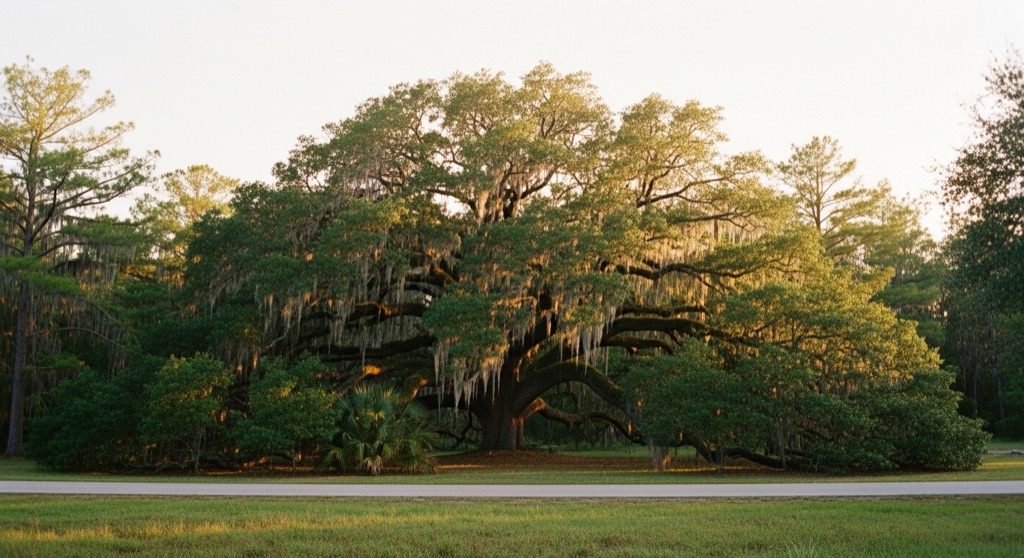
The Tree of Life (Etienne de Boré Oak)
This colossal southern live oak sprawls so low and wide that its limbs rest on the ground and rise again like a second forest, a crown roughly 160 feet across draped in Spanish moss. Inducted as one of the original members of the Live Oak Society and likely planted around 1740, it sits on land that was once Etienne de Boré's sugarcane plantation, adjacent to Audubon Zoo's giraffe exhibit. Generations of New Orleanians have climbed and sat inside its tangle of low branches, which is exactly what makes it a folk landmark rather than a roped-off relic.
→ Three more weird outdoor & roadside oddities in New Orleans — never the same twice
The story
Most 300-year-old organisms are protected by security cameras, velvet ropes, or thick wrought-iron fences. The Étienne de Boré Oak—universally called the Tree of Life—gets none of that. Planted around 1740 on land that originally served as Étienne de Boré’s sugarcane plantation, this colossal southern live oak (*Quercus virginiana*) spans roughly 160 feet from edge to edge. Over centuries, its lowest boughs grew so heavy that they sank to the ground, rested on the turf, and then turned upward again, creating a secondary ring of trunks you can stride across like wooden footbridges.
Inducted as one of the original charter members of the Live Oak Society, the tree sits on the riverward side of Audubon Park, wedged right against the back fence of the Audubon Zoo's giraffe exhibit. If you climb into the upper crotches of the branches or stand along the north side of the canopy, you can often look over the wooden boundary wall and watch giraffes grazing just thirty yards away.
What makes the place unusual isn't just its scale or age, but its complete accessibility. It operates as an unscripted neighborhood common—generations of New Orleanians have used its smooth, worn bark troughs as outdoor couches, picnic platforms, and wedding altars. You aren't meant to admire it from behind a bronze marker; you're meant to get sap on your elbows.
What it's like
Head toward the river side of Audubon Park near Magazine Street and follow the paved path past the zoo boundary. The vibe is relaxed and deeply local: you'll usually find kids scaling the lowest trunks, people reading inside the hollows formed by the canopy, and couples sitting on the horizontal boughs at dusk to watch golden light hit the Spanish moss. There are no fees or gates around the tree itself, but bring a blanket if you prefer grass over rough bark, and keep your eyes peeled toward the zoo fence for an accidental animal sighting.
The move: Pack a picnic and claim a spot in the tree's low, climbable limbs at golden hour to watch the moss catch the light.
- 📍 Uptown / Audubon Park
- 💸 Free
- ⚡ Up for anything
- 🌗 Outdoors
Where: Audubon Park, near Magazine St & the river, New Orleans, LA 70118
Hours: Added 2026-06-22 — confirm current hours before you go.
Pair it with
- Prytania Theatre Midnight Movies — Pair an afternoon under the oak canopy with a late-night screening at Louisiana's oldest operating single-screen movie house just a mile away.
- Cure — Walk or drive up to Freret Street after sunset to trade park dirt for craft cocktails in a converted firehouse.
- Rendezvous Tavern — Head down Magazine Street afterward to clear the moss out of your hair with local beer and a dedicated pinball room.
More weird in New Orleans

Good to know
How old is the Tree of Life?
It was planted around 1740, making it nearly three centuries old, and was an original inductee into the Live Oak Society.
Where is it located in Audubon Park?
It sits on the south side of the park near Magazine Street and the Mississippi River levee, directly adjacent to the back of the Audubon Zoo's giraffe enclosure.
Are you really allowed to climb it?
Yes. The tree is not roped off, and sitting or climbing on its low-hanging, ground-resting branches is a long-standing local tradition.
Is there an entry fee?
No, access to the tree and Audubon Park is free and open to the public.
Plan a visit & invite your people →
Further reading: Wikipedia · audubonnatureinstitute.org · 100oaks.blog · Atlas Obscura
last checked: 2026-06-22