Entry No. 9 — the New Orleans file — filed under: oddities
New Orleans Pharmacy Museum
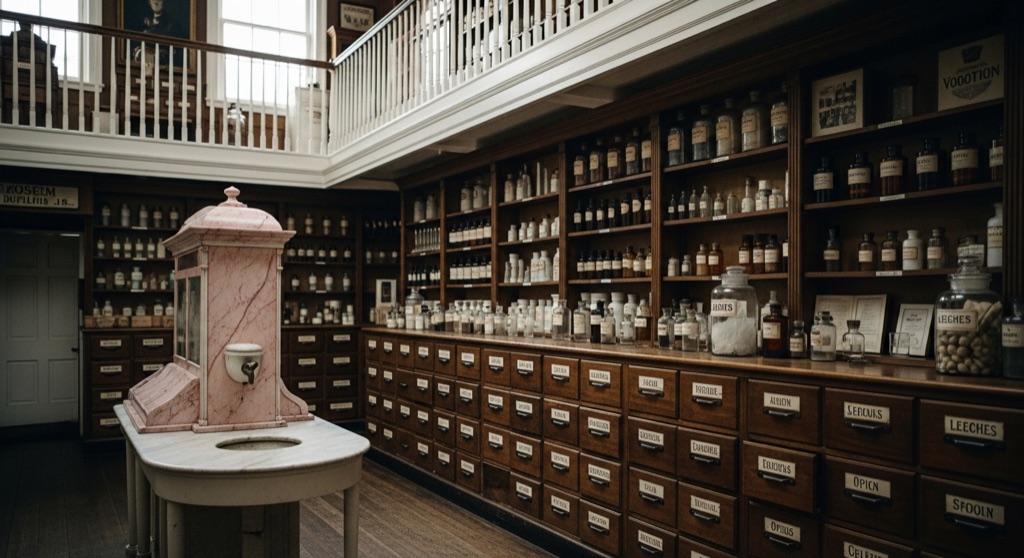
Set in an 1823 apothecary built for Louis Dufilho Jr., often cited as America's first licensed pharmacist, this two-story museum keeps its original rose-and-black Italian marble soda fountain from 1855 and rows of hand-labeled drawers and bottles. Among the cures are gris-gris voodoo potions Dufilho reportedly learned to make from a local priestess and sold by number under the counter, plus a white ceramic jar labeled "Leeches" holding live specimens. The collection runs to bloodletting tools, opium tinctures and 19th-century surgical instruments.
→ Three more oddity shops & curiosities in New Orleans — never the same twice
The story
Step off Chartres Street and into 514 Chartres, an 1823 French Quarter townhouse that belonged to Louis Dufilho Jr.—the man recognized as America’s first licensed pharmacist. Before Louisiana instituted a board examination in the early 1800s, anyone with a mortar and a pocketful of dried herbs could set up shop and sell you whatever they pleased. Dufilho legitimized the business, but he kept one foot firmly in the city’s underground remedy trade.
Inside, glass-fronted cabinets hold original bloodletting lancets, crude surgical saws, opium tinctures, and an 1855 rose-and-black Italian marble soda fountain from the era when carbonated water was treated as a delivery vehicle for medicinal tonics. Beneath rows of hand-labeled wooden drawers sits a white ceramic jar stamped for leeches, alongside a set of glass bottles labeled only by number. Dufilho reportedly learned to craft gris-gris voodoo potions from a local priestess, quietly selling them under the counter to customers who knew which code to request.
What it's like
Expect a quiet, dim refuge from the French Quarter pavement, smelling faintly of old cypress and dusty glass jars. You can self-guide through the two floors and courtyard in under an hour, but catch the 10 a.m. morning guided tour if your timing aligns—the docents lay out the grim details of 19th-century surgery and patent medicine without sugarcoating anything. Pay close attention to the lower shelves, where it's easy to walk right past the numbered voodoo bottles.
The move: Take the morning guided tour together, then linger over the antique surgical cabinets and voodoo-potion shelf and debate which 1800s 'cure' you'd least want prescribed.
📍 Before you go Open Tuesday-Saturday, roughly 11am-4pm; the 10am Sunday slot is guided-tour only and they are closed Mondays.
- 📍 French Quarter
- 💸 $
- ⚡ Up for anything
- 🌗 Indoors
Where: 514 Chartres St, New Orleans, LA 70130
Hours: Added 2026-06-22 — confirm current hours before you go.
Pair it with
- Tijon New Orleans — After looking at 19th-century apothecary bottles, walk a block over to pull on a lab coat and mix your own custom fragrance from a wall of essential oils.
- Dark Matter Oddities & Artisan Collective — Head two blocks down Chartres to trade antique surgical tools for Victorian memento mori, wet specimens, and articulated skeletons.
- Boutique du Vampyre — Stroll two blocks over to move from historical bloodletting tools directly into a shop dedicated to vampire folklore and handmade oddities.
More weird in New Orleans
Good to know
Who was Louis Dufilho Jr.?
He was the 19th-century apothecary owner who passed Louisiana's pioneering licensing exam, earning him recognition as the first board-certified pharmacist in the United States.
Why is there an 1855 soda fountain in a pharmacy?
In the 1800s, soda fountains were standard pharmacy fixtures used to dispense mineral waters and disguise the bitter taste of raw liquid medicines with flavored syrups.
What is the story behind the voodoo potions on display?
Dufilho reportedly learned gris-gris recipes from a local voodoo priestess and discreetly sold the potions under the counter by code number alongside standard pharmaceuticals.
When are guided tours available?
Guided tours are offered at 10 a.m. Thursday through Sunday mornings during peak season (September through May), though hours and tour slots should always be confirmed before visiting.
Plan a visit & invite your people →
Further reading: Wikipedia · Atlas Obscura · hcplive.com · Official site
last checked: 2026-06-22