Entry No. 44 — the New Orleans file — filed under: roadside-oddity
Jungle Gardens (Avery Island Buddha)
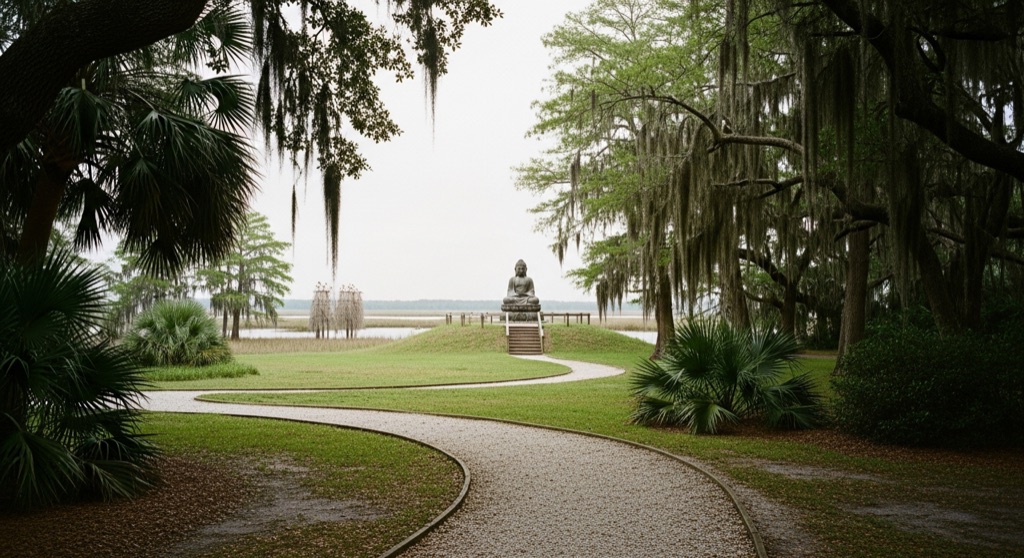
Ned McIlhenny, son of the Tabasco founder, spent decades turning this salt-dome island into a 170-acre semi-wild garden of bamboo, azaleas, and alligator-filled lagoons. Its strangest feature is a roughly 900-year-old Buddha statue, gifted to McIlhenny in 1936, sheltered in a hilltop shrine overlooking a nutria-dotted lake. The shrine has become an active place of worship for local Buddhists, who hold ceremonies there on Buddha's birthday.
→ Three more weird outdoor & roadside oddities in New Orleans — never the same twice
The story
Avery Island is known worldwide for Tabasco, but Edward Avery "Ned" McIlhenny had priorities beyond hot pepper sauce. Son of the salt-dome dynasty, Ned spent decades turning 170 acres of native salt-dome terrain into a dense, semi-wild botanical sanctuary filled with imported bamboo, azaleas, alligator-heavy lagoons, and thousands of nesting egrets at Bird City.
The strangest thing sitting in this subtropical swamp isn't native to Louisiana at all. In 1936, two of Ned’s friends in New York spotted a roughly 900-year-old carved Buddha statue up for auction in Manhattan—allegedly looted years prior from a temple in China by a rebel general. They bought the stone statue and shipped it straight to Avery Island. McIlhenny built a glass shrine on a hilltop to shelter it, overlooking a quiet lake.
What started as a rich eccentric’s garden novelty took on an unexpected second life. Rather than remaining an obscure roadside curiosity, the hilltop shrine became an active sanctuary for local Buddhist communities, who still travel to the salt dome to hold ceremonies and celebrate Buddha's birthday under the Spanish moss.
What it's like
You’ll drive a gravel loop through dark canopy and thickets of bamboo, with alligators sunning themselves along the banks and egrets swarming the rookery at Bird City. Park near the designated pull-off and take the brief walk up the hilltop trail. The glass-sheltered Buddha gazes down across a tranquil, nutria-dotted lagoon. It is remarkably quiet for a site attached to a commercial giant, though you'll want to double-check operating hours before driving out.
The move: Drive the gravel loop to Bird City and the egret rookery, then walk the short trail up to the centuries-old Buddha shrine for the view over the lagoon.
- 📍 Avery Island
- 💸 Free
- ⚡ Up for anything
- 🌗 Outdoors
Where: Hwy 329, Avery Island, LA 70513
Hours: Added 2026-06-22 — confirm current hours before you go.
Pair it with
- Chauvin Sculpture Garden — Pair one hot-sauce heir's imported hilltop shrine with a self-taught bricklayer's outsider-art environment built directly along Bayou Petit Caillou.
- Whitney Plantation — Contrast the serene, semi-wild estate grounds of Avery Island with a sobering history tour focused strictly on the lives of enslaved people in Louisiana.
- Cajun Pride Swamp Tours (Manchac Swamp) — Double down on Louisiana wetland wildlife after seeing McIlhenny's curated egret rookery and alligator lagoons.
More weird in New Orleans

Good to know
How did a 900-year-old Buddha end up on a Louisiana salt dome?
In 1936, two friends of Ned McIlhenny bought the statue at a Manhattan auction—where it had allegedly arrived after being looted from a Chinese temple—and shipped it to Avery Island as a gift.
Is the shrine an active place of worship?
Yes. Beyond garden tourists, regional Buddhist groups actively use the hilltop shrine for worship and gather there for annual ceremonies, including Buddha's birthday.
How do you explore the gardens?
The site is designed as a driving and walking route along a gravel loop, allowing you to pull over at key stops like Bird City, the bamboo groves, and the trail leading up to the shrine.
Plan a visit & invite your people →
Further reading: Official site · Wikipedia · Roadside America · gardens.si.edu · myneworleans.com
last checked: 2026-06-22