Entry No. 29 — the Nashville file — filed under: outdoor
World's Largest Cedar Bucket (Cannonsburgh Village)
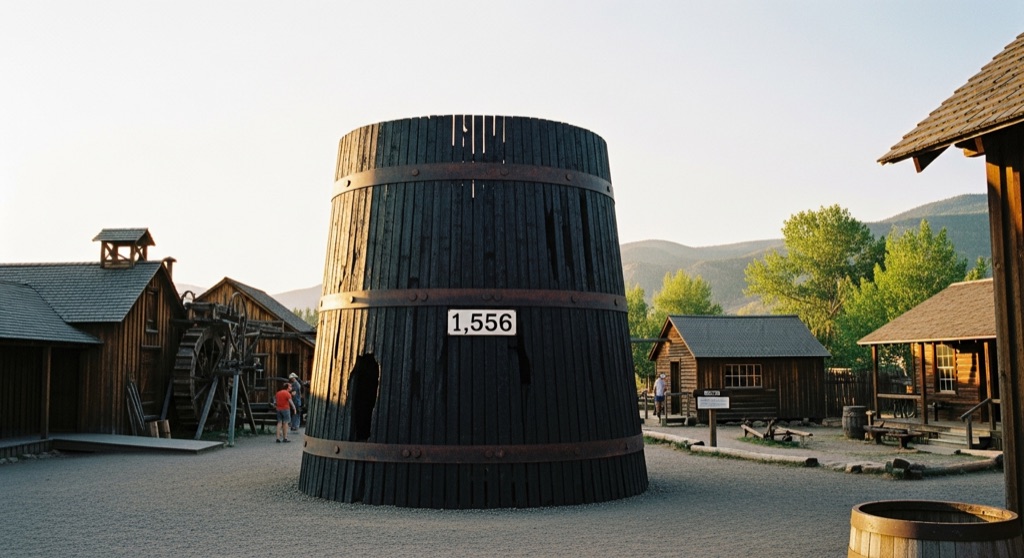
A red-cedar bucket holding 1,556 gallons, built in 1887 and shown off at the 1893 Chicago and 1904 St. Louis World's Fairs, sits inside a recreated 1830s-1930s pioneer village. Arsonists torched it in 2005, leaving 'blackened, splintered charcoal shards held together by metal bands' — a local sawmill and the Rutherford County Blacksmiths' Association rebuilt it from rare red cedar and unveiled the restoration in 2011.
→ Three at a time, never the same twice — explore weird Nashville
The story
In 1887, woodworkers crafted a red-cedar vessel designed to hold an absurd 1,556 gallons of liquid. It was never meant for actual farm chores; it was built as a spectacle of regional timber craftsmanship, eventually hitting the national stage at both the 1893 Chicago World's Fair and the 1904 St. Louis World's Fair. Decades after its fairground tour, the oversized tub settled into Cannonsburgh Village, a 1830s-to-1930s pioneer village tucked behind downtown Murfreesboro.
In 2005, arsonists torched the display, leaving behind nothing but blackened, splintered charcoal shards held together by metal bands. Rather than writing off the relic, the community mobilized. A local sawmill supplied rare red cedar timber to duplicate the original staves, and the Rutherford County Blacksmiths' Association hand-forged new iron hoops. The reconstructed bucket was unveiled in 2011, resting back under its pavilion alongside antique tractors and century-old log structures.
What it's like
Head down Front Street and step onto the grounds of Cannonsburgh Village. The giant bucket sits under an open-sided timber pavilion, towering high enough that you'll have to stand back to take in the rim. After examining the joinery, wander the surrounding village past the gristmill, one-room schoolhouse, blacksmith shop, and rows of vintage tractors. The village keeps tight weekday hours—Tuesday through Friday from 9:00 AM to 3:00 PM—so confirm the gates are open before making the drive, then grab lunch on Murfreesboro's square nearby.
The move: Wander the pioneer village around the bucket — gristmill, one-room schoolhouse, blacksmith shop — then get lunch downtown in Murfreesboro's square; note the village only opens Tuesday-Friday, 9am-3pm.
- 📍 Murfreesboro
- 💸 Free
- ⚡ Up for anything
- 🌗 Outdoors
Where: 312 S. Front St, Murfreesboro, TN 37129
Hours: Added 2026-07-20 — confirm current hours before you go.
⚠ Seasonal or scheduled — always check before you go.
Pair it with
- The Forge Nashville — The Rutherford County Blacksmiths' Association forged the metal hoops for the bucket's restoration; head up Murfreesboro Pike to visit this 23,000-square-foot makerspace to see modern metalworkers at the anvil.
- Lane Motor Museum — Pair giant 19th-century timber engineering and vintage tractors with 500+ unusual European vehicles and propeller-driven cars up in South Nashville.
- Stardust Drive-In — Combine a quiet daytime stroll through Murfreesboro's pioneer village with a night of retro double features in nearby Watertown.
More weird in Nashville


Good to know
How much liquid can the bucket hold?
It was built to hold 1,556 gallons inside its red-cedar staves.
Is the bucket on display today the 1887 original?
No. Arsonists destroyed the 1887 original in 2005. The current bucket is a restoration unveiled in 2011, built by a local sawmill and the Rutherford County Blacksmiths' Association.
Where was the bucket shown before coming to Murfreesboro?
It was displayed at both the 1893 World's Columbian Exposition in Chicago and the 1904 World's Fair in St. Louis.
What else is at Cannonsburgh Village?
The open-air grounds represent 100 years of regional history (1830s–1930s), including a gristmill, one-room schoolhouse, blacksmith shop, and antique tractor collection.
Plan a visit & invite your people →
Further reading: Wikipedia · murfreesborotn.gov · hemmings.com
last checked: 2026-07-20